Heat Stroke While Hiking: Dead in 3 Hours
A body that stops sweating isn't a body getting better: it's a body three hours away from cardiac arrest.
It’s 1:00 PM, you’re halfway down a coastal creek trail without a single tree in sight, your pack feels lighter than expected because your water bottle is already half empty, and your head is starting to spin a little. You tell yourself it’ll pass, that you just need to keep going to the next patch of shade. That exact thought is what leads healthy hikers every summer from normal fatigue to cardiac arrest in under three hours — quietly, without a fall, and without any obvious warning until it’s almost too late.
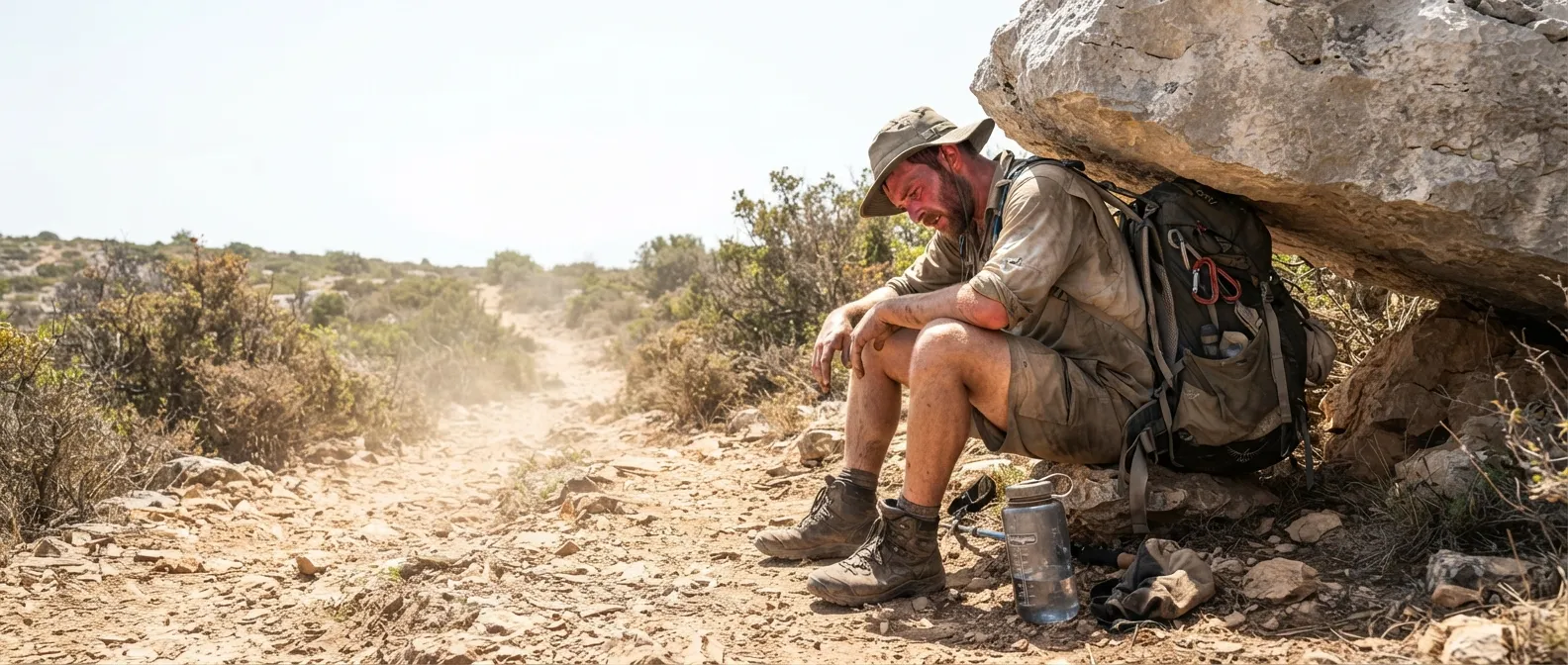
What Heat Really Does to Your Body
The human body operates within a narrow window, right around 37 °C. To stay there when it gets hot, it has only one truly powerful tool: sweating. By evaporating sweat from the surface of your skin, it sheds heat — up to 1 to 2 liters per hour for an adult pushing hard in extreme heat, a rate no other physiological function can match.
The problem isn’t heat alone: it’s heat plus humidity. Sweat that doesn’t have time to evaporate doesn’t cool anything — it just drips off. That’s why a dry 35 °C in the middle of a desert is often more bearable than a muggy 30 °C in a tropical forest: in the latter, the air is already nearly saturated with water vapor, and sweat stays on your skin with zero cooling effect.
Wet-Bulb Temperature: The Hard Limit You Can’t Cross
Wet-bulb temperature is measured using a thermometer wrapped in a wet cloth and exposed to airflow: it combines heat and humidity into a single value, representing what sweat can actually shed. In 2010, climatologists Steven Sherwood and Matthew Huber showed in a study published by PNAS that at 35 °C wet-bulb, evaporation is no longer enough to cool the body below its own core temperature — even a young, healthy person at complete rest in full shade would eventually die of hyperthermia in a matter of hours, having no other cooling mechanism left. Recent research even suggests that lethal conditions can occur below this 35 °C threshold, particularly in older adults or anyone engaging in physical activity. While this threshold is rarely reached today, values approaching it (28-32 °C wet-bulb) are already being recorded in the Persian Gulf and South Asia during severe heatwaves.
The Three Stages: Spotting the Difference Between Discomfort and an Emergency
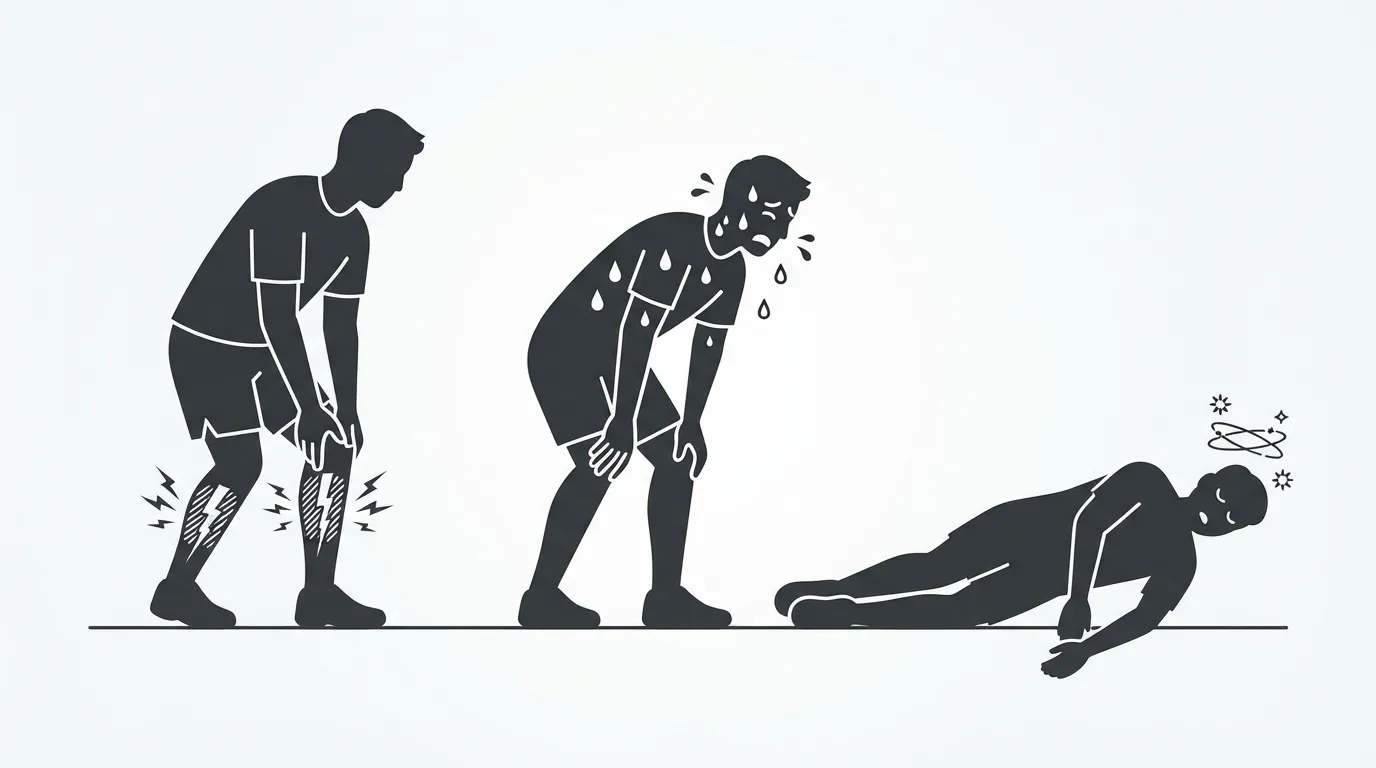
| Heat Cramps | Heat Exhaustion | Heat Stroke | |
|---|---|---|---|
| Consciousness | normal | normal, severe fatigue | confusion, slurred speech, sometimes seizures |
| Skin | moist, sweating | moist, pale, cool | can be dry OR still moist — do not rely on this sign alone |
| Core Temperature | normal | elevated, usually < 40°C | often > 40°C |
| What Is Happening | salt loss through sweat | cooling system is overwhelmed | cooling system has completely failed |
| Emergency Level | stop exertion, rehydrate | cool down, monitor closely | absolute life-threatening emergency, cool immediately |
The warning sign that changes everything isn’t dry vs. moist skin — it’s an indestructible myth that heat stroke always means dry skin: many cases of exertional heat stroke occur in people who are still sweating heavily. The real red flag is in the head: anyone who becomes confused, talks incoherently, loses their balance for no clear reason, or stops answering simple questions normally is crossing into heat stroke — a life-threatening emergency, not a reason to take a longer rest break.
What to Do: Cool Down First, Ask Questions Later
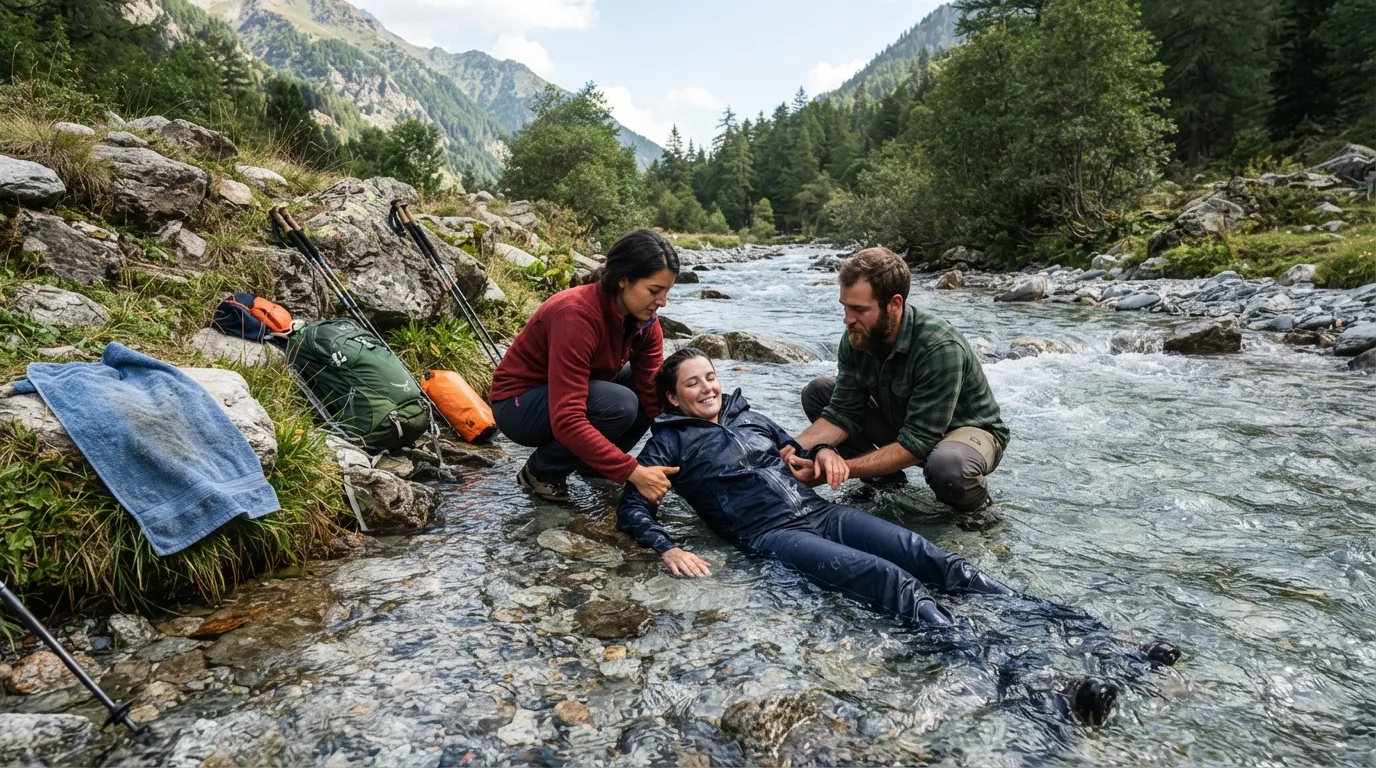
The protocol set by the Wilderness Medical Society in its latest guidelines is crystal clear: cooling takes priority over evacuation, even before calling for emergency help if you’re alone with the victim. Cold-water immersion is considered the “gold standard” — the single best method — for rapidly dropping core body temperature, targeting what’s known as the golden half-hour: bringing core temperature back below the threshold for critical cellular damage (around 42 °C) within 30 minutes of diagnosis.
- Stop all exertion immediately and move the person into full shade or a well-ventilated spot.
- Cool priority one, before even calling: perform full or partial immersion in the coldest water available (river, lake, sea) if it can be done safely; if not, soak their skin thoroughly and fan them vigorously to maximize evaporative cooling.
- Apply ice or cold packs where large blood vessels lie close to the skin surface: neck, armpits, and groin — this transfers cooling to the core fast.
- Call emergency services (112 or 911) as soon as possible, doing so in parallel with cooling efforts, never instead of them.
- Do not give anything to drink if the person is confused or unconscious: the risk of choking or aspirating liquid into the lungs is high, and cooling takes precedence over rehydration in an acute emergency anyway.
Prevention: The Protocol That Actually Works
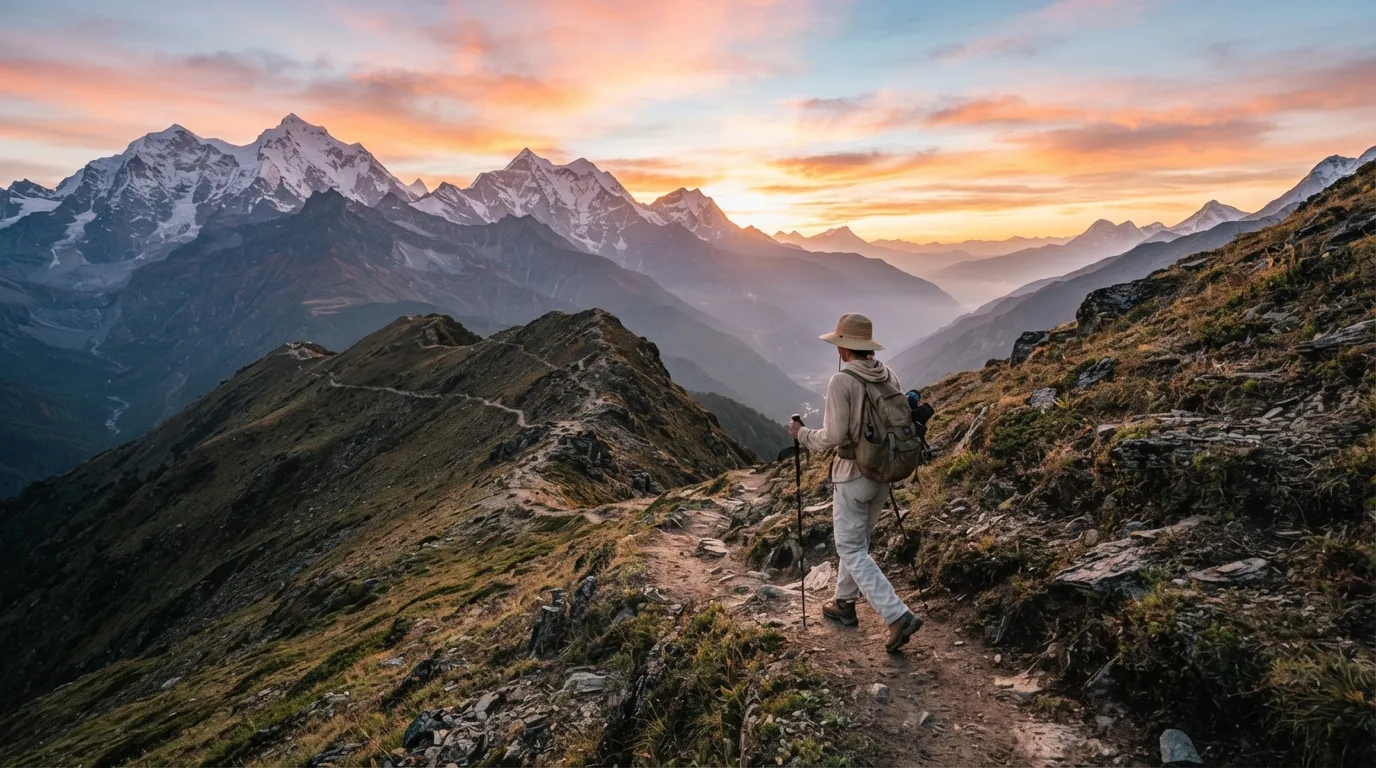
- Start early: crush the bulk of your mileage before 10:00–11:00 AM, then take a long, restful break in the shade between 12:00 PM and 4:00 PM when solar radiation peaks — this is the same logic as the Mediterranean siesta, rediscovered as a core survival strategy by Grand Canyon park rangers.
- Wear loose, light-colored clothing that allows air to circulate and reflects heat instead of absorbing it, along with a wide-brim hat or a cap with a neck flap.
- Drink 0.5 to 1 liter per hour of exertion in small, frequent sips rather than gulping huge amounts hours apart — and eat salty snacks alongside it (pretzels, salted nuts, or a pinch of salt in your bottle): drinking massive amounts of plain water without replacing the salt lost in sweat leads to hyponatremia, a dangerous drop in blood sodium levels that causes confusion and seizures.
- Acclimate over 10 to 14 days before pushing hard in extreme heat: your body gradually learns to sweat sooner and produce sweat with a lower salt concentration, drastically improving heat tolerance.
- Watch out for medications that worsen heat risk: diuretics, beta-blockers, certain antidepressants, and neuroleptics impair your body’s ability to sweat or recognize thirst.
- Alcohol dehydrates you and masks early warning signs: avoid it before and during strenuous activity in the heat.
Real-World Case Studies
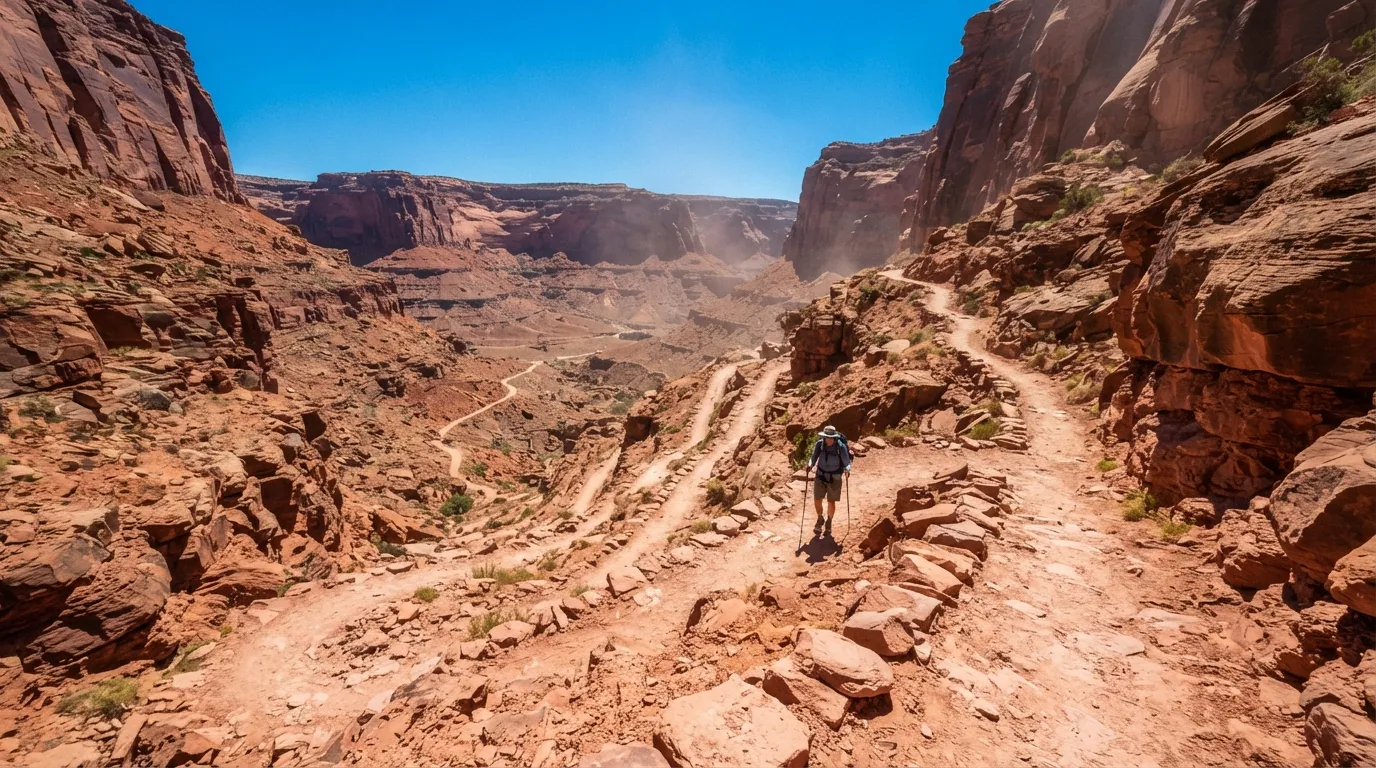
The Grand Canyon averages about a dozen deaths per year across all causes; heat-related fatalities are climbing, with several deaths documented within days of each other during recent summer heatwaves on inner-canyon trails where shade temperatures exceed 43 °C — park rangers now strongly advise against inner-canyon hiking between 10:00 AM and 4:00 PM during hot months. Death Valley, the hottest location ever recorded on Earth, attributes roughly 20% of its non-traffic fatalities over nearly two decades directly to hyperthermia — accounting for all environmental deaths in the park. The Marseille Calanques in southern France, despite their familiar Mediterranean resort vibe, trigger emergency heat stroke rescues every summer on shade-free, waterless limestone trails, often involving walkers who started late in the morning and underestimated the intense radiant heat bounced off the bright white rock. The Marathon des Sables, a multi-day desert ultra-marathon in the Sahara, built its entire medical protocol (mandatory weigh-ins, salt rations, close monitoring) around balancing two opposite risks — dehydration and hyponatremia — which share similar early symptoms but require diametrically opposed treatments.
Kids, Dogs, and Cars: Special Vulnerabilities
Children don’t regulate body temperature as efficiently as adults: their surface-area-to-mass ratio is higher, they produce sweat less effectively, and they often fail to communicate discomfort until they are already in trouble — keep a proactive eye on them rather than waiting for them to complain.
Dogs barely sweat at all (only through their paw pads): their primary cooling mechanism is panting, which is far less efficient than human sweating. A closed car in the sun is a brutal heat trap: in 21 °C ambient weather, the interior reaches 32 °C in 10 minutes and 40 °C in 30 minutes; in 35 °C heat, it can top 47 °C in just 10 minutes. A dog trapped inside can hit a lethal body temperature of 42 °C in 20 to 50 minutes, carrying an estimated 50% mortality rate.
High Altitude and Warm Nights: Two Hidden Traps
At high altitude, cooler air temperatures give a false sense of security, even though UV radiation increases by about 10% for every 1,000 meters of elevation and solar reflection off snow or light rock places a massive thermal load directly on your skin and eyes, regardless of what the ambient air feels like. Sunburn and heat exhaustion can easily strike at the same time in deceptively cool weather.
A tropical night — where the temperature never drops below 20 °C — is a proven risk multiplier in heatwave mortality studies: without a cool night recovery window where core body temperature can reset, cumulative heat stress builds up day after day, drastically increasing risk, particularly for elderly or vulnerable people resting without air conditioning.
Frequently asked questions
How long does it take for heat stroke to become fatal?
If an active person keeps pushing without cooling down, the progression from early symptoms (fatigue, cramps) to full-blown heat stroke and severe complications can happen in a matter of hours. Once heat stroke occurs, the critical treatment window is known as the “golden half-hour”: bringing the core body temperature back below dangerous cellular damage limits within 30 minutes.
Does dry skin automatically mean heat stroke?
No, that’s a myth. Many cases of exertional heat stroke occur while the victim is still sweating heavily. The most reliable indicator is neurological: confusion, disorientation, or abnormal behavior in anyone exposed to heat.
Should you offer water to someone experiencing heat stroke?
Only if they are fully conscious, alert, and able to swallow normally. Never give fluids to a confused or unconscious person due to the risk of choking and aspiration; in those cases, immediate physical cooling (water, shade, fanning) is the absolute priority while emergency services are dispatched.
Can you drink too much water while hiking?
Yes: drinking large amounts of plain water without replacing lost electrolytes can cause hyponatremia, a dangerous drop in blood sodium levels with symptoms that mirror dehydration (confusion, nausea, muscle cramps). The best practice is to sip water regularly — about 0.5 to 1 liter per hour of activity — while eating salty foods along the way.
How long can a dog safely stay in a parked car on a warm day?
Zero minutes. At an ambient temperature of 35 °C, the inside of a closed vehicle can jump past 47 °C in just 10 minutes, pushing a dog’s core temperature to critical levels in 20 to 50 minutes with a high risk of death.
Key Takeaways
- Sweat only cools you down if it can evaporate: high humidity + high heat is far more dangerous than dry heat at the exact same temperature.
- The true red flag for heat stroke is neurological (confusion), not whether the skin is dry or wet — that myth still puts lives at risk.
- Cool down before transporting: use water immersion, shade, and ice packs on the neck, armpits, and groin, calling emergency services in parallel.
- Chugging water without eating salt leads to hyponatremia, a condition just as dangerous as severe dehydration.
- There is no safe amount of time to leave a child or a pet inside a parked car in hot weather, even for a couple of minutes.
Going Further
- Wilderness Medical Society, Clinical Practice Guidelines for the Prevention and Treatment of Heat Illness, 2024 Update — the premier field medical reference.
- Sherwood & Huber, An adaptability limit to climate change due to heat stress, PNAS 2010 — the foundational paper on wet-bulb temperature limits.
- Santé publique France, Fortes chaleurs et canicule — official French public health recommendations.
- National Park Service, Grand Canyon Heat-Related Fatalities — real-world case studies from extreme environments.
Sources for this module (8)
- Santé publique France — Fortes chaleurs et canicule
- Wilderness Medical Society — Clinical Practice Guidelines for the Prevention and Treatment of Heat Illness, 2024 Update
- National Park Service — Grand Canyon, heat-related deaths
- Sherwood & Huber, An adaptability limit to climate change due to heat stress, PNAS 2010
- Météo-France — Comprendre la canicule
- CDC — Extreme heat
- Death Valley National Park (NPS) — statistiques de décès environnementaux
- Journal du Trail — L'hyponatrémie en trail
Continue in "Critical situations"
Avalanche: the 15 minutes that decide
A slab breaks loose under your skis, you have fifteen minutes before the stats turn against you: what you need to know instinctively, the night before heading out.
Lightning: When the Sky Targets You
In 3 seconds, a lightning bolt heats the air to 30,000 kelvins and kills 10% of those it strikes: here is what is at stake before you count to thirty.
Flash Flood: Water Arriving Faster Than You
It isn't raining where you are, the creek has been dry all morning, yet you have less time than you think before a wall of water rushes down the valley.