Flash Flood: Water Arriving Faster Than You
It isn't raining where you are, the creek has been dry all morning, yet you have less time than you think before a wall of water rushes down the valley.
It’s 8 p.m., and you’ve pitched your tent on a nice gravel bar beside a mountain stream that’s been dry for weeks, just three meters from the water. It hasn’t rained here all day. Around 11 p.m., a deep, low rumble echoes up the valley, too steady to be the wind. At best, you have a few minutes before this flat spot reverts to what it’s always been: the riverbed.
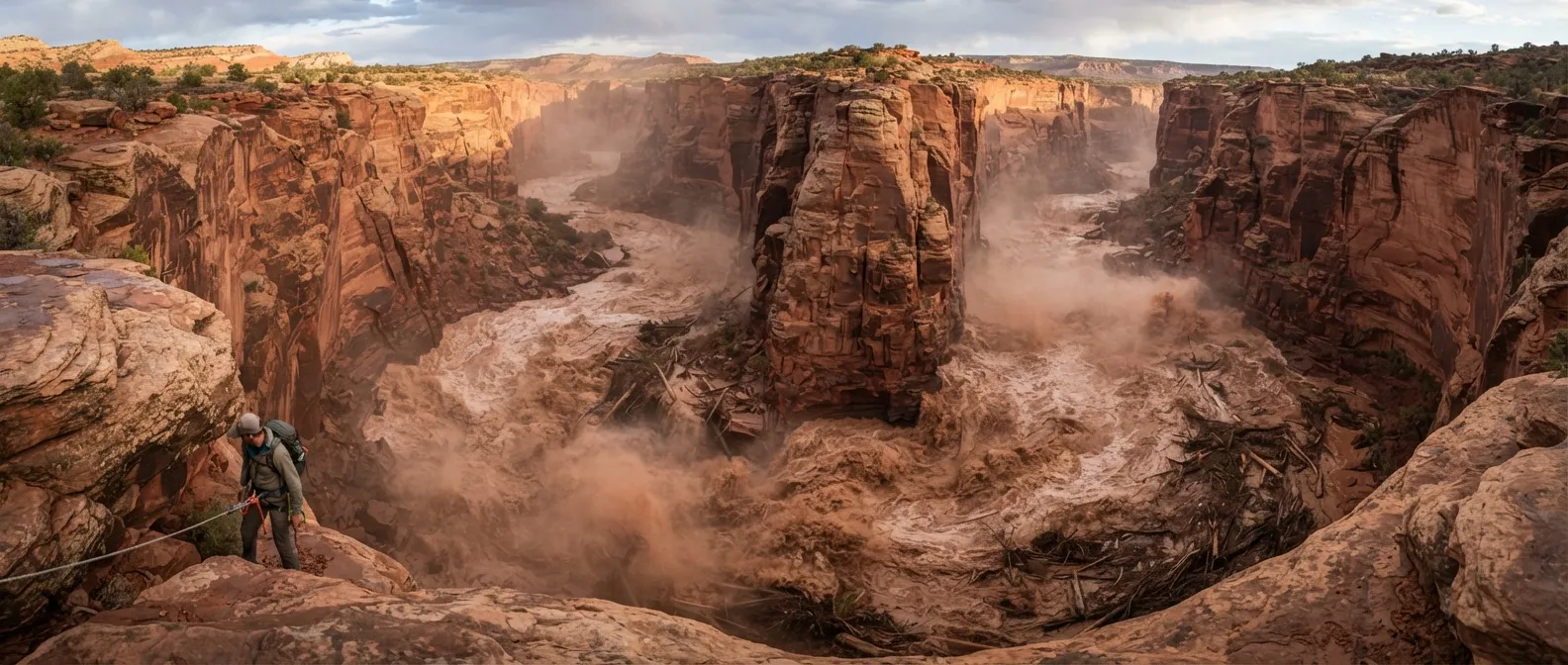
The stat that should change how you camp
In France, flooding is the number one natural hazard, ahead of earthquakes, landslides, or avalanches. And among floods, the deadliest and least predictable is the flash flood: a surge in water level that unfolds over minutes or hours, leaving no time to call for help.
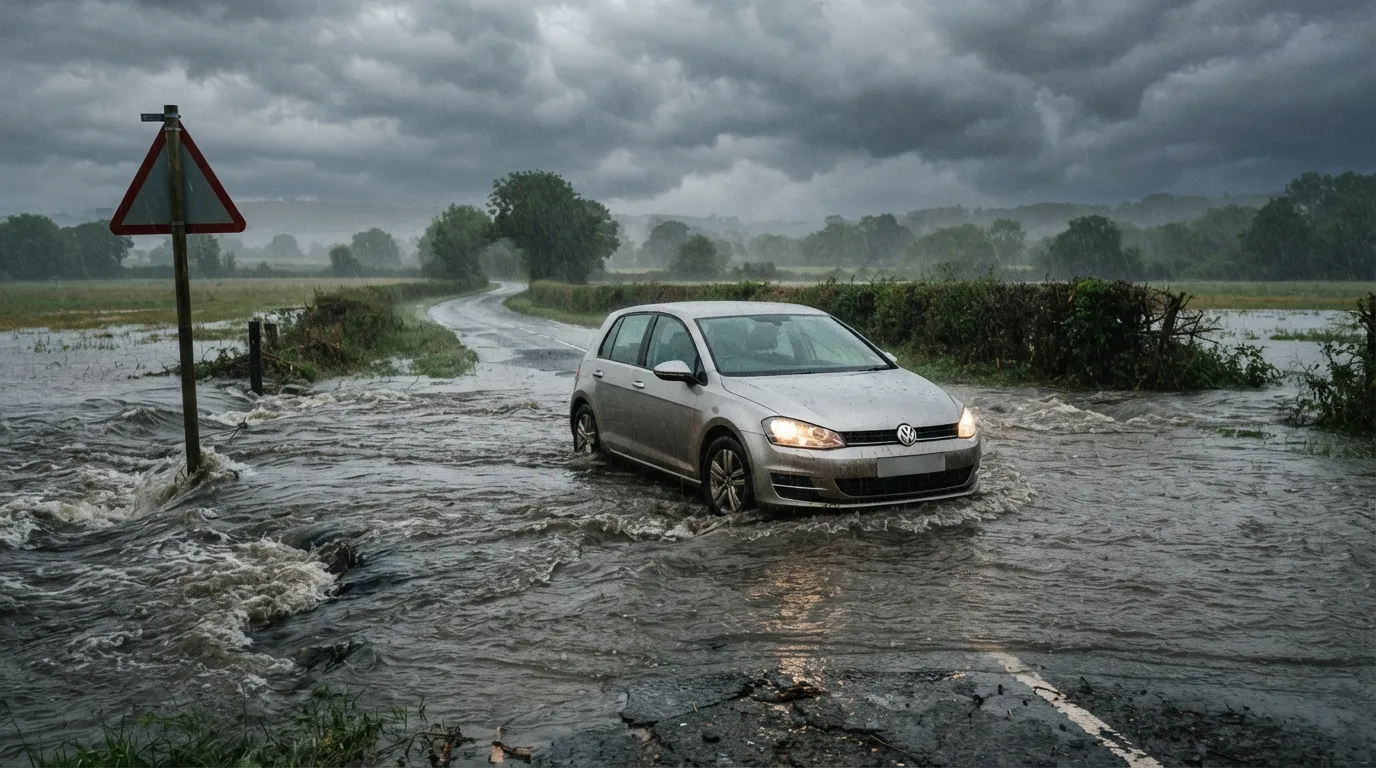
What kills is almost never the depth you imagine. The US National Weather Service is clear: six inches (15 centimeters) of fast-moving water can knock an adult off their feet, twelve inches (30 centimeters) will carry away most cars, and eighteen to twenty-four inches (45 to 60 centimeters)—barely mid-thigh—can sweep away an SUV. More than half of all flood-related drownings in the United States happen inside a vehicle on a road thought to be passable.
| 15 cm / 6 in (mid-calf) | 30 cm / 12 in (knee) | 45-60 cm / 18-24 in (thigh) | 1 m / 3 ft and up | |
|---|---|---|---|---|
| On a standing adult | Knocks you off balance | Knocks you down and sweeps you away | Impossible to stand | Drowning almost certain |
| On a car | No effect | Floats and drifts | Sweeps away SUVs and trucks | Submerges the vehicle |
| What you must do | Turn back | Never enter, on foot or by car | Get high, abandon the vehicle | Seek high ground immediately |
These numbers have real human costs. On September 22, 1992, in Vaison-la-Romaine, a stationary thunderstorm dumped up to 300 mm of rain in six hours: the Ouvèze River rose 17 meters at the Roman bridge and wiped out the municipal campsite downstream—caravans, cars, campers. Death toll: 37. In October 2018 in the Aude region, 295 mm fell in 11 hours over Trèbes, including 110 mm in just two hours: the river rose 7.27 meters in eight hours, nearing the record set in 1891. Fifteen people died, mostly elderly residents caught inside their homes. In October 2020, Storm Alex dumped over 500 mm in 24 hours on Saint-Martin-Vésubie: 21 dead (11 in France), with roughly 60 kilometers of roads and twenty bridges swept away.
How a flash flood forms
The trap begins with a simple truth often forgotten in the field: a flash flood doesn’t require rain where you are standing. A stationary storm ten or fifteen kilometers upstream, hidden behind a ridge, can fill a riverbed before you ever hear the first clap of thunder. That is what killed eleven tourists in Arizona’s Antelope Canyon in August 1997: barely a few drops fell at the slot canyon itself, but a isolated storm had unleashed a wall of water seven kilometers upstream, across a drainage basin invisible from the ground.
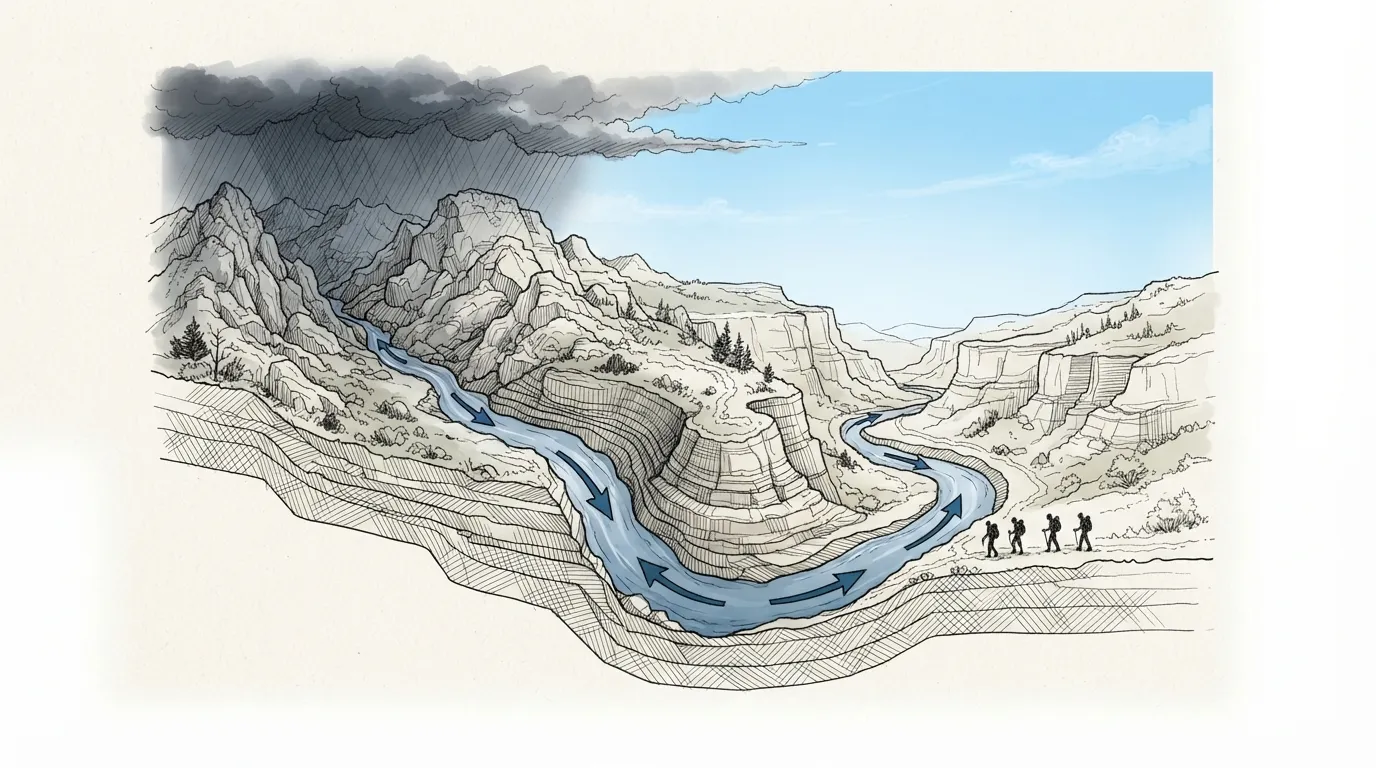
Three main factors worsen almost every severe event. First, topography: a narrow, steep watershed (mountain torrents, gorges, canyons, wadis) concentrates in minutes rain that would take hours to spread across a plain—the difference between a “slow flood,” taking over twelve hours to peak on a major basin, and a “flash flood,” rising in two to twelve hours, or even minutes in extreme cases. Second, the soil: dry and baked hard by weeks without rain, it can’t absorb a intense downpour and causes runoff like asphalt—and a fully saturated soil is even worse, having zero storage capacity left. Finally, debris dams (embâcles): uprooted trees carried by the current jam against bridges, creating natural dams. When they breach, they instantly release all the trapped water in a surge higher and faster than the flood itself.
One final factor is completely independent of the weather: dams upstream. Hydroelectric facilities can cause sudden discharge shifts in a canyon, even in clear weather, during scheduled releases. The failure of the Malpasset Dam near Fréjus in December 1959 remains a grim reminder: without an warning system, the surge killed 423 people in minutes—the disaster that prompted mandatory warning sirens downstream of major French dams ever since.
Read the water before it reads you
Zion National Park, which manages one of the world’s most famous and hazardous narrow canyons (The Narrows), lists specific warning signs to watch for continuously in a slot canyon: deteriorating weather, building clouds or thunder, water turning from clear to muddy, floating debris, and a deep roar traveling up the canyon. At the slightest sign, the rule is absolute: reach high ground immediately—even a few meters can save you—and stay put until the water recedes, usually within 24 hours.
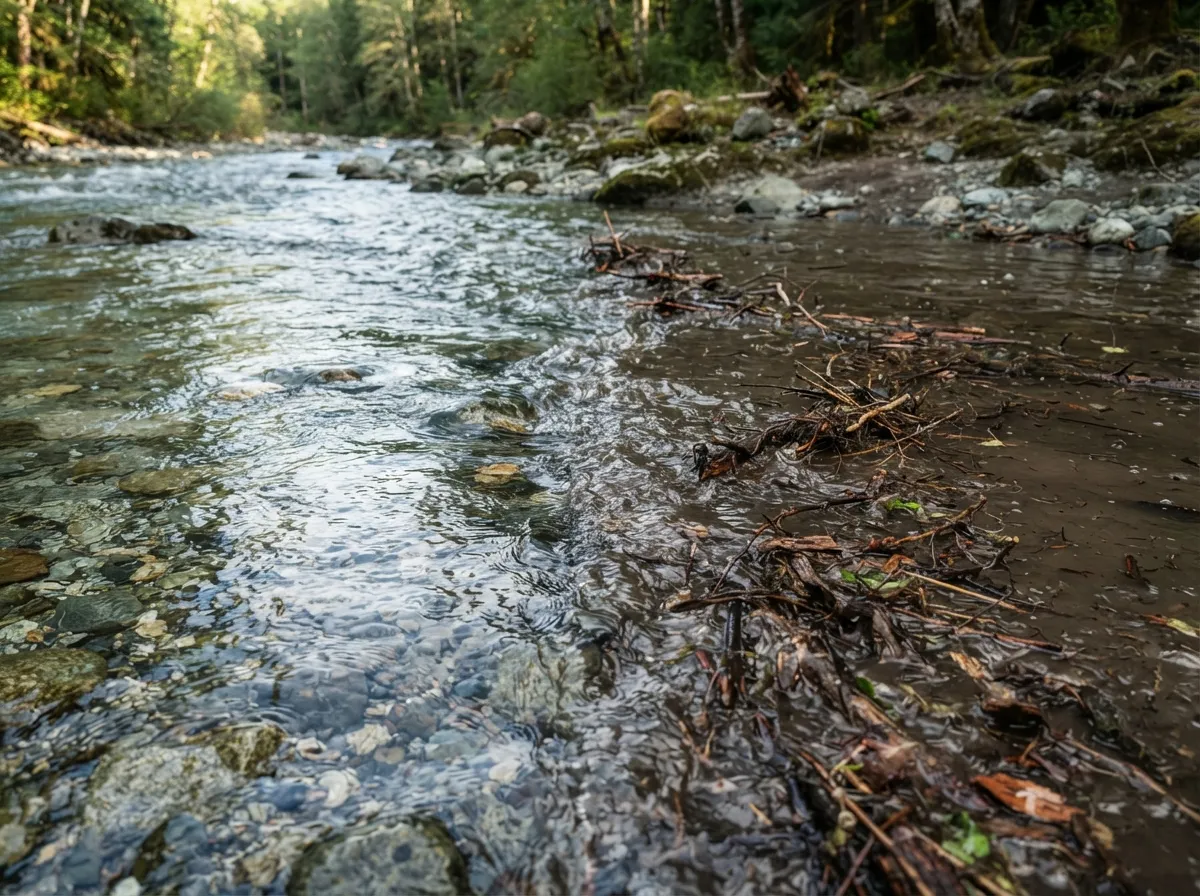
Other, non-technical signs are just as critical. Wildlife and livestock flee valley floors long before the water arrives, sensitive to the ground vibrations preceding a flood wave. A distinct smell of freshly churning earth can precede the water front by a few minutes. And the sky upstream—which hikers often forget to check while staring down at the trail—remains your best early warning: dark storm clouds building over ridges unseen from the canyon floor mean you should turn back, even if you’re standing under bright sunshine.
Where never to pitch your tent
The floodplain—the area a river occupies during high-water events, as opposed to its normal channel—can be spotted even if it’s been bone-dry for months: flat, sandy, or pebble-strewn ground lacking the mature vegetation found just higher up. The most reliable proof that it floods is the high-water mark (laisse de crue): a line of debris tangled in lower tree branches or stained onto rock faces, marking the exact peak height of the last major flood. It never lies, unlike today’s water level.
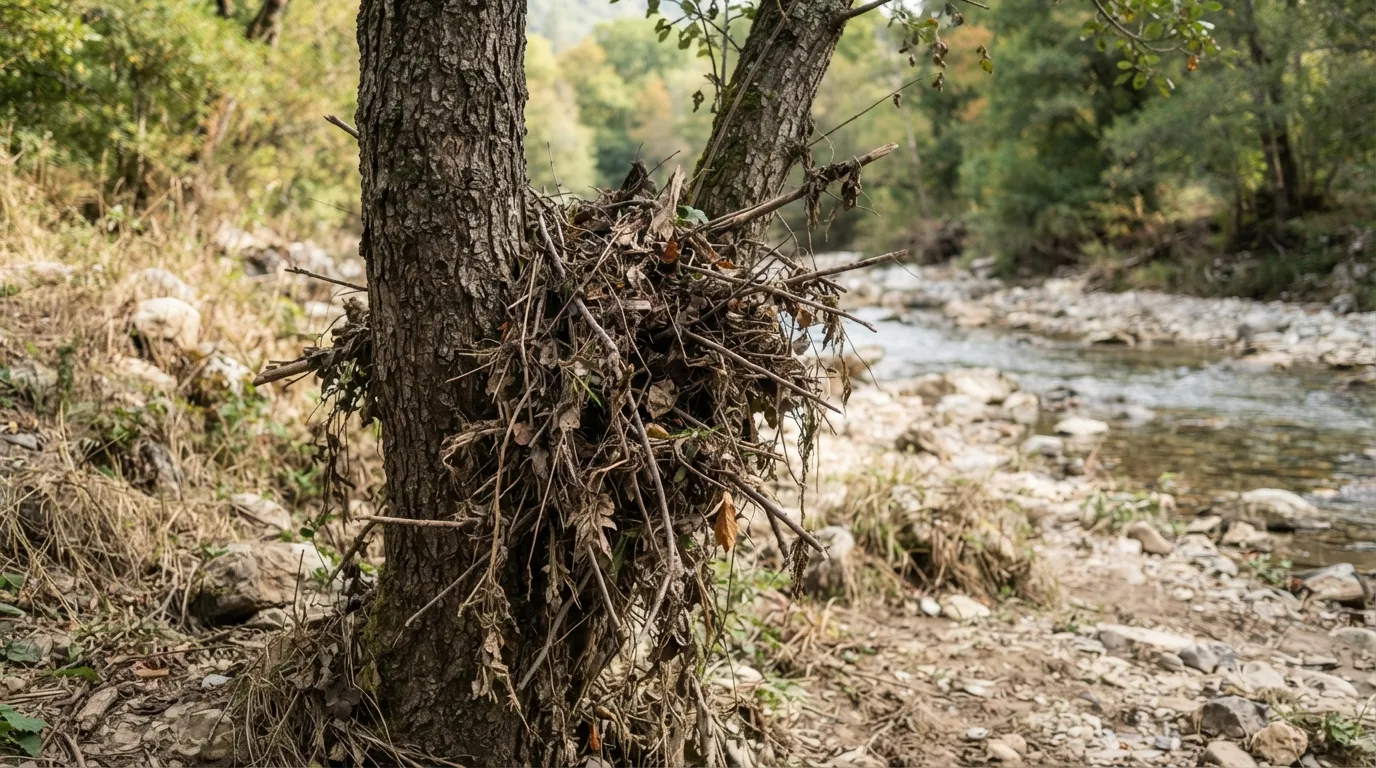
The most deceptive case is an arroyo or dry wash: a flat, inviting dry bed that looks nothing like a stream. Yet it is the single most dangerous spot to camp, precisely because it only flows a few hours a year—and those hours might hit in the middle of the night. Never pitch a tent there, even if it has been dry for weeks.
What to do when it happens
- Don’t hesitate or second-guess the warning. At the first sign—rumbling, muddying water, floating debris—move immediately. It costs you nothing to be wrong nine times out of ten.
- Climb perpendicular to the flow, straight toward the nearest high ground. Never run down or up the canyon along the riverbed: heading straight up the canyon walls gets you out of the water’s path much faster.
- Ditch your gear. Backpack, tent, canyoneering kit: nothing is worth the precious seconds lost retrieving it. You can replace gear; you can’t replace your life.
- Never try to wade across floodwaters, even if they look shallow. The riverbed is invisible and uneven, and the force of moving water just 30 cm deep can easily knock you off your feet on slick rocks.
- In a car, get out before the engine stalls. A floating car starts drifting in seconds; it’s far better to abandon it on a dry stretch of road than get trapped inside a flooding vehicle.
The 1976 Big Thompson Canyon flood in Colorado illustrates why escaping by car along a single canyon road so often fails. On July 31, 1976, a stationary storm dropped 300 mm of rain in less than four hours. Around 9 p.m., a wall of water over six meters high rushed down the narrow canyon at 5.8 m/s—jogging speed—destroying 400 cars, 418 houses, and the highway running beside the river. 143 people died, trapped between canyon walls and water rising faster than traffic could move.
If you get swept away
The survival posture, covered in detail in our whitewater and river safety guide, remains identical during a flood: on your back, feet pointing downstream, toes breaking the surface, never standing up—trying to stand risks wedging a foot between rocks (foot entrapment) and being pinned underwater by the current. Two added hazards exist in floods: strainers—downed trees or debris that let water pass like a sieve but trap larger objects (swim over them, never try to duck underneath)—and undercut rocks, hollowed out underneath by erosion (common in limestone), which can pull a swimmer beneath the surface.
Between obstacles, target the inside bend of a river (inside of a meander): the current moves slower there. The outside of a turn erodes and accelerates, while the inside deposits sediment and slows down. Pull yourself up onto a solid, fixed structure—a high boulder, an anchored tree trunk, never a floating object—at the first opportunity, rather than swimming until exhaustion.
Canyoneering: flirting with point-of-no-return terrain
Canyoneering blends vertical hazards, technical terrain, and swift water risks. Incident data is unambiguous: sudden surges in water volume caused by distant storms across the drainage basin account for most fatal accidents. The compounding danger in canyoneering is called commitment level. Many routes offer no way out before the end and no way to climb back up against the current. When an exit option exists, it’s called an escape route (échappatoire)—and you verify its accessibility before dropping in, never while inside.
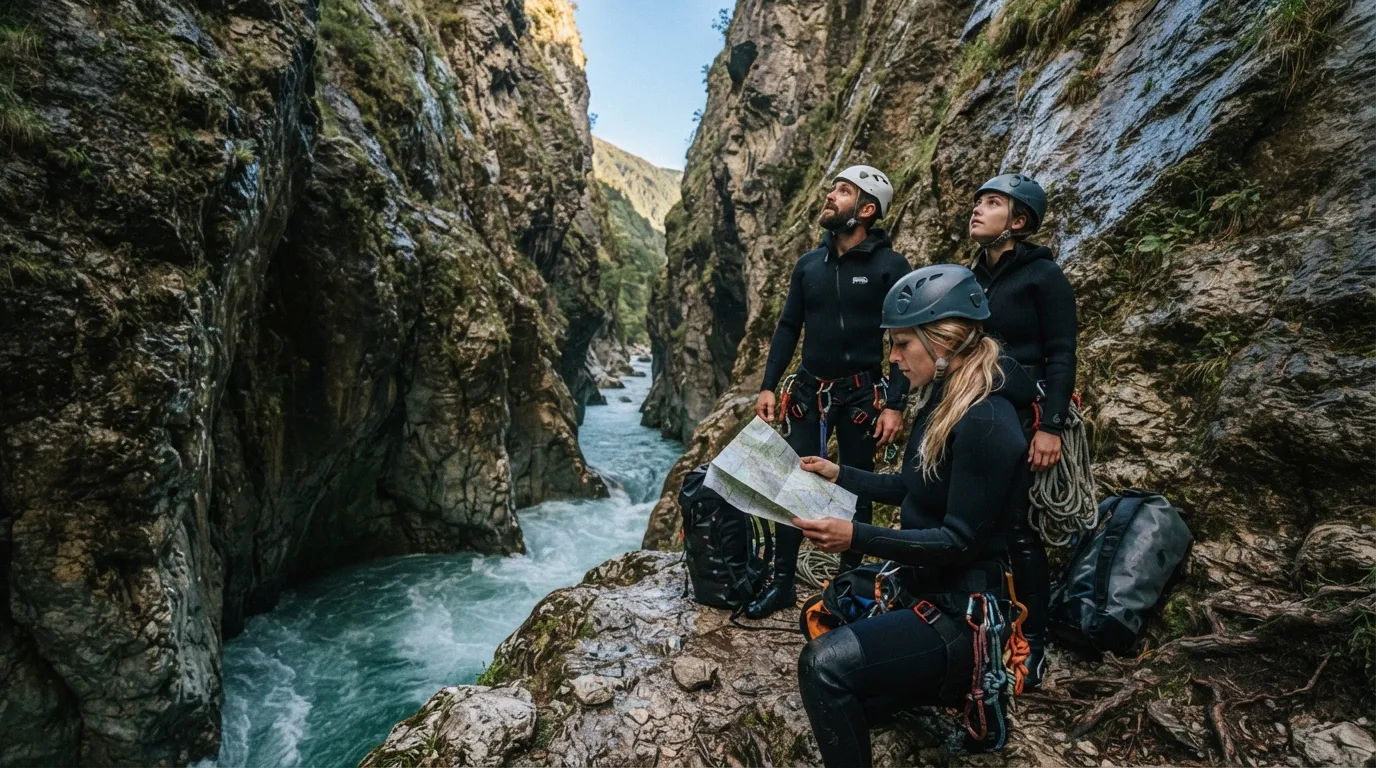
In France, canyoneering is regulated under an inter-federation agreement involving the FFME, the FFS, and the FFCAM. Their core guideline: never commit under uncertain weather forecasts, and always check upstream for hydroelectric dams before setting out.
Post-flood risks and the alerts that save lives
After floodwaters recede, hazards linger. Floodwater carries raw sewage, leaked fuel from overturned tanks, and animal carcasses: always treat water thoroughly before drinking, even if it looks clear. Snakes and other land animals flushed from their burrows are displaced and can be defensive, often congregating on the same high ground as humans. The leftover mud conceals sharp debris beneath a thin layer of silt: tread as carefully as you would on thin ice.
The best defense remains avoiding surprise altogether. In France, Vigicrues provides official flood forecasting, updated at least twice daily using a four-color scale: green (no hazard), yellow (be vigilant), orange (significant flooding expected), and red (direct danger to life and property). Météo-France publishes complementary rainfall/flooding alerts. Together, they cover both ends: Vigicrues tracks what the river is doing; Météo-France warns what’s coming from the sky.
Frequently asked questions
How fast can a flash flood form?
From a few minutes to a couple of hours, sometimes taking under thirty minutes in small, steep mountain catchments. The delay between heavy rainfall and rising water is often too short for traditional evacuations, making it critical to read environmental signs before an official warning is issued.
Can a flash flood happen if it isn’t raining where I am?
Yes, and this is the most dangerous scenario. A isolated storm miles upstream, hidden behind mountains, can launch a massive surge of water without a single drop falling on your position. This exact dynamic killed eleven hikers in Antelope Canyon in 1997.
How much moving water does it take to sweep away a vehicle?
Roughly 30 cm (12 inches) of moving water can float most passenger cars, and 45 to 60 cm (18 to 24 inches) will carry away an SUV. The US safety campaign “Turn Around, Don’t Drown” emphasizes that you should never drive onto a flooded road, regardless of perceived depth.
Where is it safe to camp near a river?
Never camp inside the floodplain—the flat, cleared area the river claims during high water—and stay well above the high-water mark (the debris line marking previous flood levels). A riverbed dry for months, like a wash or wadi, remains high-risk: its current state tells you nothing about today’s flood potential.
How can I make sure a canyon is safe before going in?
Check weather forecasts across the entire upstream catchment basin, not just at your entry point. Identify all potential escape routes along the canyon before dropping in, and confirm whether any upstream dams might run scheduled water releases.
Key Takeaways
- Flooding is France’s leading natural hazard; flash floods can crest in minutes without any local rainfall.
- 30 cm of moving water can float a car, and 60 cm can sweep away an SUV: never try to cross, whether on foot or behind the wheel.
- The high-water mark never lies: always camp well above it, never in a floodplain or dry wash, even if dry for months.
- At the first sign—rumbling sounds, muddying water, floating debris, dark skies upstream—climb immediately, move perpendicular to the current, and abandon your gear.
- If swept away: lie on your back, feet downstream, toes up, never try to stand; aggressively swim over strainers, never under; aim for the inside of river bends.
Going Further
- Géorisques, Inundation Expert Dossier — Official French flood safety resource: georisques.gouv.fr/risques/inondations
- NPS, Virgin River Narrows Safety — Identifying flash flood hazards in narrow canyons: nps.gov/zion/planyourvisit/narrowssafety.htm
- NOAA/NWS, Turn Around Don’t Drown flood safety guide: weather.gov/safety/flood-turn-around-dont-drown
- Vigicrues — Official French river level tracking: vigicrues.gouv.fr
Sources for this module (19)
- Géorisques (MTE/DGPR) — Dossier expert sur les inondations
- Wikipédia FR — Crue soudaine
- Wikipédia FR — Inondation de Vaison-la-Romaine en septembre 1992
- Wikipédia FR — Inondations d'octobre 2018 dans l'Aude
- Wikipédia FR — Tempête Alex
- Wikipédia FR — Aiguat de 1940
- Wikipédia FR — Barrage de Malpasset
- Wikipédia FR — Canyoning
- Wikipédia FR — Lave torrentielle
- Wikipédia FR — Sîq (Pétra)
- Wikipedia EN — Antelope Canyon
- Wikipedia EN — Big Thompson River (crue de 1976)
- Wikipedia EN — Boscastle flood of 2004
- Wikipedia EN — Whitewater (strainers, hydraulics, undercuts)
- National Park Service — Zion, Virgin River Narrows Safety
- National Park Service — Zion, The Narrows
- NOAA/NWS — Turn Around Don't Drown
- NOAA/NWS — Flood safety, que faire pendant
- Vigicrues (Schapi / ministère de la Transition écologique)
Continue in "Critical situations"
Avalanche: the 15 minutes that decide
A slab breaks loose under your skis, you have fifteen minutes before the stats turn against you: what you need to know instinctively, the night before heading out.
Lightning: When the Sky Targets You
In 3 seconds, a lightning bolt heats the air to 30,000 kelvins and kills 10% of those it strikes: here is what is at stake before you count to thirty.
Forest Fire: Evacuating, or Protecting Yourself When You Can No Longer Run
It moves faster than you uphill, jumps roads via embers, and won't wait for you to figure out what's happening.