Fire: light it anywhere, keep it always
In the rain, on the snow, without a lighter: the physics of fire, techniques that work, and those that only work in the movies.
It is 4:40 PM, it has been raining since noon, and your fingers can no longer feel your backpack’s zipper. You have a lighter, you have matches, you even have wood: you’ve already burned three matches on a twig that smokes and goes out. The problem isn’t the igniter: it’s that you don’t yet know what fire actually demands of you.
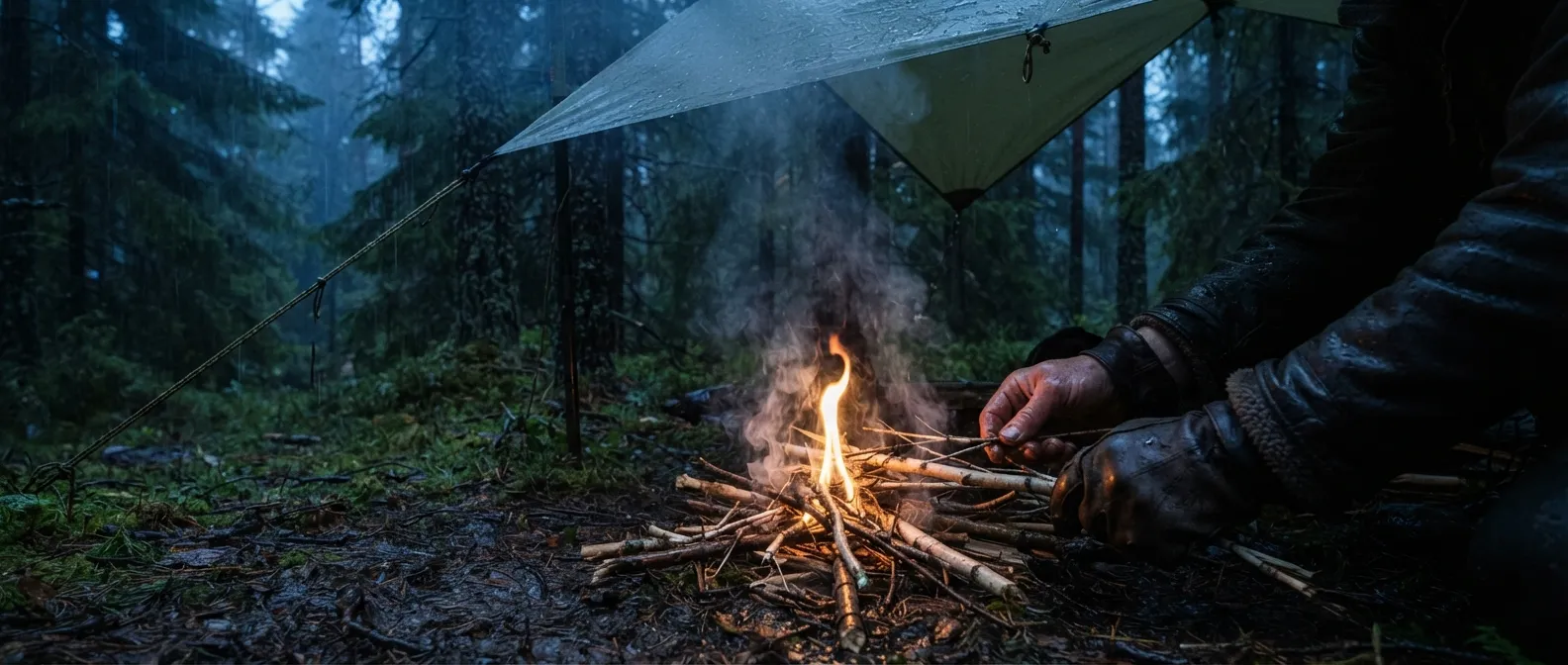
What fire really demands
Firefighters draw a triangle: fuel, heat, oxygen. Remove one of the three, and the fire dies. Research added a fourth side, the chain reaction: it’s what keeps a well-started fire going on its own, whereas an isolated twig dies as soon as you remove the match.
The detail nobody explains to you: wood doesn’t burn. It’s the gases it releases as it heats up that burn. This phenomenon is called pyrolysis. Wood starts to decompose and off-gas around 200–250 °C, and these vapors ignite above the surface. This leads to three practical consequences:
- Wet wood refuses to heat up at first: all the energy goes into evaporating the water (100 °C) before pyrolysis can even begin. Your fire “smokes and dies” because it never reaches off-gassing temperature.
- Fineness matters more than quantity: a match heats a twig to 250 °C in one second, but it will never heat a log.
- Oxygen must circulate: a fire crushed under wood lacks air and smokes. Space out the pieces, blow from underneath.
The progression: matchstick, pencil, finger, wrist
This is the golden rule from old manuals and Northern bushcraft schools, from Mors Kochanski to Paul Kirtley: fire shifts gears like a car. You don’t skip a gear.
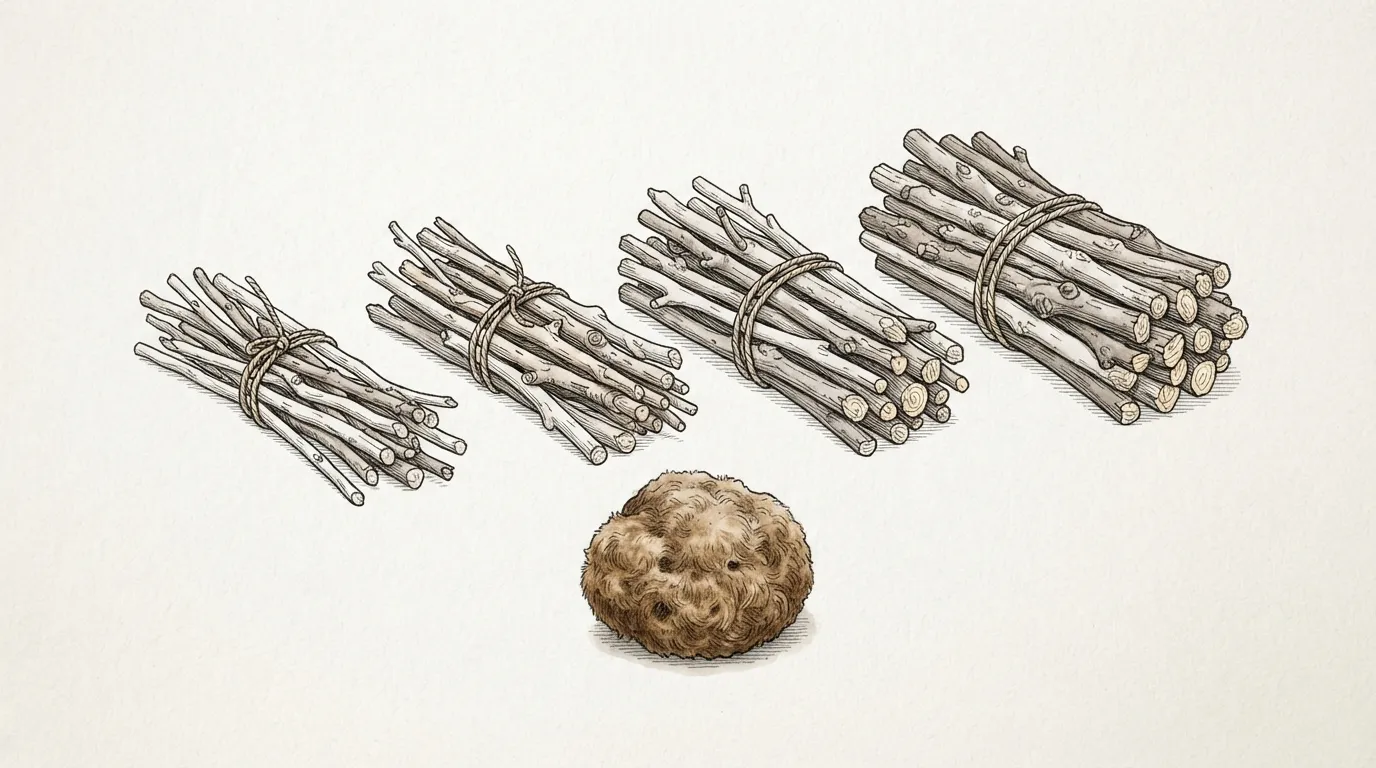
- Tinder: what catches a spark or a match flame. A fist-sized, fibrous, airy, dry bundle.
- Matchstick-sized wood: twigs the diameter of a matchstick, dry enough to snap with a clean “crack”. You need an armful, not a handful — that’s Kirtley’s golden rule, and the number one mistake beginners make.
- Pencil-sized wood, then pinky-finger, then thumb-sized.
- Wrist-sized wood: this is the actual fire. Beyond this, for a survival fire, you generally don’t need anything larger.
Prepare all steps within arm’s reach before striking the first match. Kirtley always builds a platform of dry sticks on the ground: it insulates from moisture, feeds the fire’s core, and lets air pass underneath. On waterlogged ground: two crisscrossed layers.
Natural tinders
Tinder is what turns a spark or a tiny flame into a fire. Nature provides a dozen options, and some will burn even when soaked.
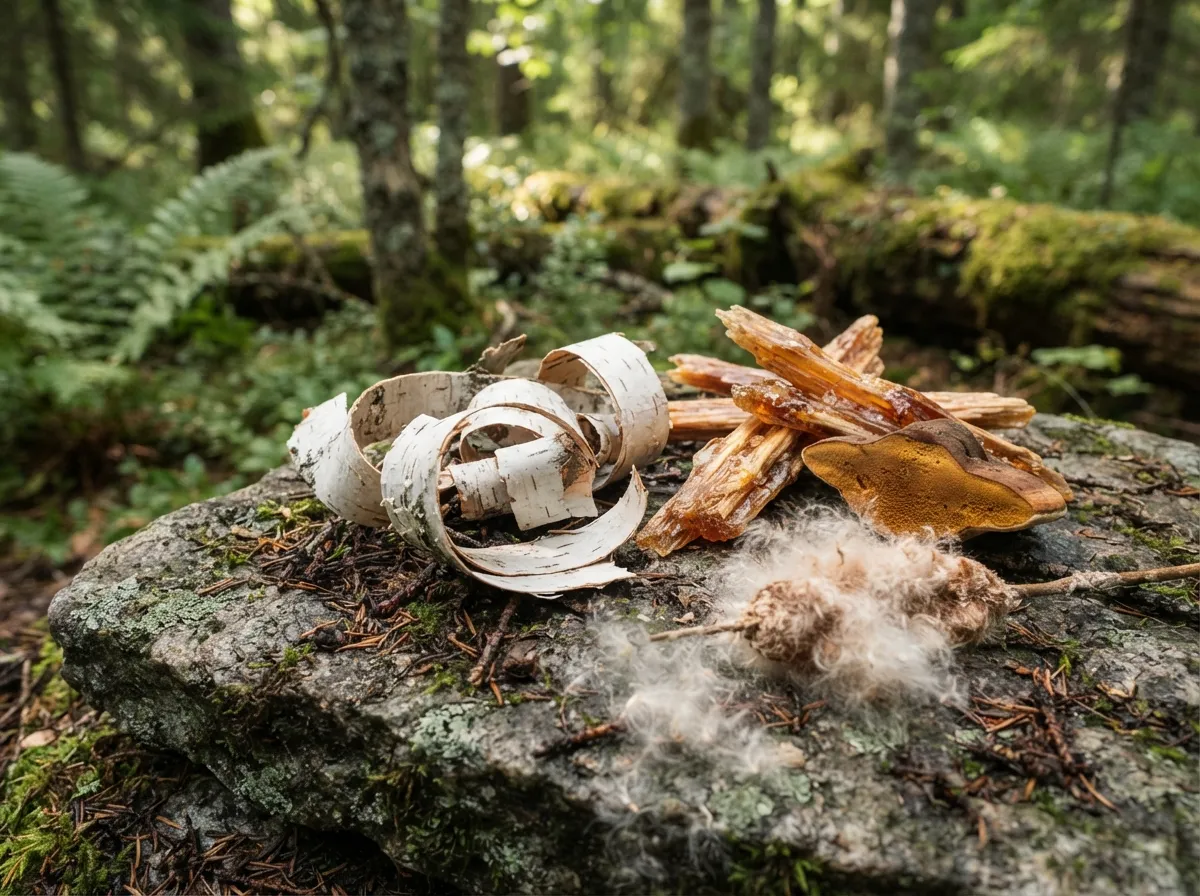
- Birch bark: contains betulin, a triterpene similar to turpentine. It burns even when wet, with a tall, oily flame. Scrape it finely with the spine of your knife to create a “wool” that catches sparks from a firesteel. Harvest it from dead trees, never by ringing a living one.
- Fatwood: resin-soaked pine heartwood found in stumps, dead tree taproots, and branch junctions. It looks amber, translucent, sticky, and smells like turpentine. Shaved into fine curls, it catches a spark; as sticks, it makes a torch. Look for Scots, maritime, or black pine.
- Horse hoof fungus (Fomes fomentarius), the hoof-shaped fungus growing on dead birch and beech trees. Ötzi, the Iceman who died 5,000 years ago in the Alps, carried a supply prepared for use with his flint and pyrite. The spongy layer beneath the crust, boiled in ash lye and pounded, catches sparks and smolders for hours.
- Chaga (Inonotus obliquus), the cracked black mass found on living birch trees: once dry, its orange inner layer catches a firesteel spark directly and smolders relentlessly.
- Cattail (bulrush): the seed fluff catches a spark instantly, but flares up in a second. You need to combine it with other materials.
- Old man’s beard (Usnea, the gray-green filamentous lichen): excellent when dry, but often too damp on the tree; slip it inside your jacket for an hour, and your body heat will dry it out.
- Dry grass, fireweed seed fluff, dry moss, old abandoned nests: good supplements, but rarely dry enough on their own.
Feather sticks
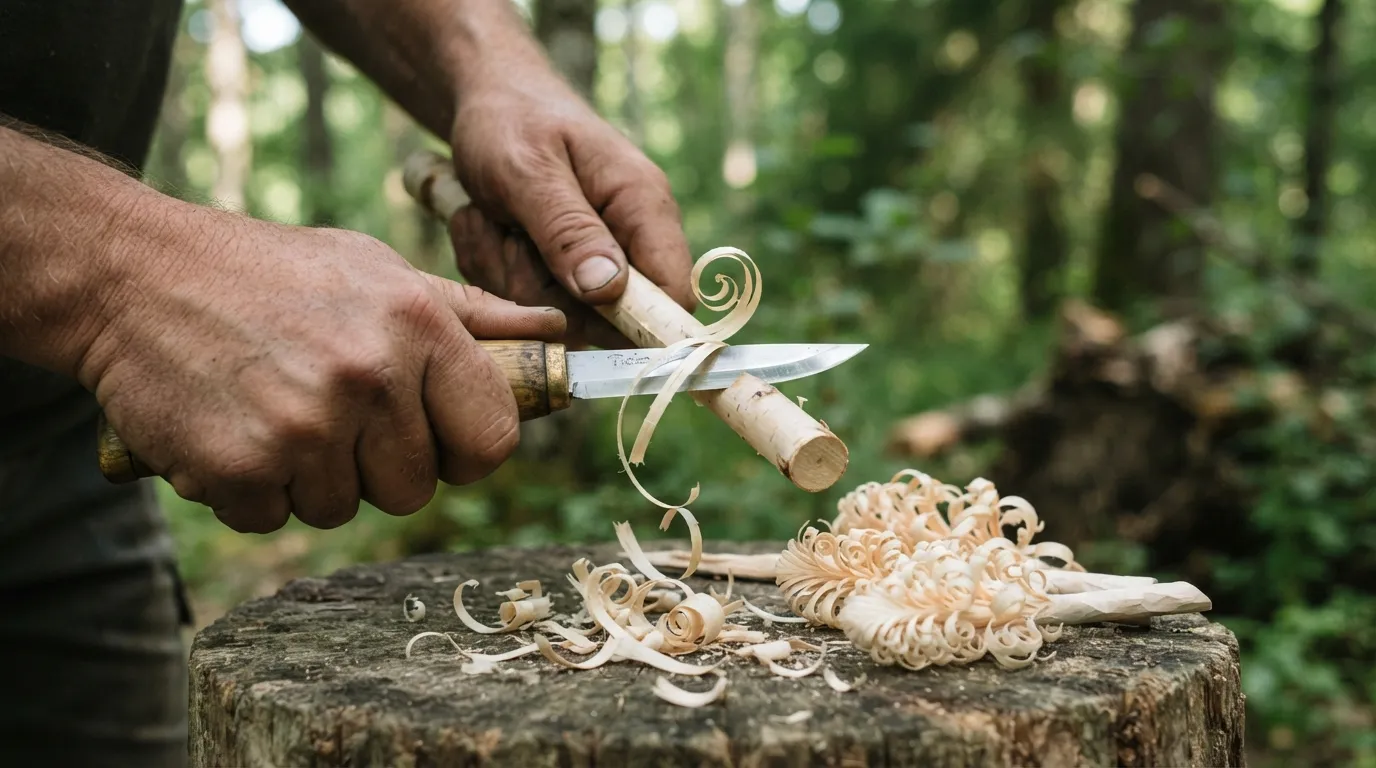
When everything is soaked, the only dry wood left is inside the wood. Take a standing dead branch about thumb-thickness, strip the bark, and shave thin, feather-like curls without detaching them: the cluster of curls forms your tinder, and the stick beneath serves as kindling. Kirtley gives the ratio: two good feather sticks in dry weather, four in cold and damp conditions, and six very fine feather sticks in the rain when failure is not an option. The secret is the thin “neck” of each curl: if the shaving is too thick, it chars without spreading the flame.
Prepared tinders: why fat burns
Anything soaked in grease, wax, or oil makes great kit tinder for a simple reason: fat is a hydrocarbon, repelling water and vaporizing at low temperatures. Cotton is just the wick.
| Vaseline cotton | Tampon | Duct tape | Corn chips | |
|---|---|---|---|---|
| Catches firesteel spark | ✅ (fluffed fibers) | ✅ (fluffed fibers) | ❌ flame needed | ❌ flame needed |
| Burn duration | 3-7 min | 5-7 min | several minutes | 30-60 s per chip |
| Moisture resistance | ✅ | ✅ inside blister | ✅ | ✅ inside bag |
| Weight for 10 fires | ~20 g | ~30 g | a few meters | one bag |
- Vaseline-soaked cotton: a teaspoon of petroleum jelly mixed into a cotton ball gives about 7 minutes of flame. Store them in a tube or small bag, and fluff out the fibers before sparking.
- Tampons: compressed cotton wool inside a waterproof blister pack; provides 5 to 7 minutes of flame, and the blister pack can double as a match holder.
- Duct tape: crumpled into a ball or frayed to expose the woven fibers, it burns for a long time and catches firesteel shavings well.
- Chips: a test by The Prepared confirmed that Doritos, Cheetos, and Fritos ignite easily with an open flame and burn for 30 to 60 seconds per chip, lasting several minutes when crushed. The secret: a thin cornstarch chip deep-fried in oil and kept dry by salt. Crackers, almonds, and ration bars failed to catch, even with a blowtorch — too thick, not greasy enough.
Ignition tools: from lighters to batteries
The basic trio
The lighter remains the most efficient tool ever invented, with one flaw: once wet or frozen, it stops working, and its gas runs out. Stormproof matches (like UCO) burn for 15 seconds in strong winds and reignite even after being submerged. The firesteel (ferrocerium rod) is your ultimate backup: invented by Carl Auer von Welsbach in 1903, this alloy throws sparks at around 3,000 °C whether dry or soaked, at any altitude, and an army-grade model lasts for about 12,000 strikes.
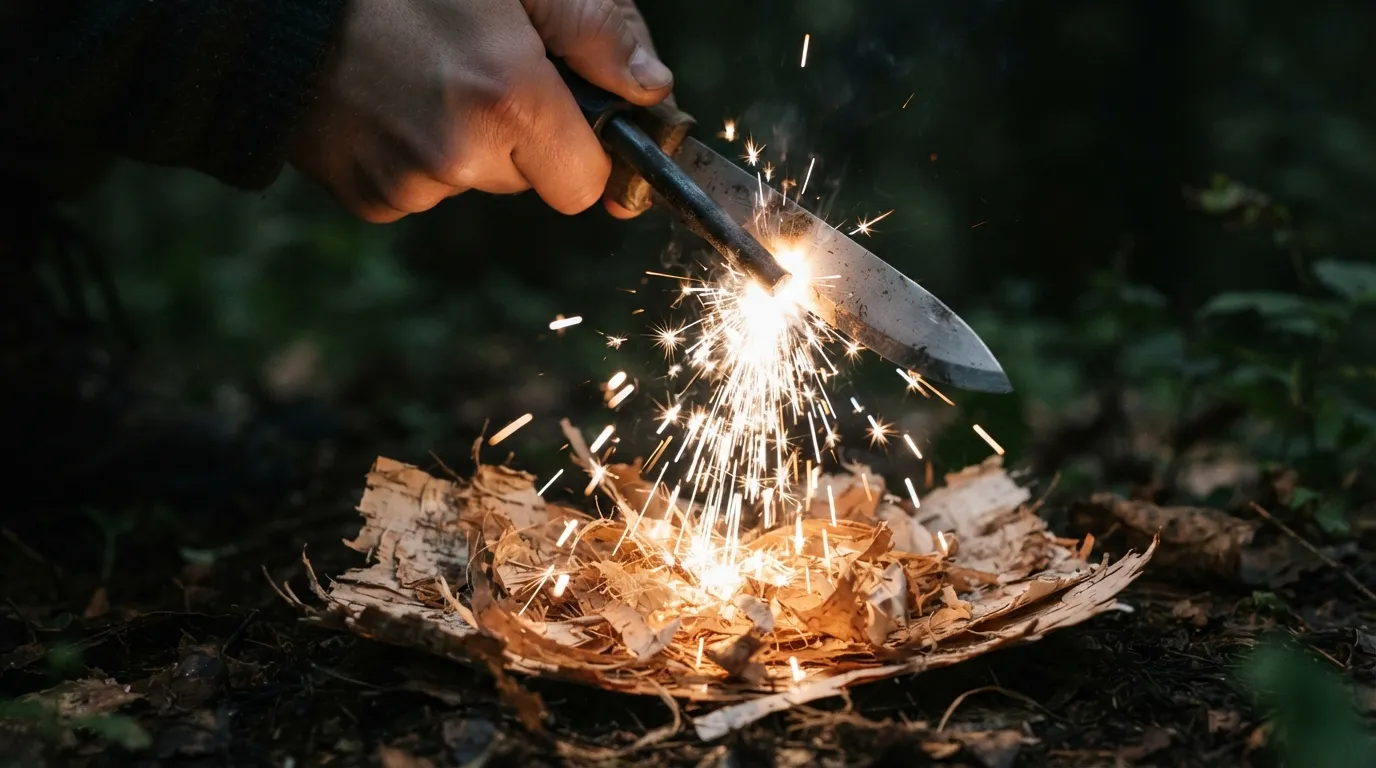
- Prepare a fine tinder nest (scraped birch bark, fluffed cotton, feather stick) and place it on the ground, secured and shielded from the wind.
- Plant the tip of the rod directly into or just above the nest. Place the spine of your knife (never the sharp edge) against the rod at a 45-degree angle.
- Pull the rod backward while keeping the striker still, rather than pushing the striker forward: this drops sparks onto the tinder without scattering your nest.
- Alternate: make a few slow scrapes to deposit ferrocerium shavings onto the tinder, followed by one quick, firm strike to ignite them.
- Blow gently as soon as an ember glows, then place the nest beneath your kindling teepee.
The sun
A magnifying glass, a credit-card-sized Fresnel lens, or reading glasses (convex lenses; farsighted glasses diverge light) focus sunlight onto dark tinder. A clear water bottle, laid on its side, makes a decent lens: Massachusetts firefighters attributed a 2021 fire in Stoneham to water bottles focusing sunlight onto paper. You need clear liquid and direct sunlight. Polished ice, on the other hand, is mostly movie fiction: MythBusters managed to get a flame, but only with a perfectly clear sphere of ice the size of half a bowling ball, made in a lab. In the wild, clear ice is rare, winter sun is weak, and shaping it takes hours.
Batteries
A 9V battery pressed against 0000 steel wool (25-micrometer strands) glows hot instantly — the current heats the strands through Joule heating, and the fine iron burns as it oxidizes. Never store them together in the same pocket: they will ignite on their own. An aluminized gum wrapper cut into an hourglass shape (wide ends, thin strip in the middle) placed across both terminals of an AA battery gets hot enough to flash into flame for a second: you must have tinder ready, and the wrapper must be genuinely foil-backed, which is increasingly rare.
Flint and steel
The ancestor of the firesteel, and the opposite of common belief: it’s not the stone that sparks, it’s the steel. The sharp edge of the flint shaves off a tiny flake of high-carbon steel, which rapidly oxidizes in the air. These sparks are cold compared to ferrocerium: they require tinder with a very low ignition point, like charcloth (cotton or linen carbonized without air in a sealed tin) or prepared tinder fungus. With practice, an 18th-century tinderbox could light a candle in under a minute — though often longer, sometimes requiring a pinch of black powder.
Chemical ignition
Potassium permanganate (purple crystals, historically found in some military first-aid kits) mixed in roughly equal parts with glycerin spontaneously ignites within 30 to 60 seconds at room temperature, though it can take 2 to 3 minutes below freezing. It is a powerful oxidizer: it stains everything purple and must never be stored in the same container as anything greasy.
Friction firemaking
The skill that brings the most pride, and forgives the fewest mistakes. The principle is always the same: generate extremely fine wood dust, heat it through friction until it smolders, and transfer the coal into a tinder nest.
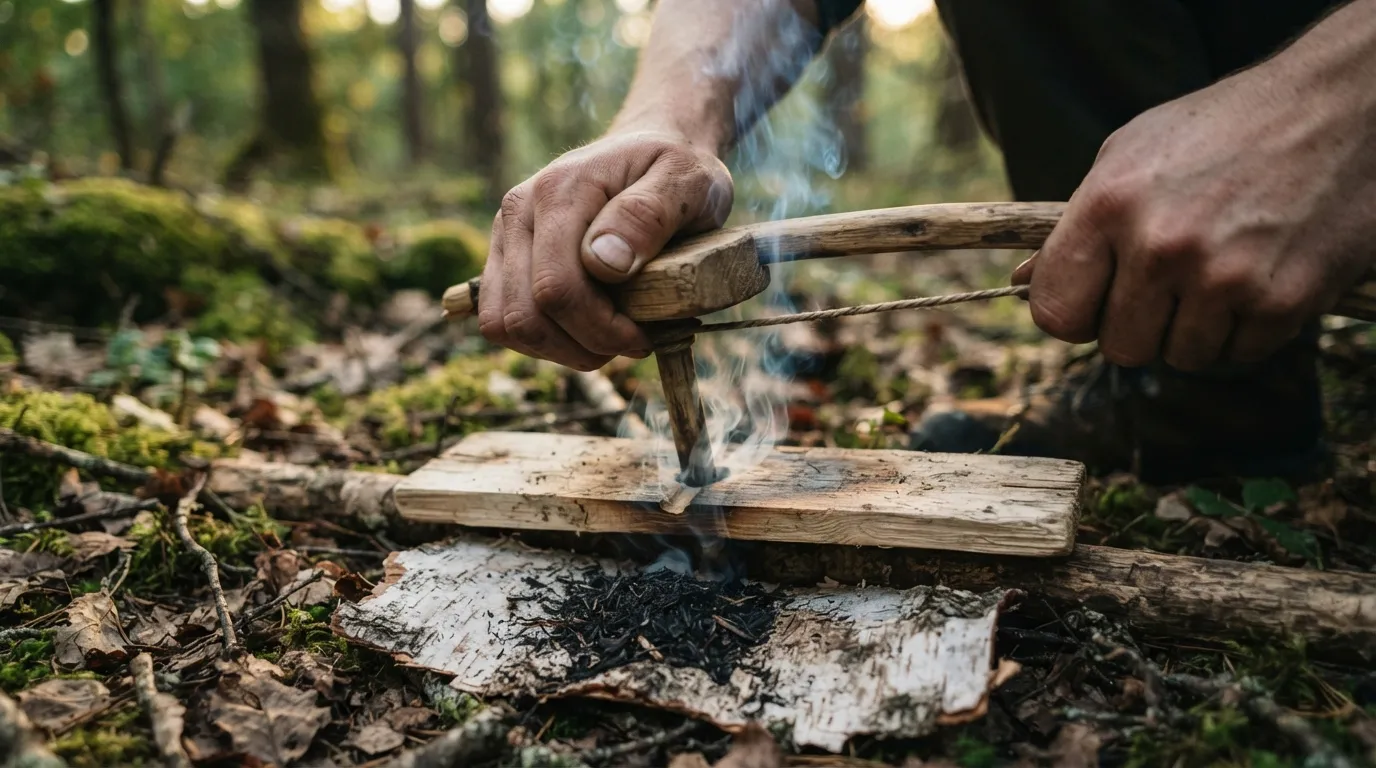
- The bow drill: the most reliable method in temperate climates. Use soft, dry, non-resinous woods: willow, poplar, linden (basswood), cedar, or aspen — if your fingernail leaves a dent in the wood without much force, it’s good. Avoid pine, as its resin acts as a lubricant. Cut a pie-shaped notch into the socket hole, place a piece of bark underneath to catch the dust; when the smoke thickens and the dust turns dark black, give it ten more vigorous bow strokes, then lift carefully.
- The hand drill: uses no bow. The spindle is a straight stalk of mullein, cattail, or yucca, about arm’s length and pinky-finger thick. Captain Bourke, cited by Walter Hough in 1890, witnessed Apache practitioners produce fire in under 8 seconds using yucca and a pinch of sand. Thumb loops (cordage securing your thumbs to the top of the spindle) act as “training wheels” for beginners.
- The fire plough: rubbing a hard stick back and forth inside a wooden groove. This Polynesian technique works well on beach hibiscus (Hibiscus tiliaceus, Hawaiian hau) or kaikōmako (used by the Māori). Hough noted Samoans producing a flame in 40 seconds.
- The fire piston: a airtight cylinder and piston; a swift, hard strike compresses air at a 25:1 ratio, pushing temperatures past 260 °C to ignite a small piece of charcloth on the piston’s tip. Invented by Austronesian peoples in Southeast Asia and patented in London and Paris in 1807 — Rudolf Diesel actually got the idea for his engine after seeing Carl von Linde light a cigarette with a fire piston brought back from Penang.
Fire structures: every fire has a purpose
| Teepee | Star | Swedish torch | Dakota | Long log | |
|---|---|---|---|---|---|
| Easy lighting | ✅ | average | ❌ (flame needed) | average | ❌ |
| Wood efficiency | ❌ | ✅ | ✅ | ✅ | ❌ |
| Stealth | ❌ | average | average | ✅ | ❌ |
| Cooking | average | ✅ | ✅ (flat top) | ✅ | average |
| Overnight heat | ❌ | ❌ | 2-5 h | ❌ | ✅ 8+ h |
| On deep snow | with platform | with platform | ✅ | ❌ | ✅ |
- The teepee: kindling leaned together in a cone around your tinder. The easiest layout to light because flames travel upward, licking the entire cone. It collapses quickly: that’s normal, move on to the next phase.
- The log cabin: crossed logs built into a square frame around a small teepee. Stable, well-ventilated, and produces a steady bed of coals for cooking; scouts call it the “Kapla” layout.
- The star fire: four or five logs laid out like wheel spokes, with only their tips meeting at the center. Push logs inward to increase heat, pull them back to slow down or extinguish. Used by Plains tribes when wood was scarce: it burns logs end-by-end without needing an axe.
- The Swedish torch (Scandinavian log): a vertical log split three-quarters of the way down in a cross pattern, lit from the top. The vertical slits create a chimney draft, allowing you to burn freshly cut green wood. Swedish soldiers during the Thirty Years’ War used them to stay warm using freshly felled pines; a 30–60 cm diameter log burns for 2 to 5 hours, and its flat top serves as a stove.
- The upside-down fire: thickest logs laid flat on the bottom, tightly packed, topped with progressively smaller layers, finishing with a small teepee on top. The fire burns downward, dropping embers that ignite the lower layers. It feeds itself for hours without needing to be turned.
The Dakota fire hole: stealthy and efficient
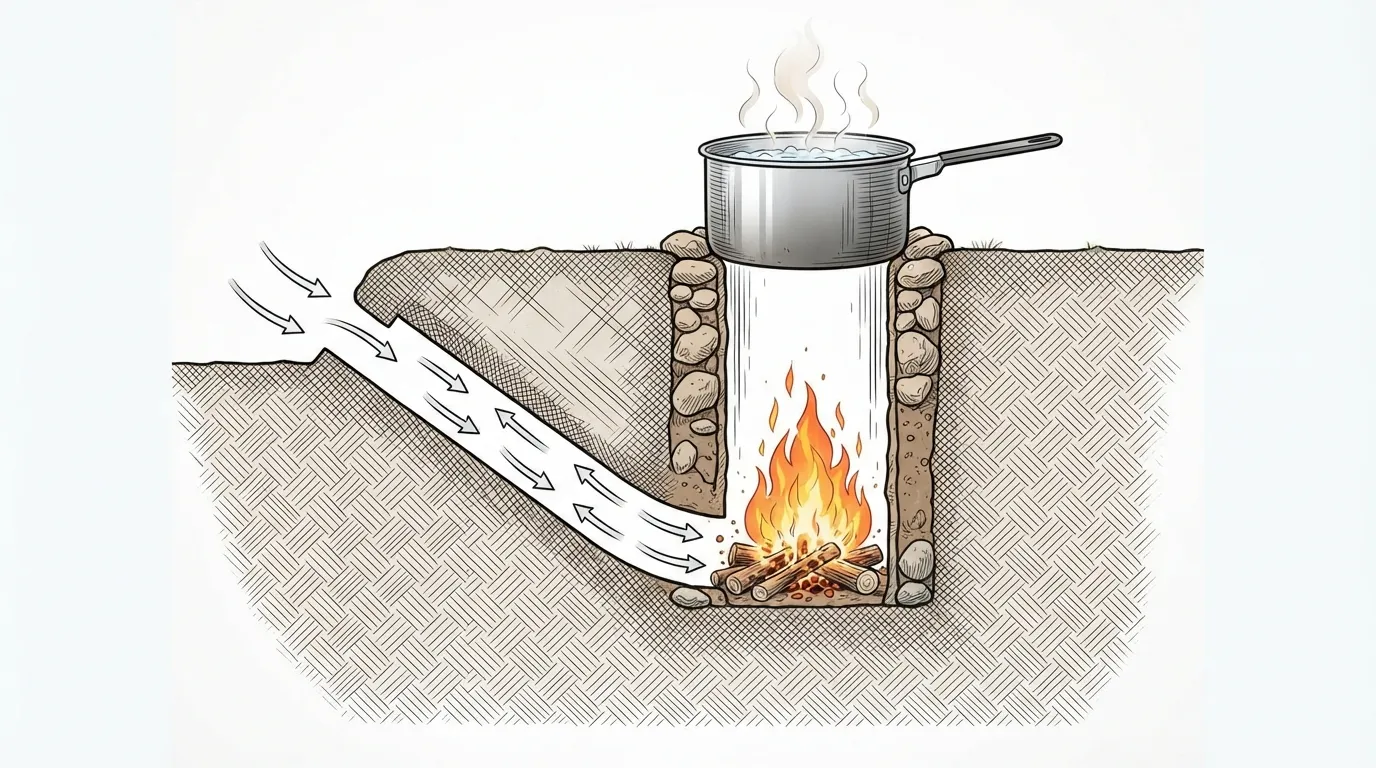
FM 21-76 sums it up cleanly: dig a pit, then, on the windward side, dig a second angled hole connected to the first by a tunnel, and build your fire at the bottom of the main pit. Wind rushes down the airflow hole, feeds underneath the embers, and the fire draws like a wood stove. The result: a focused flame that consumes less wood, produces almost no smoke due to complete combustion, stays hidden from a distance, remains protected from wind, and extinguishes quickly by filling the holes back in. A pot set across the top cooks just like on a stove burner. Space the holes 25 to 50 cm apart. Avoid root-filled or peaty soils, which can smolder underground for days.
The long log fire for sleeping
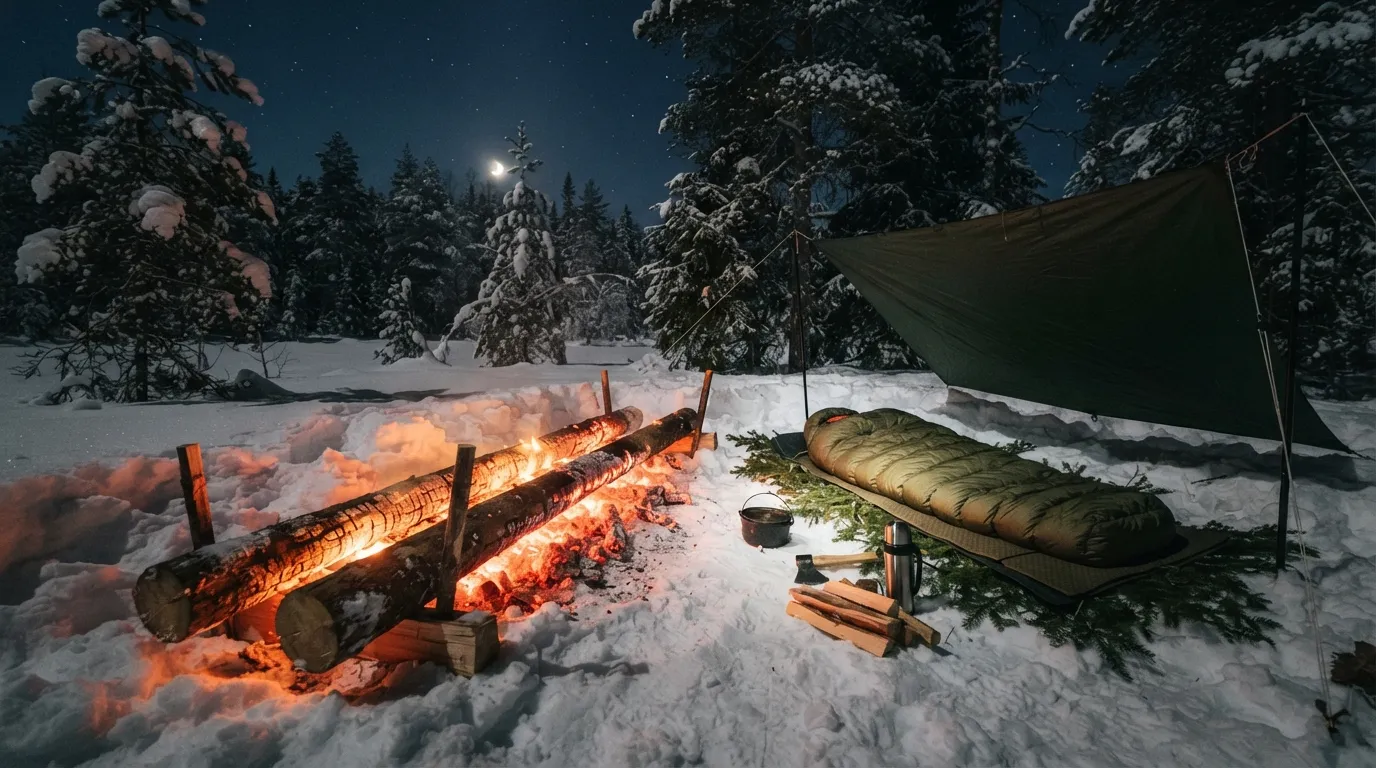
A fire designed to keep a sleeper warm all night isn’t a tall heap: it’s a fire as long as your body, burning evenly along its entire length. The Sámi reindeer herders, traveling without tents in the autumn, perfected the nuorssjo, known in Swedish literature as “the ultimate log fire”: two standing dead Scots pine trunks, about 2 meters long, flattened on one side with an axe. You light the flat side of the bottom log, place the second log on top with flat sides facing, and adjust the gap using wooden wedges. It produces a slow, steady heat that lasts all night. Finns use the rakovalkea (“slotted fire”) on the same principle; the Siberian version stacks several logs in a fan shape over a heavy base log.
In the rain and on snow
Kirtley’s rule: set up your tarp before lighting the fire, or the first flame will melt the tarp while you’re trying to string it up. Underneath it, rising warm air cools and circulates back down: a pocket of heat forms, helping the fire burn better with less wood. Double your amount of fine kindling when rain falls directly on your setup, shield the first few seconds of ignition with your jacket or pack, and pick a spot sheltered from the wind — but avoid deep depressions, where cold air and moisture settle.
On snow, use one of two strategies. For a quick lunch break, build your fire on a thick platform of logs: use green or wet logs laid out in two crisscrossed layers, which will hold up for a few hours without burning through because they’re waterlogged. For an overnight camp, dig down to bare ground or build a long log fire raised on its own timber base. A fire built directly on snow melts the snow, sinks, and drowns itself.
Preserving fire, carrying fire
Rebuilding a fire every morning costs matches and an hour of work. Keeping a fire alive costs nothing.
- Let the flames die down after an hour or two of strong burning without adding fresh wood: you want a thick bed of coals, not active flames.
- Gather the embers into a tight, compact heap in the center. A tight pile holds heat; a spread-out pile dies.
- Cover the pile with several centimeters of cool ash until the glow dims without vanishing completely. Ash restricts oxygen while providing insulation.
- Place one or two dense logs alongside the edge of the pile (not directly on top): they will absorb heat and slowly ignite.
- In the morning, rake away the ash, find the glowing embers, place fine tinder over them, and blow gently with long, steady breaths.
To transport an ember from one camp to the next, you need materials that smolder without burning up quickly: horse hoof fungus, chaga, dry rotten wood (“punkwood”), or pinecones, packed with damp moss inside a metal tin. Quinault elders in Washington State wove 1-meter-long cedar bark matches, keeping them burning for weeks underneath their blankets. Australian Aboriginal groups transported a glowing fungus (Laetiporus portentosus) that smoldered for hours overnight. And the slow match used by early musketeers — a hemp cord boiled in an ash and saltpeter solution — burns at roughly 20 minutes per inch: 2 meters provides a full day of portable fire in your pocket.
Hazards: carbon monoxide, shelters, wildfires
Fire also destroys from the outside. A 21-year US study attributed 84% of wildfires to human causes, with campfires accounting for roughly 5%: left unattended, poorly extinguished, or built over roots and peat that smolder underground for days. The Leave No Trace rule comes down to three words: douse, stir, feel — a fire is truly out when you can touch the ashes with your bare hand. Beware of two common traps: green pinecones pop and launch sparks, while gorse and broom burn hot even when green, generating intense, uncontrollable heat.
Cooking, signaling, keeping morale high
For cooking, you need coals, not flames: log cabin and star layouts create them easily, while a Dakota pit focuses them beneath your pot. For signaling, the international emergency signal is three columns of smoke; tossing green vegetation or damp moss onto a large fire produces thick white smoke, while rubber or oil creates black smoke. Choose a color that contrasts with your surroundings: white smoke against a dark forest, black smoke against snow. Keep in mind that smoke signaling only works in calm, clear weather; wind, rain, or snow scatter smoke before a pilot can spot it.
Fire also settles the mind. In 2014, anthropologist Christopher Lynn measured the blood pressure of 226 adults sitting beside a fireplace: combined with crackling sounds, blood pressure dropped by roughly 5%; without sound, the visual image alone had no effect. Fire acts as a natural sedative, but it comes with instructions: you need to hear it. In a survival scenario, it keeps your hands busy, provides a clear objective, and makes the long night feel shorter.
Myths debunked
Frequently asked questions
How do I light a fire in the rain?
Look for dead branches hanging on standing trees rather than wood lying on the ground, as gravity pulls water downward, leaving vertical wood much drier. Carve feather sticks (fine, attached wood shavings) from the dry inner wood, prepare all your kindling sizes before striking your first spark, and pitch a tarp overhead before lighting up.
What natural materials burn even when wet?
Birch bark burns with a tall, hot flame even when damp thanks to its high betulin content. Fatwood — the resin-soaked heartwood of pine stumps — also burns reliably when wet, whether shaved into fine curls or cut into splinters.
How do I make a fire without a lighter or matches?
A firesteel (ferrocerium rod) is the most reliable tool whether wet or dry, at any altitude: pull the rod backward while keeping the striker still so sparks land directly on your tinder. Without a firesteel, a bow drill using softwoods (willow, basswood, poplar) works well with practice, as does a magnifying glass or a 9V battery applied to fine steel wool.
How do I keep a fire burning all night without waking up?
A long log fire, built as long as your body, burns down its entire length to provide steady heat for hours without adjustment, much like the Sámi nuorssjo. To preserve coals for the morning, let the flames die down into a thick bed of embers and cover them with several centimeters of cool ash to starve them of oxygen.
Does green (freshly cut) wood burn?
Poorly, but it does burn: it contains 50 to 100% water content relative to its dry weight, and all that moisture has to evaporate before the wood can off-gas and ignite. Don’t use it to start a fire, but you can add it to an established, hot fire, or burn it using a Swedish torch layout, where vertical slits create a chimney effect.
How do I light a fire with a firesteel on the first try?
Prepare a fine tinder nest (scraped birch bark, fluffed cotton) set on the ground and sheltered from wind, then plant the tip of the rod into it with the spine of your knife held at a 45-degree angle. Pull the rod backward while keeping the striker stationary so sparks land directly into the nest, then blow gently once an ember begins to glow.
Key takeaways
- Wood doesn’t burn, its gases do: your fire needs heat and air before it needs more wood.
- Matchstick, pencil, finger, wrist: prepare all wood sizes before striking your first spark, and gather an armful of kindling, not a handful.
- In the rain, dry wood is inside the wood: look for standing deadwood, bark it, split it, and carve feather sticks. Birch bark and fatwood burn wet.
- Pull your firesteel backward while keeping the tinder still; store batteries away from conductive materials.
- A long log fire keeps you warm overnight, a Dakota pit hides your cooking fire, and burying coals under ash saves effort in the morning — and never bring coals into an enclosed shelter.
Going further
- Mors Kochanski, Bushcraft: Outdoor Skills and Wilderness Survival (1988) — the ultimate firecraft guide for boreal forests, introducing the diameter-based wood progression.
- Paul Kirtley, Fire Fundamentals, free course — a thorough, practical framework for damp environments.
- Walter Hough, Fire-making Apparatus in the U.S. National Museum (1890) — the most comprehensive ethnographic firecraft survey ever written, available free on Project Gutenberg.
- FM 21-76, US Army Survival Manual, Chapter 7 — covers Dakota fire holes, hearth layouts, and improvised igniters in ten concise pages.
Sources for this module (20)
- FM 21-76 US Army Survival Manual, ch. 7 Firecraft
- Paul Kirtley — Tactics for fire-lighting in the damp, cold months
- Paul Kirtley — Nuorssjo, the best log fire (feu long sami)
- Walter Hough, Fire-making Apparatus in the U.S. National Museum (1890)
- Wikipedia — Fire piston
- BUSHCRAFT.FR — Guide des allume-feux naturels et artificiels
- Lynn C. D. (2014), Hearth and Campfire Influences on Arterial Blood Pressure, Evolutionary Psychology
- CDC MMWR — Carbon Monoxide Poisoning Deaths Associated with Camping, Georgia 1999
- The Prepared — Confirmed: Doritos, Cheetos and similar snacks make great fire tinder
- Woodland Ways — Slow match
- Frontier Bushcraft — The Swedish Firesteel
- LaToileScoute — Allumer un feu de camp par tous les temps
- Wikipédia — Bûche scandinave
- Jack Raven Bushcraft — Outer barks as tinder
- Wood Trekker — True tinder fungus (chaga)
- Survival-Kompass — Making fire with ice: myth debunked
- Te Papa — Hika ahi, making fire (Maori)
- Smithsonian — Study shows 84% of wildfires caused by humans
- Bushcraft USA — Fire reflectors? (débat sur les murs réflecteurs)
- T-O-T — 5 clés pour allumer un feu sous la pluie
Continue in "The fundamentals"
Mindset: the key to everything
Before fire, before water, before shelter: what happens in your head during the first ten minutes.
Water: Finding, collecting, and making it drinkable
Three days without water is the popular myth. The real question is where it's hiding and what's inside it.
Shelter: sleeping warm when everything is against you
Three hours. That's all the time you have left in cold rain if you don't get out of the wind and off the ground.