Forest Fire: Evacuating, or Protecting Yourself When You Can No Longer Run
It moves faster than you uphill, jumps roads via embers, and won't wait for you to figure out what's happening.
It’s 3 p.m., and you’ve been hiking for three hours through a pine forest smelling of heated resin. Whiffs of a barbecue-like smell roll in, a bit too strong for a simple campfire. In the distance, a streak of gray smoke rises straight up, then flattens out all at once as the wind shifts. You might have twenty minutes to decide which way to run — and the wrong decision, in a forest fire, gives you no second chances.
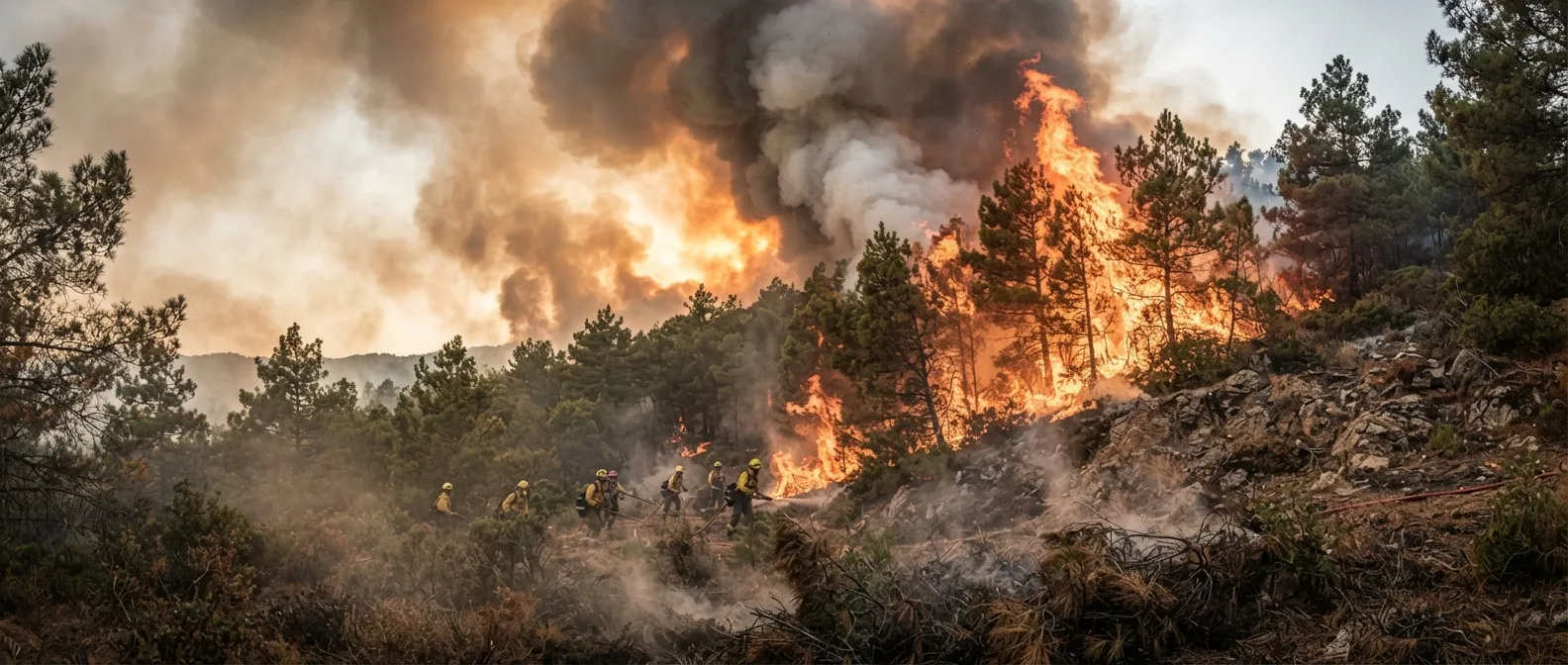
How a forest burns
A forest fire doesn’t spread like a puddle spilling over: it rolls in one direction, pushed by the wind and its own heat. On flat ground covered in low, dry vegetation, it can move up to 6 km/h — faster than a brisk walk. The real issue is slope: fire preheats the fuel above it through convection, much like a tilted lighter flame ignites whatever is right in front of it faster. American trainers at the NWCG teach a simple rule of thumb: the rate of spread roughly doubles for every 10 degrees of slope. A fire creeping at 2 km/h on flat ground can exceed 15 to 20 km/h up a 30–40% incline — faster than you can run.
Wind dictates everything else. In Mediterranean climates, the fire front advances at roughly 3 to 8% of the wind speed. And it doesn’t just push the fire along: it throws embers far ahead. In Spain, spot fires have been recorded up to 2.4 km ahead of the front; in Australia, during Black Saturday in 2009, up to 20 km. A spot fire is a brand-new blaze igniting behind you, cutting you off from the road you thought was safe.
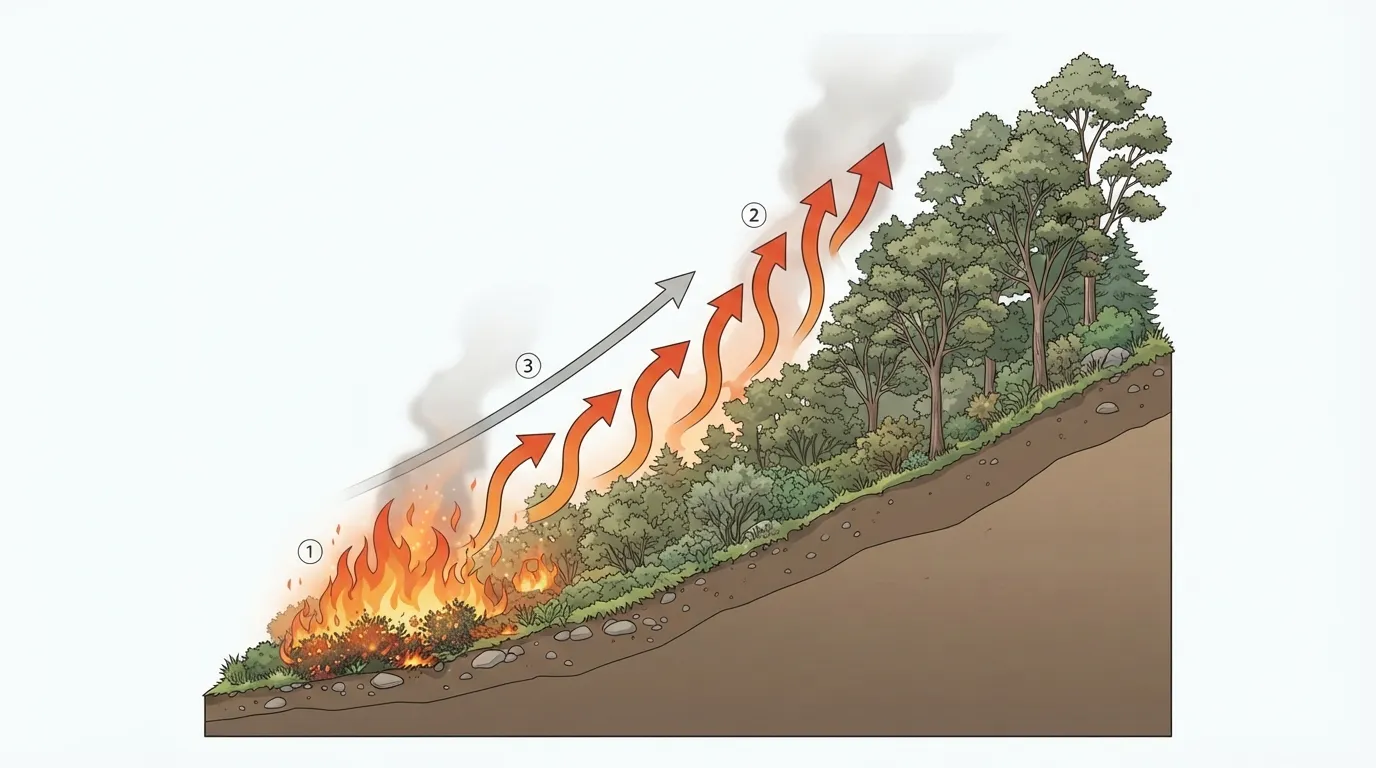
Scrubland and pine woods don’t burn like a grassy field: they explode. The resins and essential oils in pine needles, rosemary, or rockrose vaporize before the wood itself even ignites, creating a cloud of gas that can flash over an entire canopy in an instant — a crown fire. This is also why the most violent fires often start between 2 p.m. and 6 p.m.: peak temperatures, lowest humidity levels, and thermal valley winds all line up simultaneously.
Signs that mean you need to leave right now
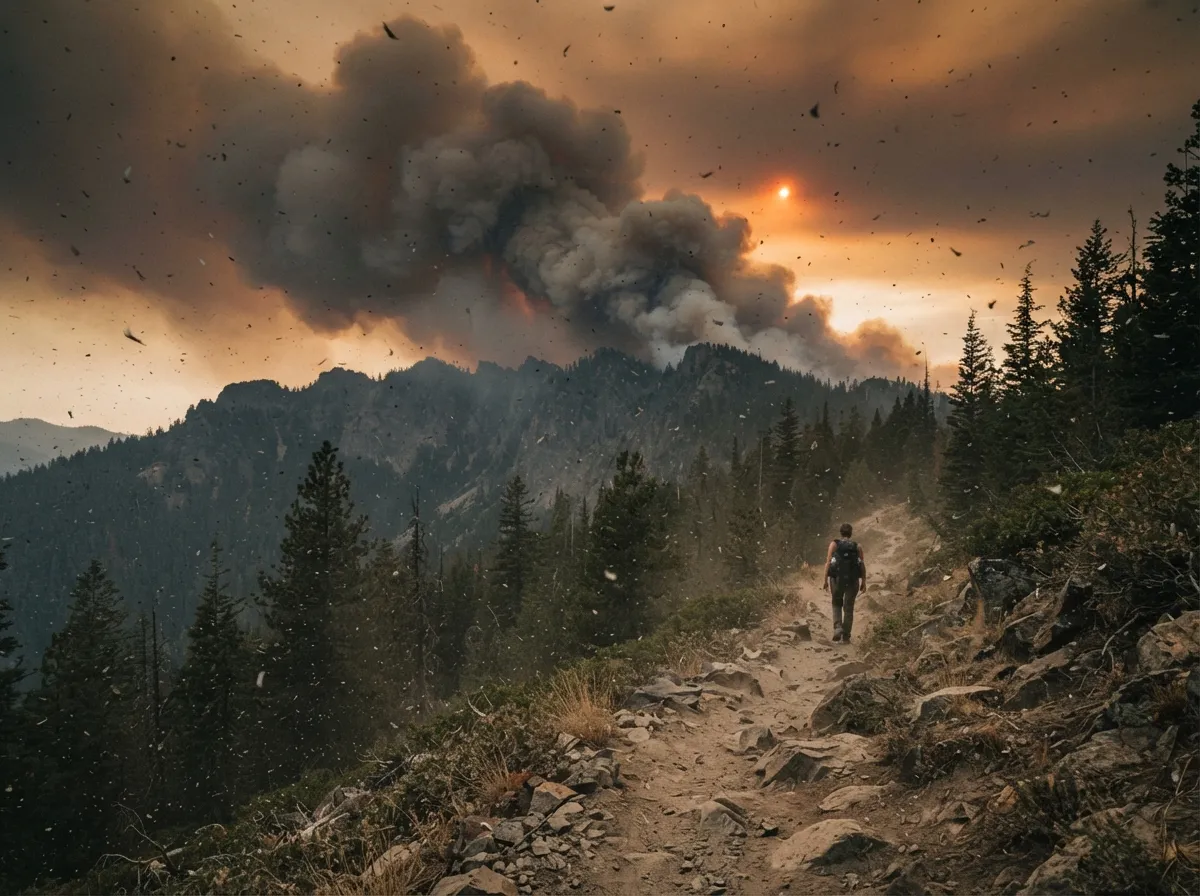
You smell a forest fire before you see it. An acrid smoke smell, far harsher than a campfire, is your first signal — if it gets stronger instead of fading, it’s getting closer. The light changes: a sky turning orange in broad daylight or a sun you can stare at without squinting means heavy smoke is accumulating upwind. Fine ash falling like snow, even far from visible flames, means a plume is blowing overhead — the fire could be miles away. Animals don’t hesitate: deer, wild boars, and birds fleeing in the same direction are a far better radar than your nose. And low-flying planes or helicopters, or emergency vehicles speeding up a forest road, aren’t an invitation to satisfy your curiosity — they’re your cue to leave.
In France, 95% of forest fires are caused by human activity — 50% due to carelessness, nearly 40% arson, and only 8% natural causes. In short: in the vast majority of cases, someone saw the fire start before you did. If you run into hikers sprinting down a trail, believe them instead of trying to check for yourself.
Evacuating: which direction to head
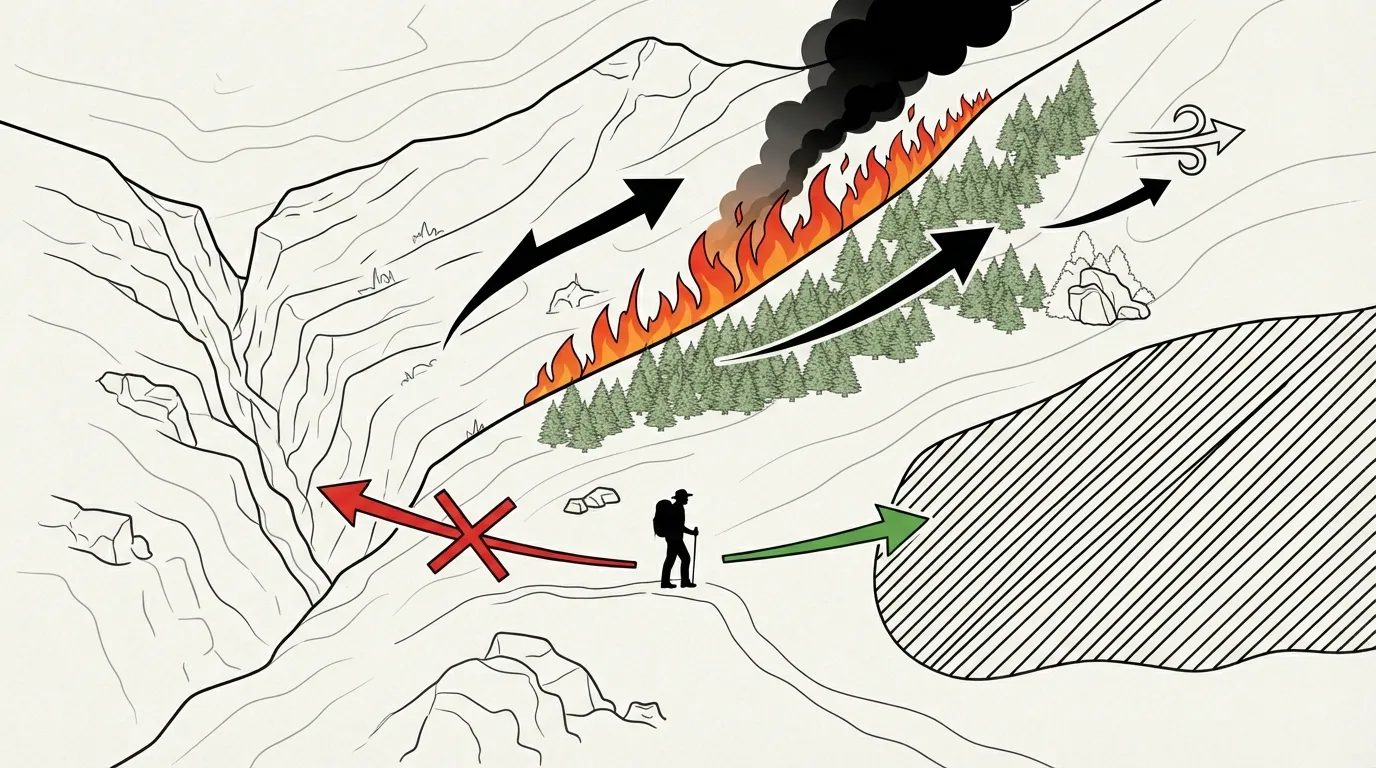
The golden rule boils down to one simple concept: downhill, and into the wind — never uphill, and never downwind with the fire at your back. Going downhill is always faster than climbing, and a fire moving away from you gains ground far slower than one blowing toward your face.
U.S. wildland firefighters refer to the burnt area as “the black”: the fuel is gone, there’s nothing left to burn, and it is statistically the safest refuge in open country. A charred area behind the fire front is a much better target than an untouched forest that seems “farther away, hence safer.” Other good refuges follow the exact same logic — little to no fuel surrounding you: a wide cleared road, a body of water, a boulder field, or a cleared field.
Two mistakes kill more people than any others. Running uphill ahead of a fire: you will never win that race, as the incline speeds up the flames while slowing you down. Trapping yourself in a canyon or narrow draw in the wind’s path: these terrain features act as chimneys, sucking in and accelerating superheated air — the exact trap that claimed the lives of thirteen firefighters at Mann Gulch in 1949 and nineteen more at Yarnell Hill in 2013 (see below).
| Burned area ("the black") | Wide cleared road | Body of water | Boulder field / scree | |
|---|---|---|---|---|
| Fuel around you | None | Low if shoulders are cleared | None | None |
| Smoke hazard | Moderate | Moderate | Low if submerged | Low |
| Overall reliability | ✅ Wildland firefighters' top pick | ✅ Good fallout spot | Decent with precautions | Decent |
What to do when running is no longer an option
If the front is right on top of you, if heavy smoke causes you to suffocate before reaching shelter, or if your escape path is blocked, running is no longer the right play. Survival now comes down to two things: minimizing the surface area exposed to radiant heat and securing breathable air.
- Find the least vegetated spot available in the remaining seconds: a ditch, a ground depression, a trail, or a flat rock outcrop.
- Lie down face first at the lowest point — a ditch protects you from low-sweeping flames and radiant heat, which mostly travels horizontally.
- Cover exposed skin: draw up your hood, pull down your sleeves, or use wet clothing if you have water.
- Breathe right next to the ground, preferably through cloth: air is cooler and carries less smoke down there.
- Stay still until the front sweeps over — usually taking no more than a few minutes.
U.S. wildland firefighters carry a emergency fire shelter as a last resort: a personal shelter made of aluminum foil, woven silica, and fiberglass that reflects radiant heat and traps a pocket of breathable air.
At Yarnell Hill, temperatures exceeded 1,090 °C (2,000 °F), far surpassing what any shelter can withstand under direct, prolonged flame contact: all nineteen members of the Granite Mountain Hotshots, trapped in dense chaparral when the wind suddenly shifted, were overrun despite deploying their shelters. Only their lookout, positioned elsewhere and evacuated early via radio, survived. The same logic applies to improvised shelters: seven of the 173 deaths during Black Saturday in 2009 occurred inside fire bunkers that proved poorly ventilated or too small to survive the passage of the fire front. No shelter is a magic shield; it’s a tool to buy a few precious minutes — never a substitute for getting out early.
In your car, or in water
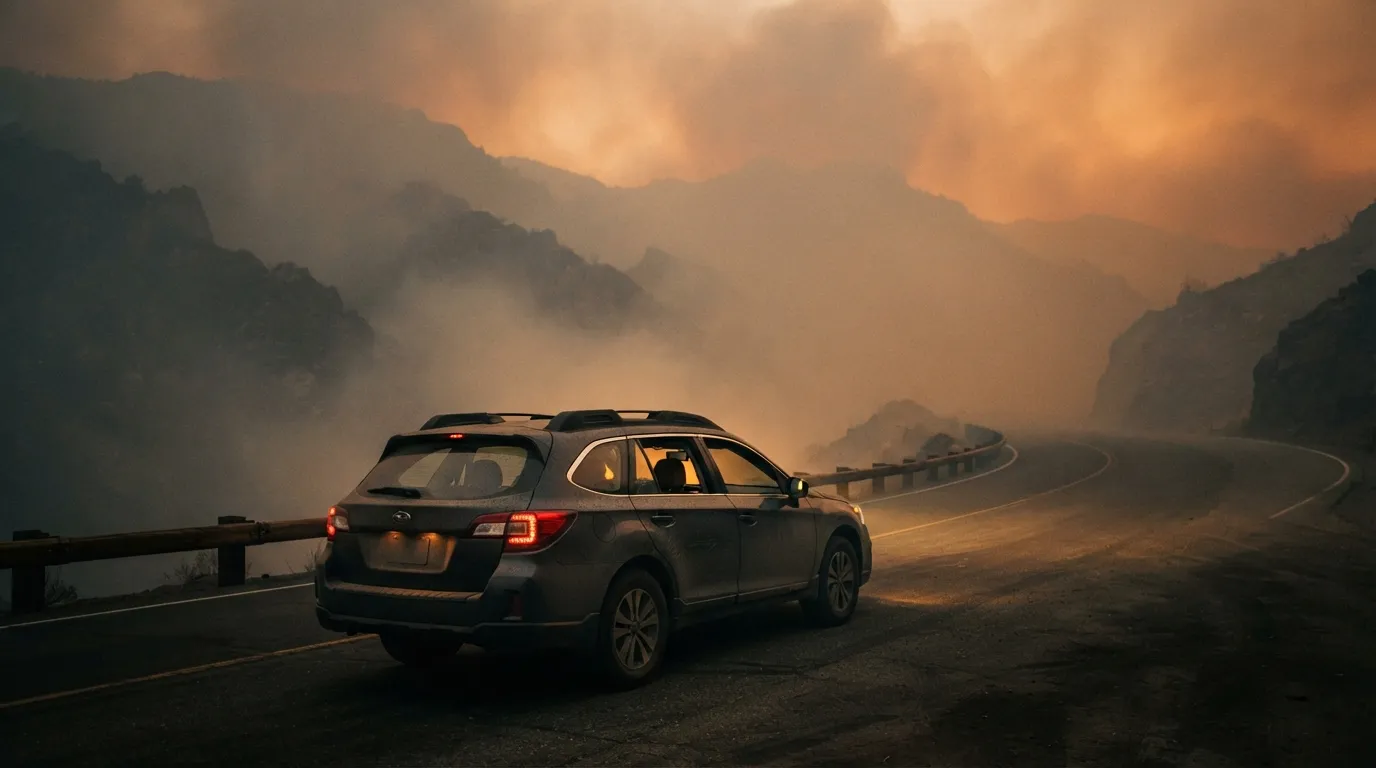
A car is a much better shelter than most people think, provided you stay inside: the sheet metal and glass block the vast majority of radiant heat. Roll up all windows and close air vents, leave the engine running, duck below window level, and cover yourself with a blanket or jacket. Do not panic and run outside if flames are near: during the 2003 Cedar Fire in California, at least ten people died trapped outside their vehicles trying to flee on foot from a fire advancing at up to 6,000 acres an hour, driven by 60+ mph winds.
A body of water — a pond, river, or swimming pool — provides good protection against radiant heat if you submerge most of your body, but beware of two deadly traps: heavy smoke settling right at water level that can suffocate you even while wet, and intense radiant heat baking any exposed skin or hair above the surface. Stay clear of vegetated shorelines, which can burst into flames right over your head.
Fires you must never start
In a country where 95% of wildfires are sparked by human action, the single best survival skill is never causing one in the first place. In France, Legal Brush-Clearing Obligations (OLD) require landowners to clear brush and undergrowth within 50 meters of any building (100 m in select areas) and 10 meters along access driveways, anywhere within 200 meters of woods, forests, or high-risk scrublands. Open-air burning of green waste has been illegal since 2004, carrying fines up to €30,000: mulching or composting are the required alternatives.
If you must build a campfire in a wilderness area — assuming no local fire bans are in place, which you should always check beforehand —, a pit-dug Dakota fire hole (detailed in the Fire Making module) reduces the risk of escaping embers far better than an above-ground teepee fire. Extinguishing it is never optional: pour water while stirring embers until everything is cold to the touch, not just mildly smoking. Abandoning a fire that rekindles holds you legally and criminally liable, even without intent — it remains one of the top causes of wildfires.
Fires that teach us lessons
Gironde, France, Summer 2022: over 32,000 hectares burned between La Teste-de-Buch and Landiras, 36,750 people evacuated on short notice — and zero fatalities. What set this apart from major disasters wasn’t the size of the fire, but how fast the decision to evacuate was made, well before roads turned into death traps.
Pedrógão Grande, Portugal, June 2017: at least 66 deaths, including 47 on a single rural road overrun by flames while families tried to flee — thirty caught inside their vehicles, seventeen on foot after abandoning stalled cars. The road, typically perceived as a safe haven, transformed into a fire corridor lined with eucalyptus trees whose volatile oils make their canopy insanely flammable.
Black Saturday, Australia, February 7, 2009: 173 fatalities, a national tragedy. 46.4 °C (115.5 °F), humidity crashing to 2%, wind gusts topping 125 km/h. The Kilmore East fire traveled 50 km in a straight line through multiple towns, throwing spot embers up to 20 km ahead. The subsequent Royal Commission heavily criticized the “stay or go” policy (staying to defend your home versus leaving early): crucial warnings in the mid-afternoon arrived far too late for people to make a real choice.
Smoke: the silent killer that precedes the flames
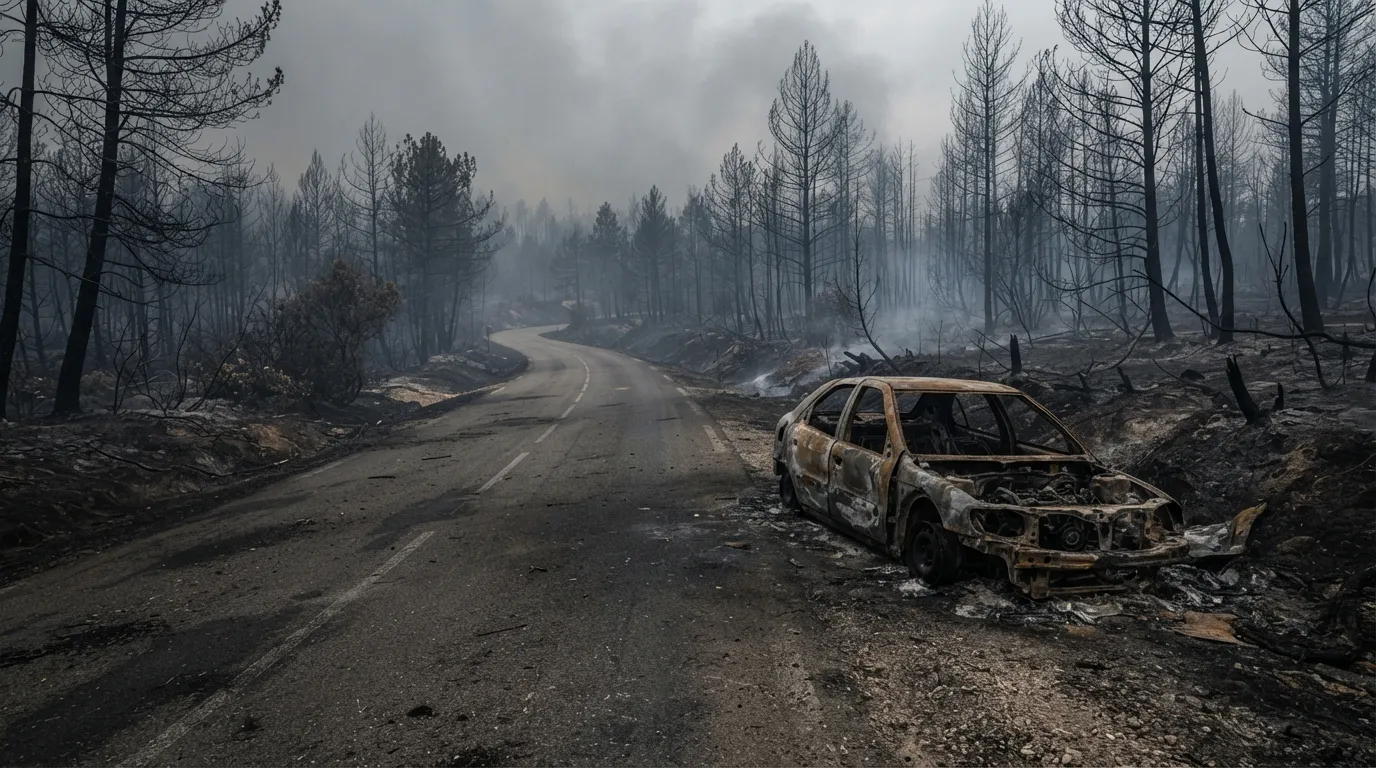
Forest fire smoke isn’t just irritating: it’s packed with carbon monoxide, toxic PM2.5 fine particulates that go deep into your lungs, formaldehyde, and chemical compounds. Carbon monoxide is odorless and colorless; it deprives your blood of oxygen long before you realize it, right up until dizziness hits. In an enclosed space inundated with smoke, the air becomes lethal long before flames come anywhere near — which is why you should roll up car windows entirely rather than leaving them cracked “to catch a breeze”: a steady trickle of toxic smoke is far worse than a sealed cabin holding clean air for a few extra minutes.
An intense fire can also trigger its own cloud column, a pyrocumulonimbus: this superheated column creates convective storm clouds capable of generating lightning and violent, unpredictable surface winds — which can instantly flip a fire front back onto itself, the exact phenomenon that trapped the Yarnell Hill firefighters.
Afterwards
A fire front passes in minutes, but the fire will continue burning around the area for hours, sometimes days. Never return to a freshly burned zone until local authorities declare it clear: hidden underground hotspots, burnt tree trunks still smoldering inside that can collapse without warning, and heavy particulate smoke lingering near the ground remain dangerous long after visible flames die down. If you experience a persistent cough, shortness of breath, or headaches following smoke inhalation, seek medical attention right away — respiratory damage can flare up hours later.
Frequently asked questions
How fast does a forest fire travel?
On flat ground, up to about 6 km/h — roughly a brisk walking pace. However, the speed roughly doubles for every 10 degrees of uphill slope, and high winds can multiply that rate significantly.
Which direction should you run to escape a forest fire?
Head downhill and into the wind, never uphill ahead of advancing flames or into a narrow canyon that acts like a chimney. A previously burned area (“the black”), a wide cleared road, a body of water, or a boulder field are your safest bets.
What should you do if trapped inside your car by a wildfire?
Stay inside with all windows rolled up and air vents closed, leave the engine running, and duck down below window level. Running away on foot has cost many people their lives in past fires, such as the 2003 Cedar Fire in California.
Can you take shelter in a body of water during a forest fire?
Yes, by submerging as much of your body as possible, away from vegetated banks that can catch fire overhead. Keep in mind two major risks: heavy smoke settling right at the water’s surface that can suffocate you, and extreme radiant heat blistering any exposed skin.
Can wildfire smoke kill you before the flames arrive?
Yes. Wildfire smoke contains odorless carbon monoxide and fine particulates that penetrate deep into the lungs, making enclosed spaces unbreathable long before flames are ever visible.
How long does a fire front take to pass over?
Rarely more than a few minutes at any single location, even if the surrounding forest burns for hours. This short duration is what makes last-resort shelter strategies viable: you only need to survive those critical few minutes, not the whole night.
Summary
- A forest fire doubles in speed roughly every 10 degrees of uphill slope: never try to outrun a fire climbing toward you.
- Evacuate downhill and into the wind toward a burned area, a wide road, a body of water, or a boulder field — never into a narrow canyon.
- If you’re trapped: drop low in a depression, stay inside a sealed vehicle with the engine running, or submerge in water away from banks — listed in order of availability, not reliability.
- Smoke kills long before flames reach you: a closed, clean space protects you better than cracking a window “for fresh air.”
- 95% of wildfires in France are caused by human activity: your best survival strategy is ensuring you never start one.
Further reading
- Norman Maclean, Young Men and Fire (University of Chicago Press, 1992) — the detailed account and investigation of the Mann Gulch fire that reshaped modern American wildland firefighting safety doctrine.
- NWCG, 10 Standard Fire Orders and 18 Watch Out Situations — the safety framework established following Mann Gulch, still taught to wildland firefighters today.
- Ready.gov, Wildfires — official U.S. government guidance on wildfire preparedness and emergency evacuation.
- 2009 Victorian Bushfires Royal Commission Report — the most comprehensive critical review ever conducted on evacuation policies and emergency responses during major forest fires.
Sources for this module (19)
- Wikipedia — Mann Gulch fire
- Wikipedia — Yarnell Hill Fire
- Wikipédia — Incendies de 2022 dans la forêt des Landes (Gironde)
- Wikipedia — June 2017 Portugal wildfires (Pedrógão Grande)
- Wikipedia — Black Saturday bushfires
- Wikipedia — 2009 Victorian Bushfires Royal Commission
- Wikipedia — Wildfire
- Wikipedia — Wildfire suppression (LCES, the black)
- Wikipedia — Fire shelter
- Wikipédia — Feu de forêt
- Wikipédia — Débroussaillement (Obligations légales de débroussaillement)
- Wikipedia — Firestorm
- Wikipedia — Pyrocumulonimbus
- Wikipedia — Carr Fire (tornade de feu de Redding)
- Wikipedia — Cedar Fire (2003)
- Wikipedia — 2018 Camp Fire
- Wikipedia — Ember
- Ready.gov — Wildfires
- Norman Maclean, Young Men and Fire (University of Chicago Press, 1992)
Continue in "Critical situations"
Avalanche: the 15 minutes that decide
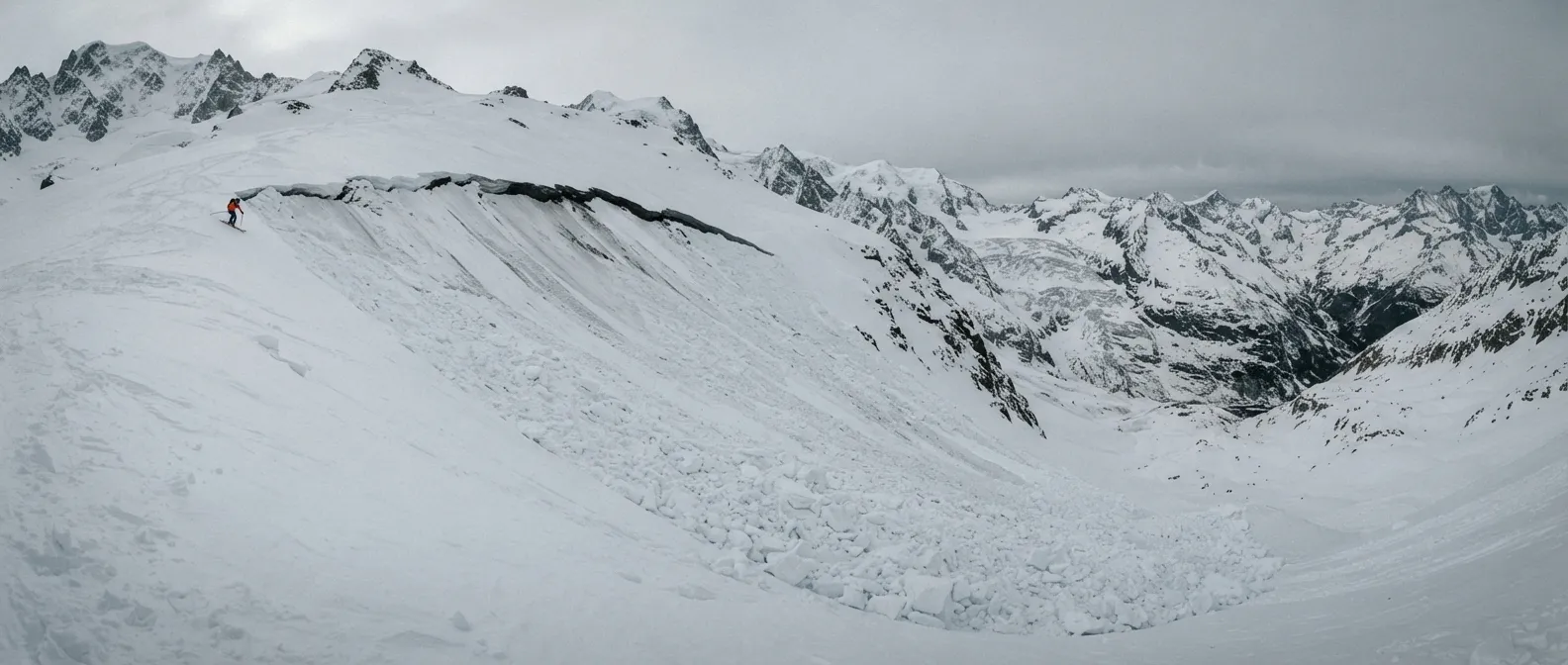
A slab breaks loose under your skis, you have fifteen minutes before the stats turn against you: what you need to know instinctively, the night before heading out.
Lightning: When the Sky Targets You
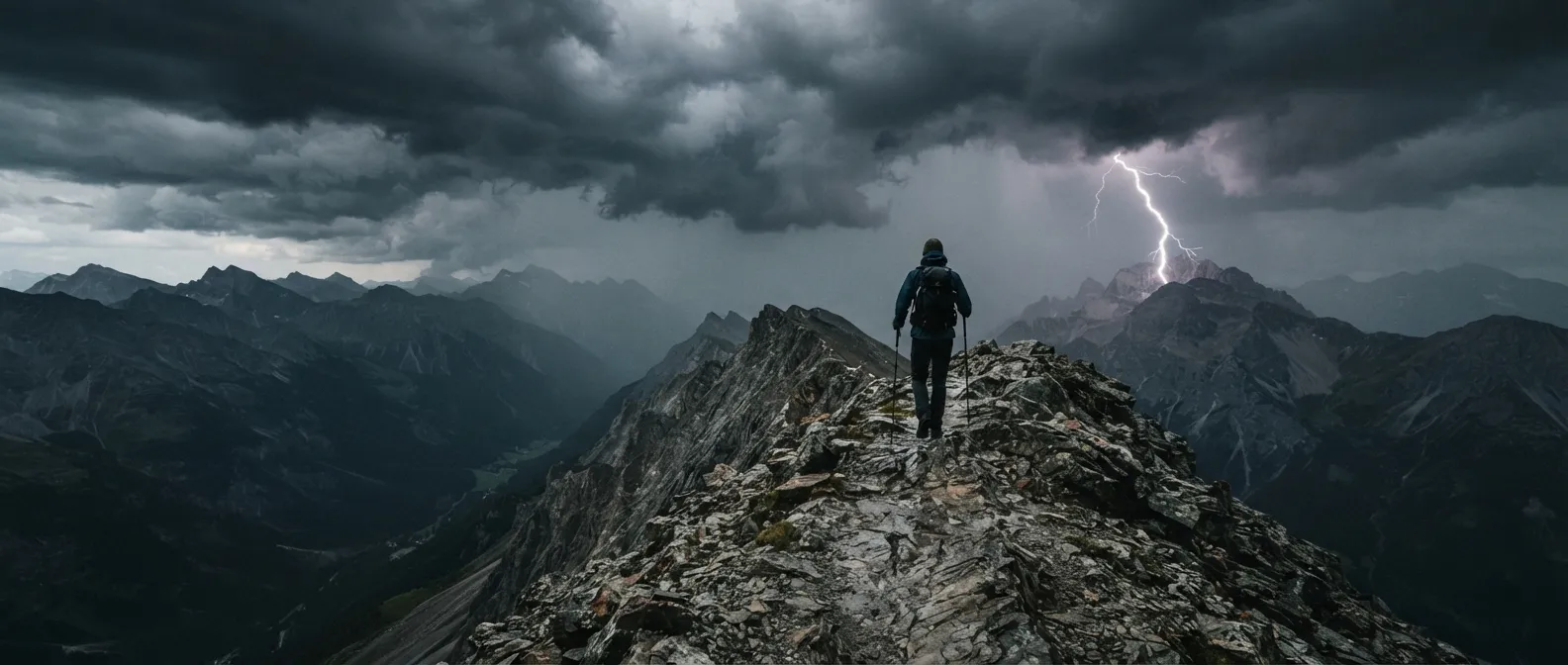
In 3 seconds, a lightning bolt heats the air to 30,000 kelvins and kills 10% of those it strikes: here is what is at stake before you count to thirty.
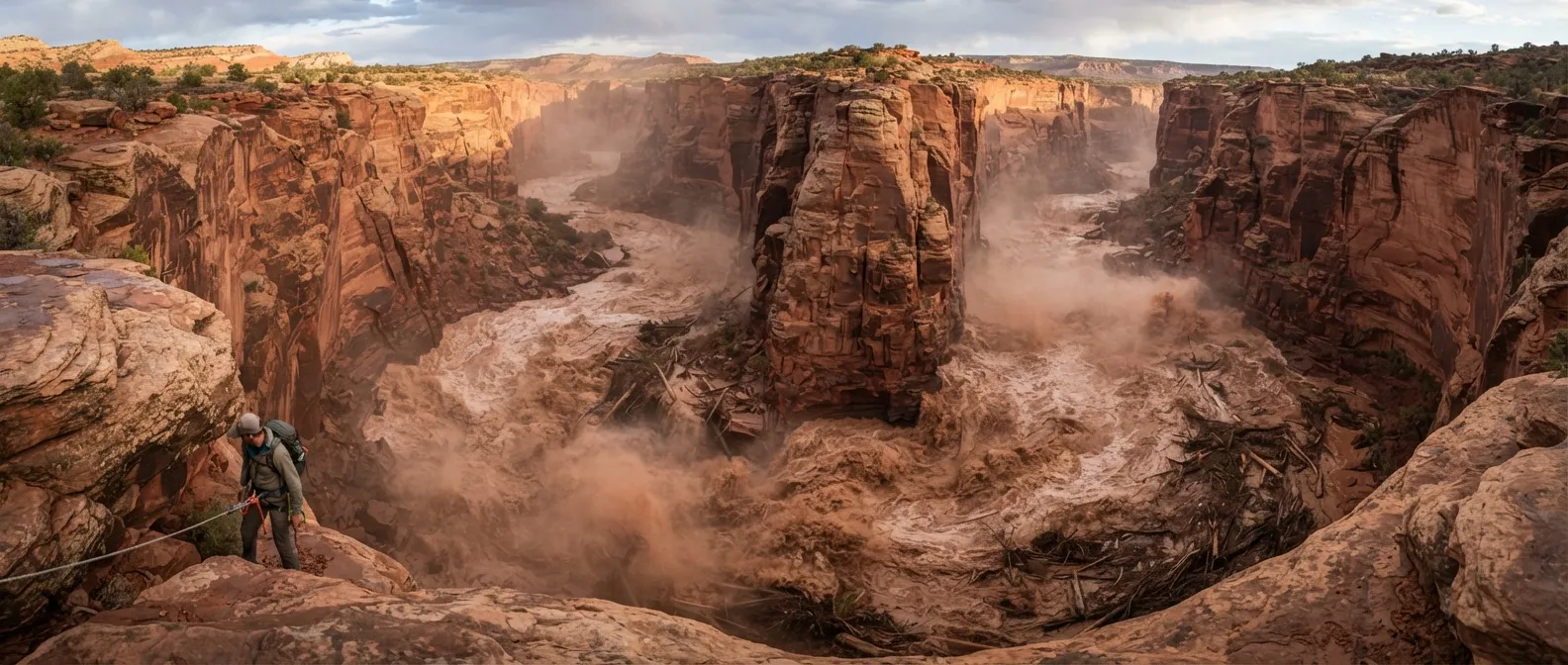
Flash Flood: Water Arriving Faster Than You
It isn't raining where you are, the creek has been dry all morning, yet you have less time than you think before a wall of water rushes down the valley.