Mindset: the key to everything
Before fire, before water, before shelter: what happens in your head during the first ten minutes.
It’s 5:40 PM, late October. You left the trail “just to check out” the waterfall forty minutes ago. You turn around: every tree looks identical, the light is fading, your phone reads “No Service”. Your heart races, your legs want to run. This is the exact moment everything is decided — not in your pack, but in your head.
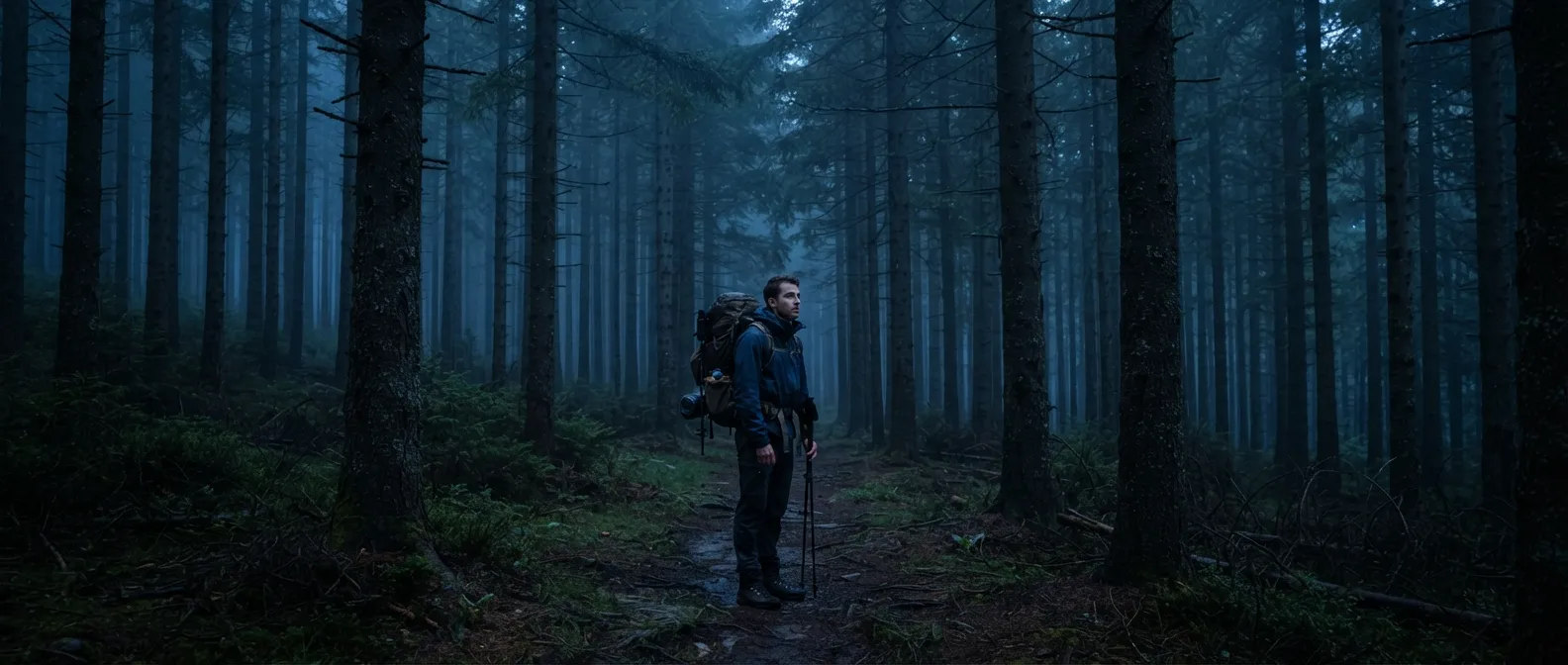
The Rule of Threes: a hierarchy, not a stopwatch
The US Army manual, FM 21-76, opens its chapter on psychology with a line that should be engraved on every knife: “Having survival skills is important; having the will to survive is essential.” People with zero training have made it out alive, while trained individuals have died with their skills intact. The difference boils down to what your brain does in those first few minutes.
And the very first thing it must do is prioritize. The Rule of Threes is a mnemonic device that originated among military and outdoor instructors to keep you from spending your energy in the wrong order:
- 3 minutes without air (or with massive bleeding);
- 3 hours without thermal protection in harsh conditions;
- 3 days without water;
- 3 weeks without food.
Each step assumes the previous one is handled. What it’s really telling you: building a shelter comes before hunting for food, and stopping a bleed comes before everything else.
You’ll encounter extended versions: “3 seconds to decide,” “3 minutes in ice water,” “3 months without hope or companionship.” They are explicitly flagged as non-scientific — but the “3 seconds” has real value: it reminds you that the true battle takes place right at the start, before cold or thirst even enter the picture.
Why you freeze, and how to snap out of it
Amanda Ripley spent years interviewing survivors of terror attacks, shipwrecks, and fires for The Unthinkable. From this, she derived a three-phase “survival arc” that everyone experiences:
- Denial. The brain initially refuses to admit that this is really happening. On September 11, 2001, workers shut down their computers, tidied their desks, and chatted with colleagues before heading for the stairs. First responders call this “negative panic”: you don’t scream, you don’t move.
- Deliberation. You know it’s serious, but you don’t know what to do. Tunnel vision, muffled hearing, clumsy hands: stress narrows everything you perceive.
- The decisive moment. You act — or you don’t.
British psychologist John Leach, who studies human behavior in extreme environments, proposed the 10-80-10 distribution: roughly 10% of people remain calm and rational, 10% suffer full-blown panic, and 80% freeze, their capacity for clear thought “significantly impaired.” On the Estonia ferry in 1994, out of 989 people on board, only 137 survived: many simply didn’t stand up. It’s not cowardice; it’s a neurological reflex: when working memory hits overload, the brain stops retrieving what it knows.
The good news, according to Leach: this breakdown isn’t set in stone. You move from the 80% to the 10% through mental preparation — knowing in advance what you will do.
In the woods, this frozen state is called “woods shock.” Professor Kenneth Hill, who analyzed over 800 case files of lost persons in Nova Scotia, describes people passing right by searchers as if in a trance, failing to respond to shouts. Above all, they feel an overwhelming urge: to keep moving. “When you’re scared, you just want to keep walking.”
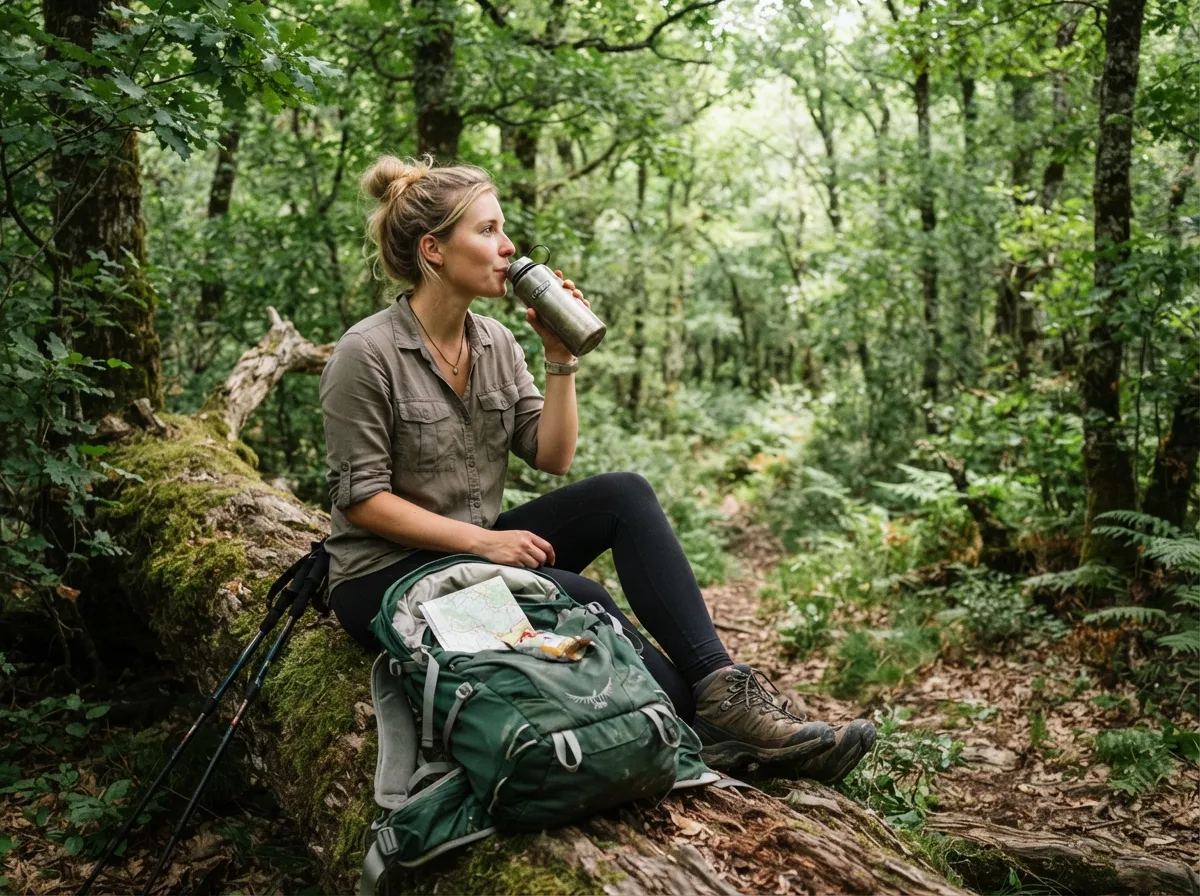
STOP: the routine that breaks the urge
The STOP method is taught across North American hunting safety courses and by bushcraft instructors like Paul Kirtley. It’s simple, and that’s its superpower: under extreme stress, you only have access to simple thoughts.
- S — Stop. Stop physically. Sit down. Take a sip of water, eat a bite. Treat any urgent injury. The simple act of sitting breaks the urge to bolt.
- T — Think. How did you end up here? What is the last point you are 100% sure of? What are your actual priorities for the next three hours: warmth, signaling, water?
- O — Observe. Really look around: hazards, shelter materials, firewood, water, the time and remaining daylight, the condition of your partners. Inventory your pack, item by item.
- P — Plan. Formulate a simple plan and say it out loud, even if you’re alone. Then execute it without second-guessing yourself every five minutes.
Regaining control of your body
You can’t just command yourself to stop feeling afraid. You can command yourself to breathe, and your physiology will follow.
- Inhale through your nose for a count of 4.
- Hold your lungs full for 4 seconds.
- Exhale slowly for 4 seconds.
- Hold your lungs empty for 4 seconds. Repeat four times.
This 4-4-4-4 pattern was named “box breathing” by Mark Divine, a former Navy SEAL commander who integrated it into SEAL training; Lieutenant Colonel Dave Grossman has taught it as “combat breathing” to police and military personnel since the 1990s. The underlying mechanism: slow exhales and holds activate the parasympathetic nervous system, putting the brakes on your fight-or-flight response. It isn’t magic — it won’t make the threat disappear — but it restores the use of your hands and your memory.
Priorities: the order in which to spend your energy
Not every school of thought ranks items identically, but they all share the same foundation. Boy Scouts of America teach seven priorities in this order: positive mental attitude, first aid, shelter, fire, signaling, water, food. Notice that food is last and mindset comes first — that’s not poetry, that’s the outcome of analyzing decades of accident reports.
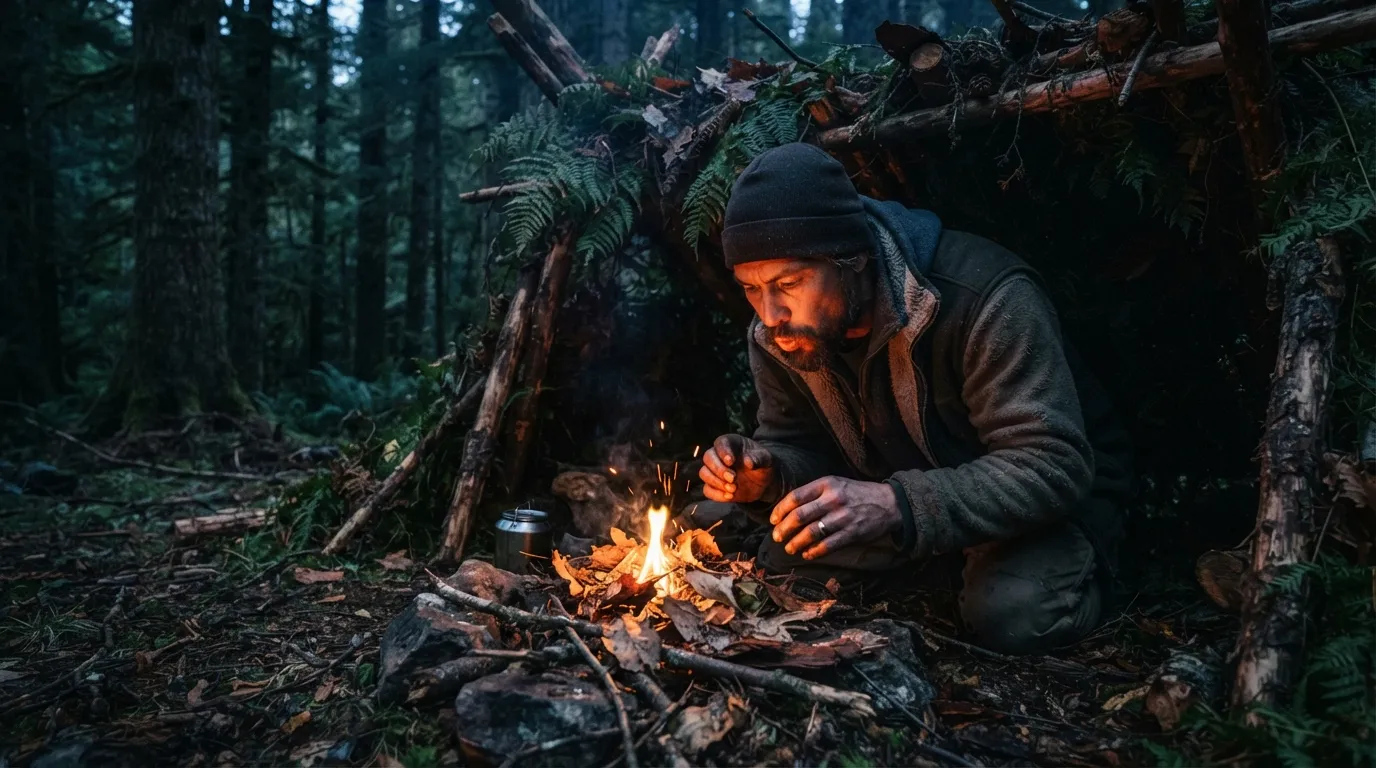
John “Lofty” Wiseman, a twenty-six-year SAS survival instructor, boils it down to an acronym: PLAN — Protection (from elements), Location (making yourself visible), Acquisition (water, then food), Navigation (knowing where you are and where you’re going). Ray Mears adds a rule that anyone who has ever camped in the rain will recognize: “The state of your fire is directly proportional to your morale.” A successful fire elevates anyone’s spirits; a failed fire at dusk causes your morale to drop “like a stone.” If you aren’t sure you can light it in a downpour, wait for a break in the weather rather than risking failure.
Impaired judgment: cold, thirst, fatigue
Your greatest vulnerability isn’t that you’ll get cold or thirsty — it’s that you won’t realize it, because the very organ responsible for noticing is the first one compromised.
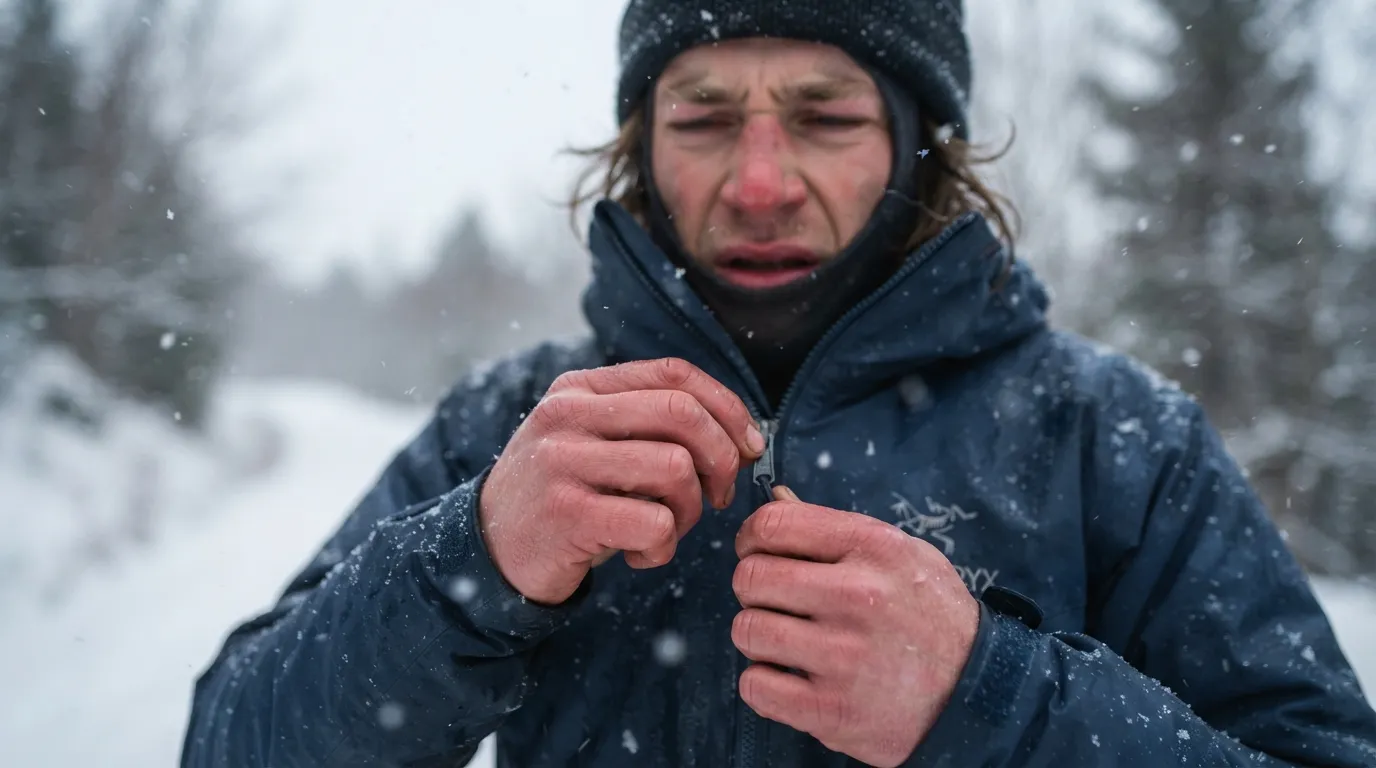
Cold. Instructors at Princeton Outdoor Action teach how to spot the “umbles”: stumbles, mumbles, fumbles, grumbles — the companion who trips, slurs words, struggles with zippers, and complains needlessly. Mild hypothermia is setting in, and judgment is already slipping. Their test: if someone can’t walk straight along a ten-meter line, they are hypothermic. The core issue is that nobody diagnoses themselves.
Thirst. A meta-analysis of 33 studies (413 participants) shows that losing just 2% of your body mass in water — which can happen in a half-day hike without drinking — significantly degrades attention, executive function, and motor coordination. In practical terms: you start making terrible decisions long before feeling “properly” thirsty, becoming irritable and pessimistic, which fuels panic.
Fatigue. Ian McCammon analyzed 715 avalanche accidents in North America (1972-2003) and identified six “heuristic traps” — familiarity, acceptance, commitment, expert halo, social proof, scarcity. Exhaustion amplifies all of them: when you are cold, dehydrated, and worn out, you systematically underestimate how compromised your judgment really is.
Stay or move
Everyone’s gut reaction is to keep walking. Out of 800 case files studied by Ken Hill, only two people consciously chose to stay put and await rescue: an 11-year-old boy who had taken a safety course, and an elderly woman. Everyone else walked — and most of those who were ultimately found stationary were exhausted, asleep, or unconscious, not acting strategically.
Why? Gonzales calls this “bending the map”: when the terrain no longer matches our mental map, we twist reality to fit our expectations rather than admitting we are lost. Ken Killip, an experienced firefighter, got lost in Rocky Mountain National Park convinced he was hiking up the correct mountain; he kept ascending instead of turning back, until a fall forced him to stop — and that’s when, sitting motionless beside a fire, a helicopter spotted him.
Robert Koester, whose ISRID database tracks over 183,000 search-and-rescue cases worldwide, and Skip Stoffel, who trains law enforcement, agree: “A moving target is much harder to find. Stay put, pick a spot, make yourself visible.”
| Stay put | Try to walk out | |
|---|---|---|
| Someone knows your location and return time | ✅ searchers are coming | ❌ you move outside the search grid |
| Night falling, injured, exhausted | ✅ shelter, fire, signaling | ❌ risk of falls and hypothermia |
| You are near a vehicle or downed aircraft | ✅ easily visible from above, shelter | ❌ almost always a mistake to leave |
| No one expects you, no water or shelter available | ❌ you will grow weaker | ✅ move in the morning, rested, on a clear bearing |
| You are certain of a landmark and can backtrack | ➖ | ✅ backtracking is the single most effective move (Hill) |
Lost children survive better than adults
This is one of the most surprising findings in search and rescue research. According to Koester, lost children aged 1 to 3 have a 95% chance of being found alive within 24 hours, and still an 83% chance beyond that; children aged 4 to 6 drop from 98% down to… 38% after 24 hours. Toddlers simply curl up in a hollow or under a bush and stop moving — unintentionally doing exactly what survival manuals advise. Kids aged 4 to 6 begin developing mental maps, try to “un-lose” themselves, and make things worse. Gonzales adds that 7 to 12-year-olds fare worst of all: old enough to navigate, too young to regulate panic. Adults, meanwhile, bend the map.
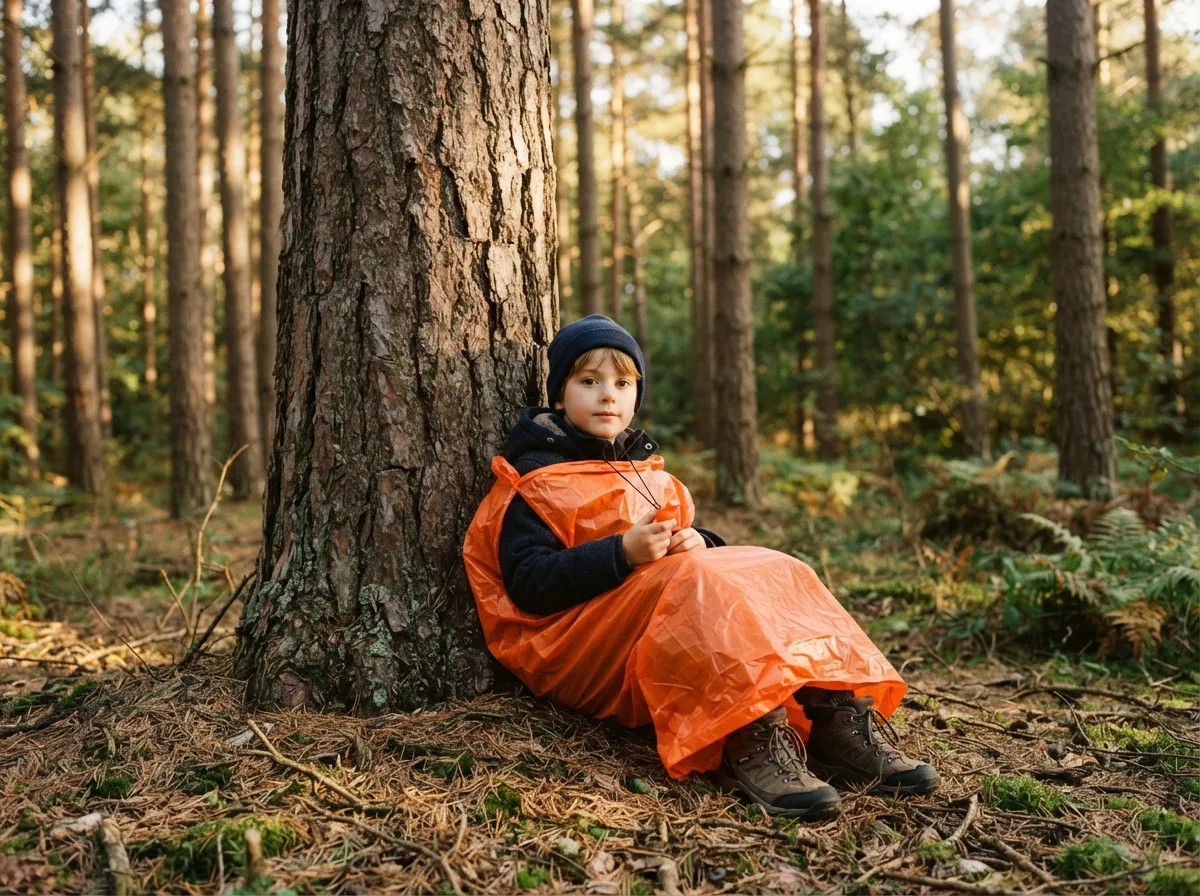
The Hug-a-Tree and Survive program, created in San Diego following the tragic loss of nine-year-old Jimmy Beveridge in the mountains, teaches 5-to-12-year-olds simple rules that apply to anyone:
- hug a tree — talk to it even; it grounds you and stops you from running;
- carry a heavy-duty trash bag (cut a hole for your face: instant rain and wind shelter) and a whistle, which carries much farther than your voice with less effort;
- make yourself big: wear bright colors, find a clearing, lie down if a helicopter passes overhead;
- if you hear strange noises at night, shout or blow your whistle — wild animals run away, rescuers answer back;
- above all: no one will be angry with you. Hill documented cases of children hiding from searchers out of shame for getting lost, or because at that point “any unfamiliar stimulus becomes a source of terror.” Adults have been found doing the exact same thing.
Long-term survival: the will to live
Past the first few hours, the core threat evolves. It’s no longer acute panic; it’s slow erosion. FM 21-76 lists the emotional sequence that follows — fear, anxiety, anger, frustration, depression, loneliness, boredom, guilt — warning that a survivor who lets these take over “suffers mental defeat long before their body gives out.” Leach even identified a name for the extreme outcome observed in POW camps and shipwrecks: give-up-itis, a progressive decline — withdrawal, apathy, loss of executive function, immobility — culminating in death without an underlying physical cause. The counter-agent is always the same: a task, a goal, a purpose.
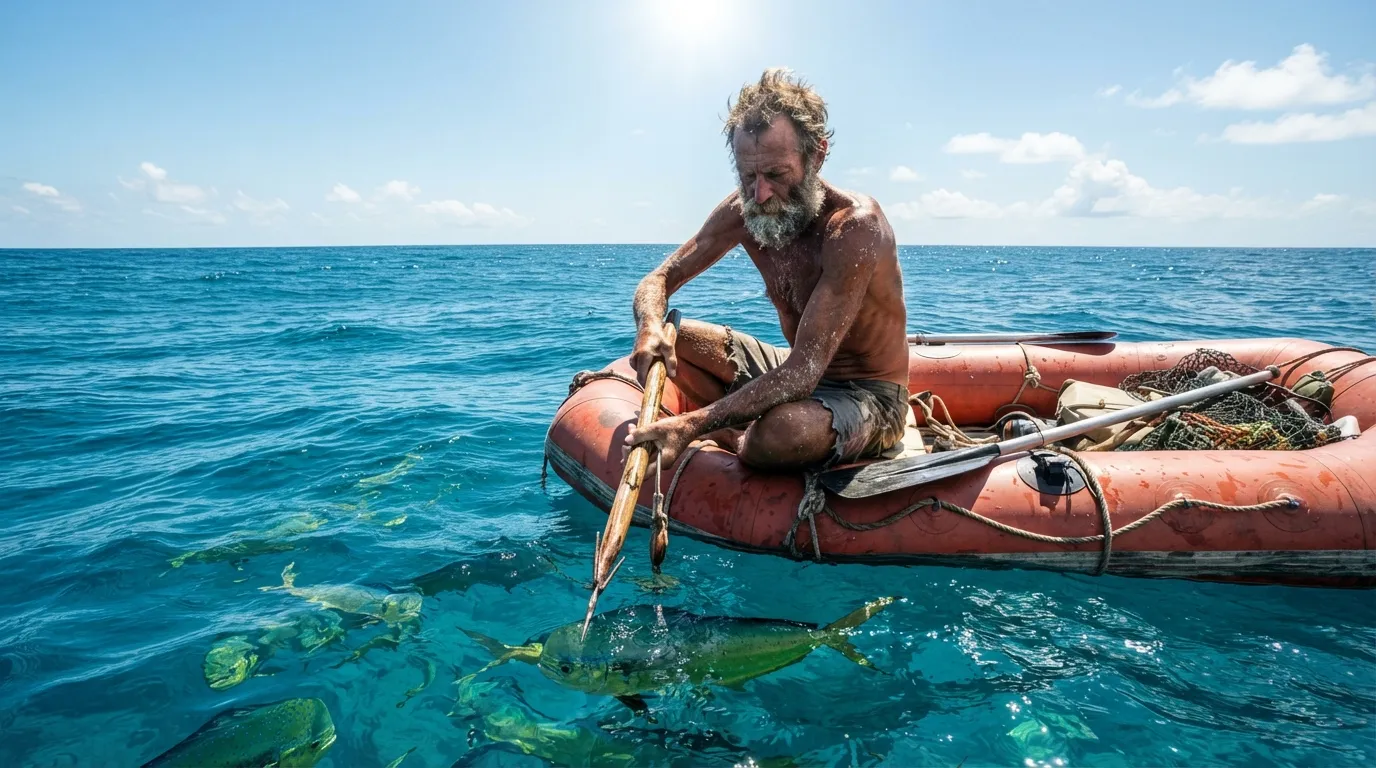
Steven Callahan spent 76 days alone in a 6-foot life raft after his sailboat sank in February 1982. Three solar stills yielded barely a pint of water a day; he speared mahi-mahi, lost a third of his body weight, and watched cargo ships pass on the horizon without spotting him. What kept him alive, according to his accounts and Gonzales’s analysis: a strict daily routine (exercise, navigation, repairs, fishing, storing supplies), keeping a logbook, and a deliberate psychological split — an inner “captain” giving firm orders to a terrified “crew” tempted to drink all the water. He named his raft, mapped out “rooms” inside it, and allowed himself controlled mental breaks into childhood memories. He was ultimately rescued by fishermen off Marie-Galante who noticed birds circling above his raft.
Aron Ralston survived five and a half days — with just 12 ounces of water, his arm pinned under an 800-pound boulder, and nobody aware of his location. He rationed, drank his own urine, recorded video goodbyes, and carved his name and estimated death date into the sandstone. Only after reaching complete acceptance on the sixth night did he experience a vision of a young boy he would one day hold with one arm — followed the next morning by the technical realization that he could break his arm bones by leveraging his body. He then rappelled down a 65-foot cliff and hiked six miles.
What survivors share, based on Gonzales’s twelve rules: they face reality squarely without drowning in it, channel fear into constructive action, break big tasks into steps, celebrate small wins, count their assets, play games (singing, counting, reciting, mental math), find beauty in their surroundings, maintain faith they will survive while accepting they might die, and never give up.
Humor plays a central role here, and it’s far from superficial. On day eleven in the Andes in 1972, survivors of Flight 571 heard over a transistor radio that search efforts were called off. Total despair set in — until Gustavo Nicolich reframed the news: “Hey boys, there’s good news! It means they’re going to let us get out of here on our own.” Nando Parrado, before embarking on a ten-day trek toward Chile: “I’d rather walk to meet my death than wait for it to come find me.” Beck Weathers, left for dead twice on Mount Everest in 1996, blind and severely frostbitten, forced himself up with one rule: “As long as my legs work, I walk toward that camp; if I fall, I get back up.” What kept him moving was the image of his family.
The Good Samaritan syndrome
Gonzales states it plainly: helping someone else is “the single best way to ensure your own survival,” because it lifts you out of your own terror — you become a rescuer rather than a victim. Ripley observed this during the 1977 Beverly Hills Supper Club fire: roughly 60% of employees took action to assist others, compared to just 17% of patrons. Having a defined role forces you to act.
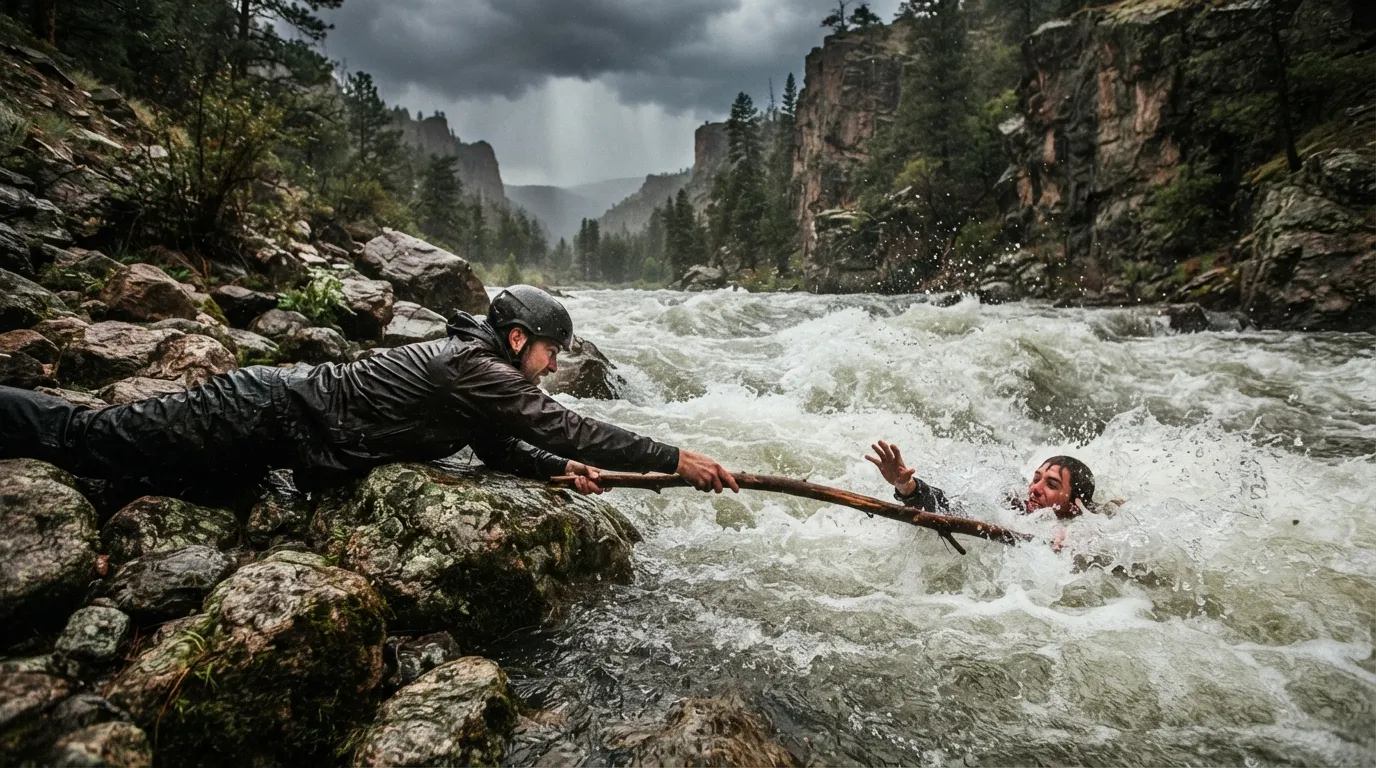
Yet the urge to save can also kill. In Turkey, a study documented 88 drowning incidents in which 114 bystander rescuers drowned attempting a save; in Australia, 103 bystander rescuers died between 1992 and 2010; in New Zealand, 81 between 1980 and 2012 — often a parent, and frequently when the original victim managed to survive. Rescuers refer to this as the aquatic victim-instead-of-rescuer dynamic: a drowning person reflexively climbs onto anything that floats, including you. The fundamental lifeguard rule: reach or throw, don’t go — extend a branch, throw a rope or a cooler, but keep your body out of the water.
Frequently asked questions
Que faire quand on réalise qu’on est perdu ?
Apply the STOP method: physically stop and sit down, breaking the panic urge to keep walking. Think about how you got there, observe your surroundings (materials, remaining light, your team’s state), then decide on a simple plan, speak it out loud, and stick to it without second-guessing every five minutes.
Que dit vraiment la règle des 3 minutes, 3 heures, 3 jours, 3 semaines ?
It’s a mnemonic framework for prioritizing emergencies (air, shelter, water, food), not a precise physiological rule: an adult holds their breath for 30 to 90 seconds, and in extreme heat, heatstroke can kill in hours. Use it to decide what to fix first, never to rationalize that you “have time.”
Pourquoi on se sent paralysé face au danger, au lieu de paniquer ?
According to psychologist John Leach, about 80% of people freeze during a crisis, 10% experience active panic, and only 10% stay calm and rational. Freezing is a neurological overload reaction; mental rehearsal helps you shift into the 10% who take action.
Vaut-il mieux rester sur place ou essayer de sortir seul quand on est perdu ?
Staying put is almost always best if someone knows your route: out of 800 lost person cases studied by Ken Hill, only two individuals deliberately stayed put, yet a stationary target is found far faster than a moving one. Only move if you are certain of a landmark and can backtrack safely.
Comment calmer rapidement sa panique en pleine nature ?
Box breathing works quickly: inhale for 4 seconds, hold for 4 seconds, exhale for 4 seconds, hold empty for 4 seconds; repeat four times. Stating your fear out loud (“I’m scared and lost”) also measurably lowers amygdala activity, according to a 2007 brain imaging study.
Pourquoi les jeunes enfants perdus survivent-ils souvent mieux que les adultes ?
Lost toddlers aged 1 to 3 have a 95% survival rate within 24 hours because they instinctively crawl into a shelter spot and stay put — exactly what survival manuals teach. Adults tend to “bend the map” to fit their expectations, walking until total exhaustion.
Key takeaways
- The Rule of Threes ranks your priorities, it doesn’t buy you time: you never have “three days” to find water.
- Roughly 80% of people freeze. The fix is straightforward: STOP, sit down, box breathe, name your fear, speak out loud.
- Mindset, first aid, shelter, fire, signaling, water, food — and your fire’s condition directly mirrors your morale.
- Cold, thirst, and exhaustion compromise your judgment long before you notice: drink, warm up, sleep, then decide.
- Out of 800 lost people, only two chose to stay put. Rescuers look for a stationary, visible target — be that target unless you have a proven path back.
Going further
- Laurence Gonzales, Deep Survival: Who Lives, Who Dies, and Why (Norton, 2003) — the classic deep dive into survivor psychology.
- Amanda Ripley, The Unthinkable: Who Survives When Disaster Strikes — and Why (Crown, 2008) — analyzing human responses from the World Trade Center to shipwrecks.
- Steven Callahan, Adrift: Seventy-six Days Lost at Sea (1986) — an incredible raft log showcasing internal leadership under pressure.
- Kenneth Hill, The Psychology of Lost (Saint Mary’s University, Halifax) — the foundational text on lost person behavior, available free online.
Sources for this module (20)
- FM 21-76 US Army Survival Manual, ch. 2 « Psychology of Survival »
- Wikipedia — Rule of threes (survival), origines et limites
- Amanda Ripley, The Unthinkable (2008) — extrait dans Time, « A Survival Guide to Catastrophe »
- Laurence Gonzales, Deep Survival — les 12 règles
- Kenneth Hill, The Psychology of Lost (Saint Mary's University)
- Robert Koester, Lost Person Behavior — statistiques ISRID (UVA Today)
- Hug-A-Tree and Survive — Alpine Rescue Team
- Paul Kirtley — How to use STOP in a survival situation
- Police Magazine — Box Breathing (Grossman, Divine)
- Lieberman et al. 2007 — Affect labeling (Wikipedia)
- Princeton Outdoor Action — Hypothermia and Cold Weather Injuries (les « umbles »)
- Wikipedia — Hypothermia (paradoxical undressing, 20 à 50 % des décès)
- Hydration for Health — hydratation, humeur et cognition (méta-analyse de 33 études)
- McCammon — Heuristic traps in recreational avalanche accidents (ISSW 2002)
- Wikipedia — Steven Callahan
- Wikipedia — Juliane Koepcke
- Wikipedia — Aron Ralston
- Wikipedia — James Stockdale (le paradoxe de Stockdale)
- Wikipedia — Instinctive drowning response (décès de sauveteurs improvisés)
- Scouting Magazine — Should I stay or should I go?
Continue in "The fundamentals"
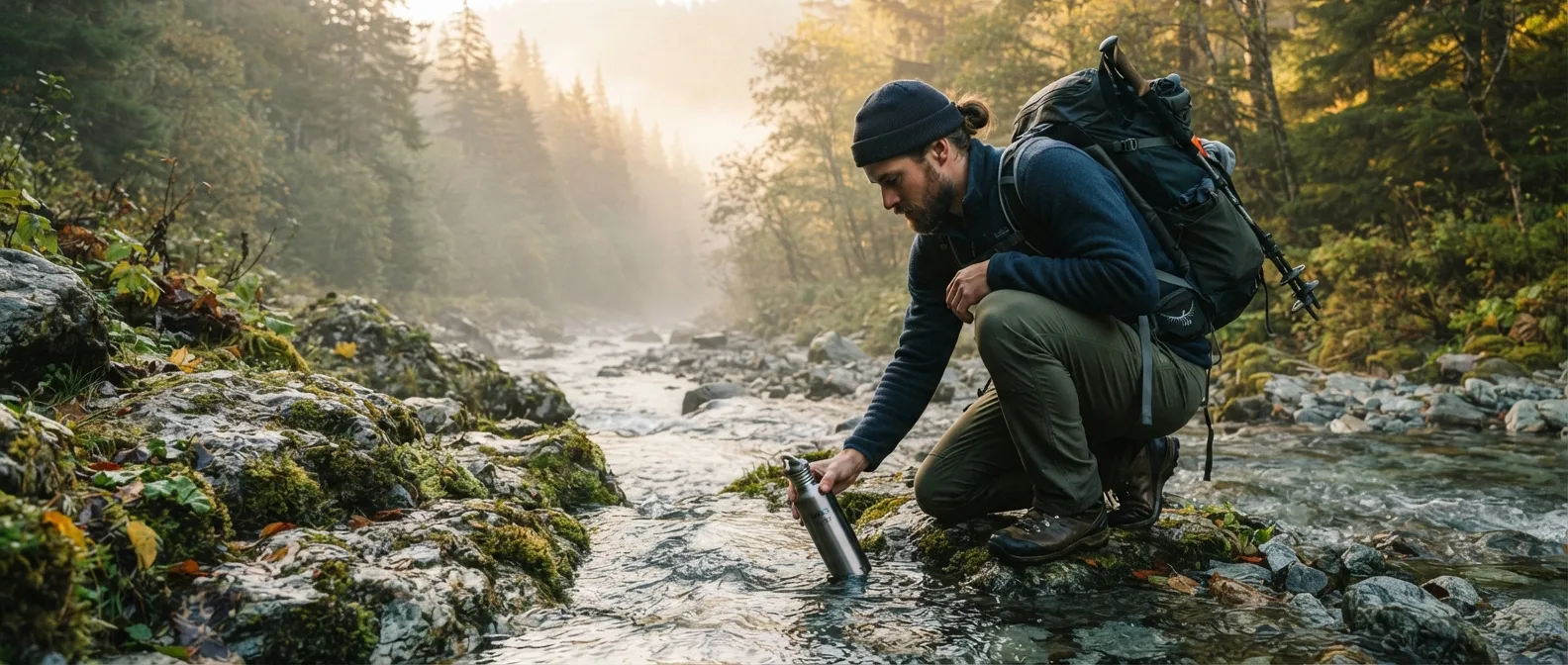
Water: Finding, collecting, and making it drinkable
Three days without water is the popular myth. The real question is where it's hiding and what's inside it.
Fire: light it anywhere, keep it always
In the rain, on the snow, without a lighter: the physics of fire, techniques that work, and those that only work in the movies.
Shelter: sleeping warm when everything is against you
Three hours. That's all the time you have left in cold rain if you don't get out of the wind and off the ground.