Knots and Cordage: The 10 That Actually Matter
3,857 knots listed in the reference book, and ten that are enough to pitch a shelter, scale a cliff, or save a life.
It’s 6 p.m., the tarp is flapping in the wind, and you’ve just messed up your third bowline of the evening: a loop that comes undone, or jams so badly you’ll have to cut the rope tomorrow morning. You don’t lack knots. You actually know too many: a bit of bowline, a bit of clove hitch, a vague Scout memory mixed with YouTube videos you watched once. The problem isn’t the number of knots you’ve run across. It’s that you haven’t truly mastered a single one.
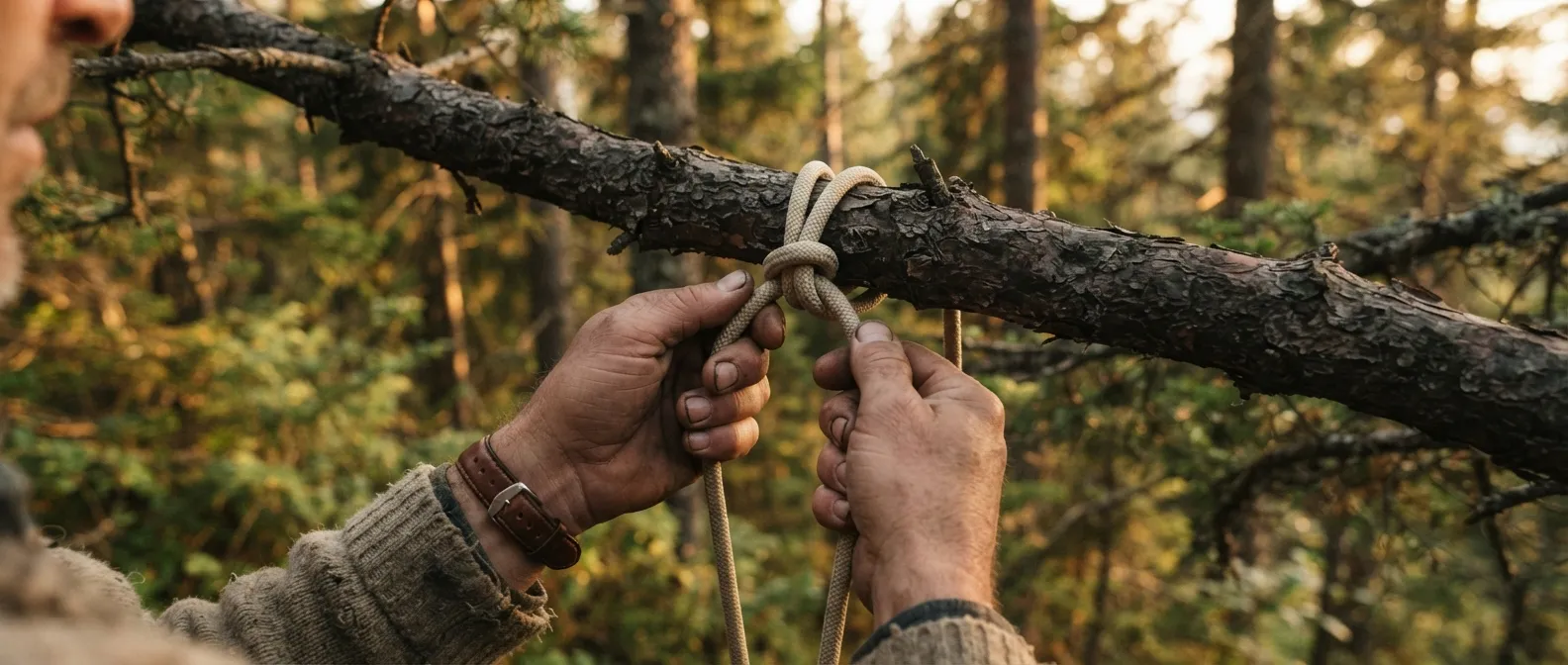
Ten knots, not two hundred
The reference book, The Ashley Book of Knots, published in 1944 by American sailor and painter Clifford Ashley after eleven years of work, lists 3,857 numbered knots across 638 pages and roughly 7,000 illustrations. Ashley suffered a stroke the year after publication and was never able to oversee a corrected edition; nonetheless, the book remains the bible of the field.
Nobody needs 3,857 knots. A common saying in sailing and mountain guide schools claims that six knots are enough for almost all real-world situations—it’s more of an instructor’s rule of thumb than an exact statistic, but the principle behind it is rock solid: the International Guild of Knot Tyers (IGKT) itself promotes a “Six Knot Challenge” centered around the bowline, the clove hitch, and the sheet bend. This module keeps ten, slightly broader, because bushcraft adds two needs that sailing doesn’t have: tensioning a tarp and ascending a fixed line.
What the remaining 3,847 knots have in common is that they are ultra-specialized variants or applications (the classical guitar loop, the surgical suture technique of the constrictor knot, the wool spinner’s knot). A camp knot-tyer doesn’t need them. You need to know, for a handful of knots, why they hold, when they fail, and how to untie them with freezing hands.
Why a knot always weakens the rope
A new rope lists a breaking load. That load capacity never survives a knot. According to tests conducted by climbing and rescue equipment manufacturer Edelrid on textile materials, a knot typically causes a 20 to 45% loss in strength, and up to 50–75% for certain poorly chosen stopper knots on modern materials like Dyneema.
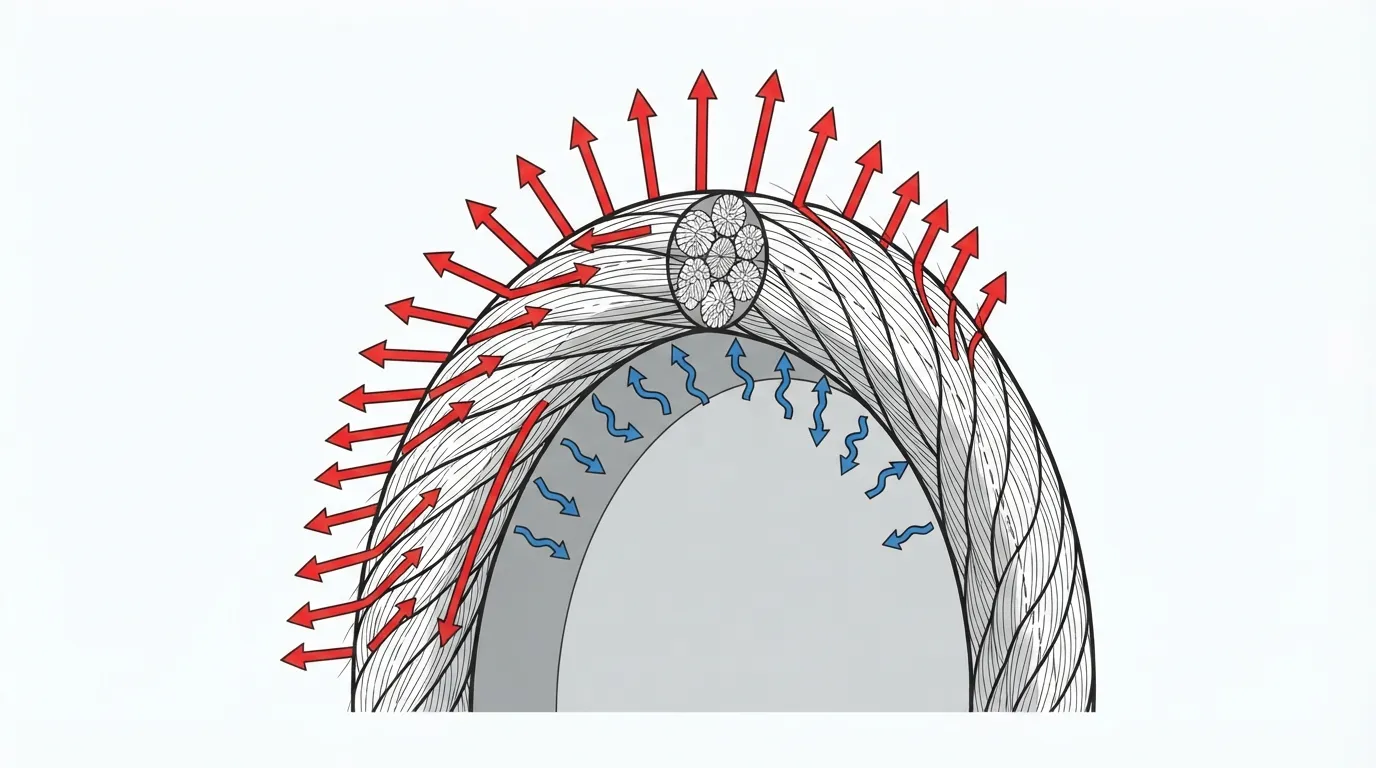
The mechanism is always the same: inside the tight part of the knot, the rope bends around a small bend radius, and the outer fibers of the curve are stretched much more than the inner fibers. The load, which is supposed to spread equally across all strands, concentrates on the most stretched fibers—which fail first. The smaller the radius and the more complex the knot (multiple tight bends layered together), the greater the loss. That’s why a splice (where the rope’s strands are braided back into each other rather than bent) retains nearly 100% of its strength, whereas a simple knot loses a quarter of it.
The rope you pack, the rope you make
Paracord and its 7 hidden strands
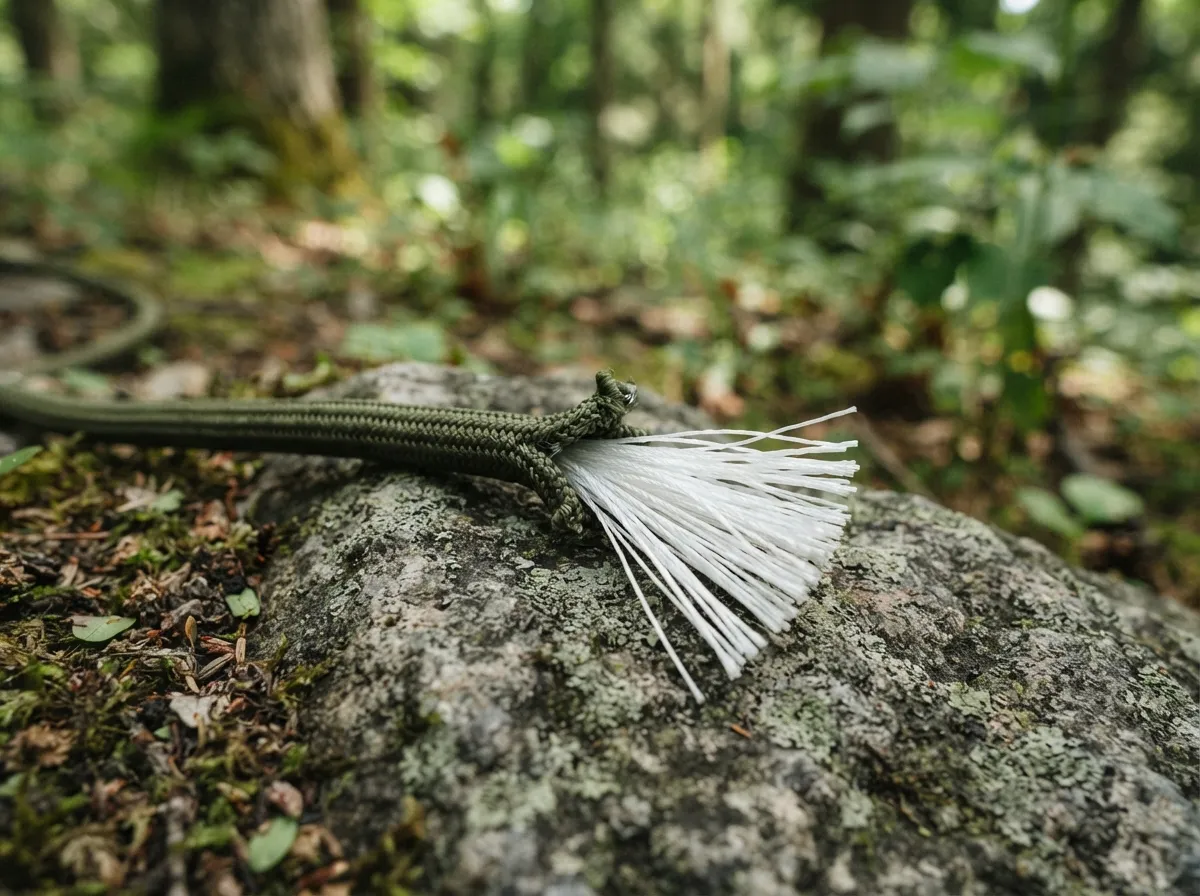
Type III paracord, commonly known as “550” (550 pounds minimum breaking strength, or about 250 kg), was created for military parachute suspension lines and sold off as surplus after World War II. Its braided sheath of about 32 strands encases a core of 7 to 9 twisted inner yarns. This detail changes everything in actual use: the sheath alone works as a shoelace or light lash, but each inner strand, once separated, becomes sewing thread, fishing line, or fire-starting tinder. Astronauts included: paracord was used during Space Shuttle mission STS-82 for an impromptu repair on the Hubble Space Telescope.
Making your own rope: two-strand reverse wrapping
When paracord runs out, nature provides fibers almost everywhere: the inner bark (the “bast”) of linden (lime/basswood), the retted stems of stinging nettle, the de-thorned bark of bramble, and dried animal sinew for an even stronger cordage.
For linden, harvest the bark from a dead branch or fallen tree, separate it from the sapwood, and then ret it—soak it in standing water for several weeks—until the fibers easily separate from the pulp. The principle is the same for nettle: cut and retted stems release long, tough fibers used since prehistoric times—Bronze Age archaeological digs in Great Britain even show a preference for linden fiber over flax for clothing. The Ainu of Japan wove their traditional garment, the attus, from linden bast, and the Manchus of Manchuria made ropes, baskets, raincoats, large fishing nets, and slow matches for gunpowder from it.
Once the fibers are gathered, dry, and pliable, the universal technique is two-strand reverse wrapping:
- Gather a thin bundle of fibers, about the thickness of a pencil, and fold it in half to create a small loop in the middle: you now have two strands.
- Twist the strand closest to you forward, clockwise, until a tight twist forms.
- Cross this twisted strand over the other one: it becomes the back strand, and the other becomes the front strand.
- Repeat the process on the new front strand: twist, then cross over. Each cycle advances the rope by a few centimeters.
- Splice in new fibers by slipping them into a thinning strand before it breaks—never into both strands at the same time, to avoid creating a clear weak point.
The result: a two-strand cord that twists tighter onto itself under tension instead of unraveling—this same principle of counter-rotation is what you find, industrialized, in every commercial rope.
The ten knots that actually matter
1. The Bowline
The bowline forms a fixed loop at the end of a rope that won’t slip or jam under load, yet remains easy to untie even after holding a heavy weight—provided it hasn’t remained under continuous tension. It was found on a remnant of Pharaoh Khufu’s solar ship (26th century BC), and the English Navy formally documented it as early as 1627. Even today, the FAA requires it for tying down aircraft on the ground, and British firefighters must know how to tie it.
What it’s used for: attaching a rope to a fixed point (ring, tree, harness), tying into a rope for climbing, making a emergency rescue loop.
When it’s dangerous: it can work itself loose when unloaded, and can “capsize” under a load that frequently changes direction (cyclic loading)—never use a standalone bowline to tie in for climbing; always back it up with a stopper knot (a simple knot tied with the working end against the main line).
How to remember it: the classic mnemonic told in sailing schools goes like this: “the rabbit comes out of the hole, goes around the tree, and goes back down the hole.” The small loop you form first is the hole; the working end is the rabbit.
How to untie it: once unloaded, simply “break the back” of the knot (push the loop back toward the main body) to pop it open in one motion, even after a heavy load.
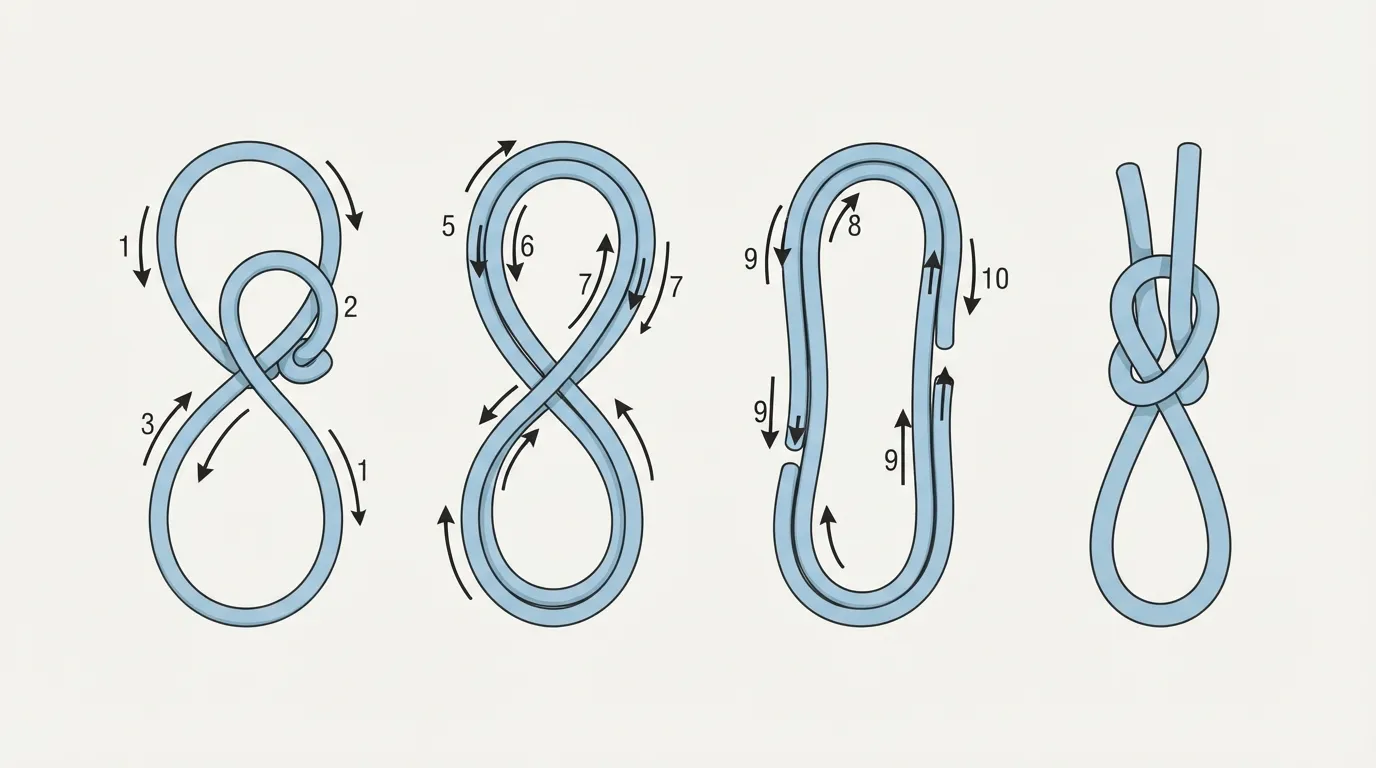
2. The Figure-Eight Loop
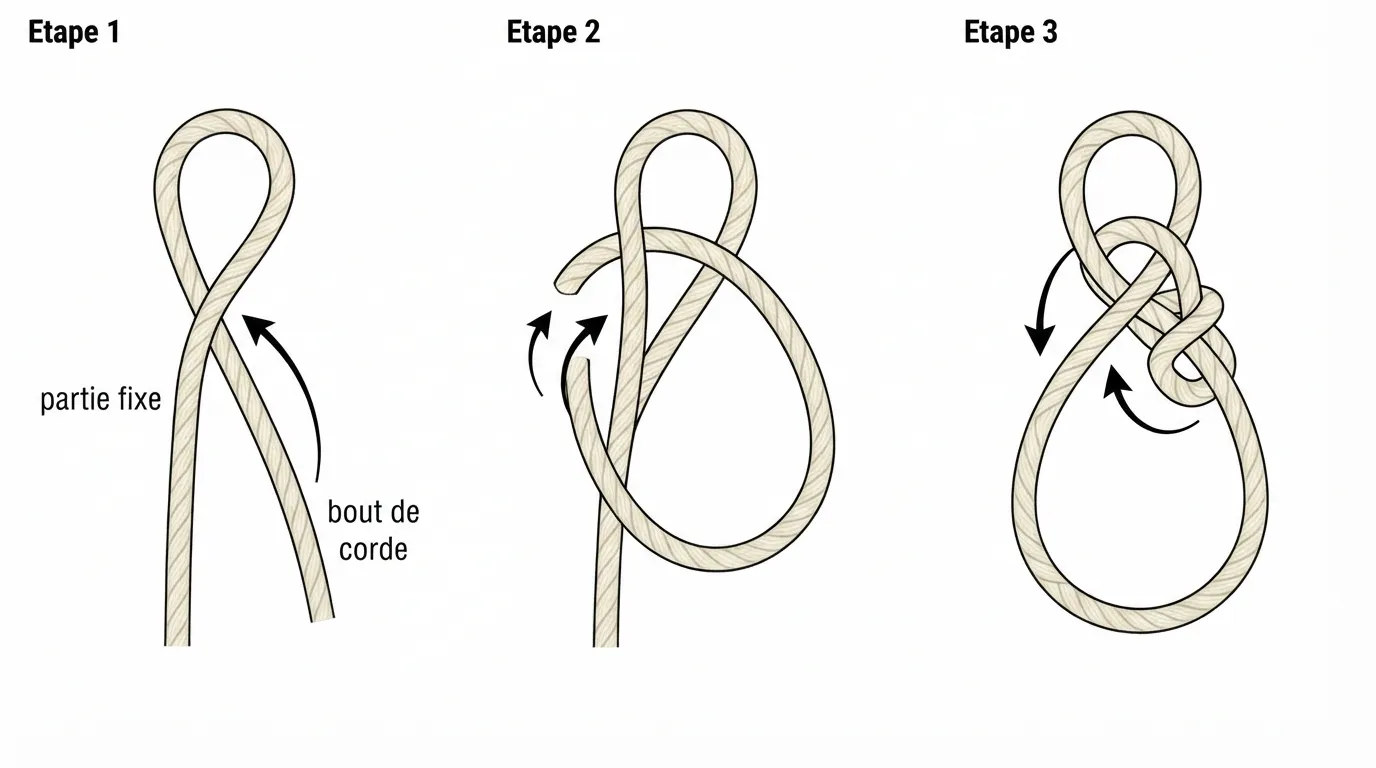
Less adjustable than the bowline but more predictable under load, the figure-eight also forms a loop, especially in climbing—it is the standard tie-in knot for most climbers, precisely because it doesn’t slip and can be verified at a glance.
What it’s used for: tying in on a harness, stopper knot at the end of a rope to prevent it from running through a belay device, loop creation in tension systems (base for a trucker’s hitch).
When it’s dangerous: under repeated heavy loads, it becomes extremely difficult to untie—leave enough working end so you can wiggle it loose before it sets completely.
How to remember it: tie a simple figure-eight in the rope, then trace the path backward with the working end (a rethreaded figure-eight).
How to untie it: break the figure-eight shape by bending each loop against itself rather than pulling along the load axis.
3. The Double Fisherman’s Knot
The double fisherman’s knot joins two ropes or cords end-to-end and, when tied back on itself, forms a continuous loop (a “prussik loop”)—the foundation for any friction hitch or emergency sling in climbing, arboriculture, or rescue.
What it’s used for: joining two ropes of equal diameter for rappelling, closing a cord into a continuous loop.
When it’s dangerous: on slick modern materials like Dyneema, it can slip—use the triple fisherman’s version instead, which is rated to hold under higher loads.
How to remember it: each working end ties a double overhand knot around the standing line of the other cord, and then both knots are jammed together against each other.
How to untie it: that’s the knot’s main flaw—it jams tight, making it tough to untie after holding a heavy load; work it loose strand by strand, never by sheer force.
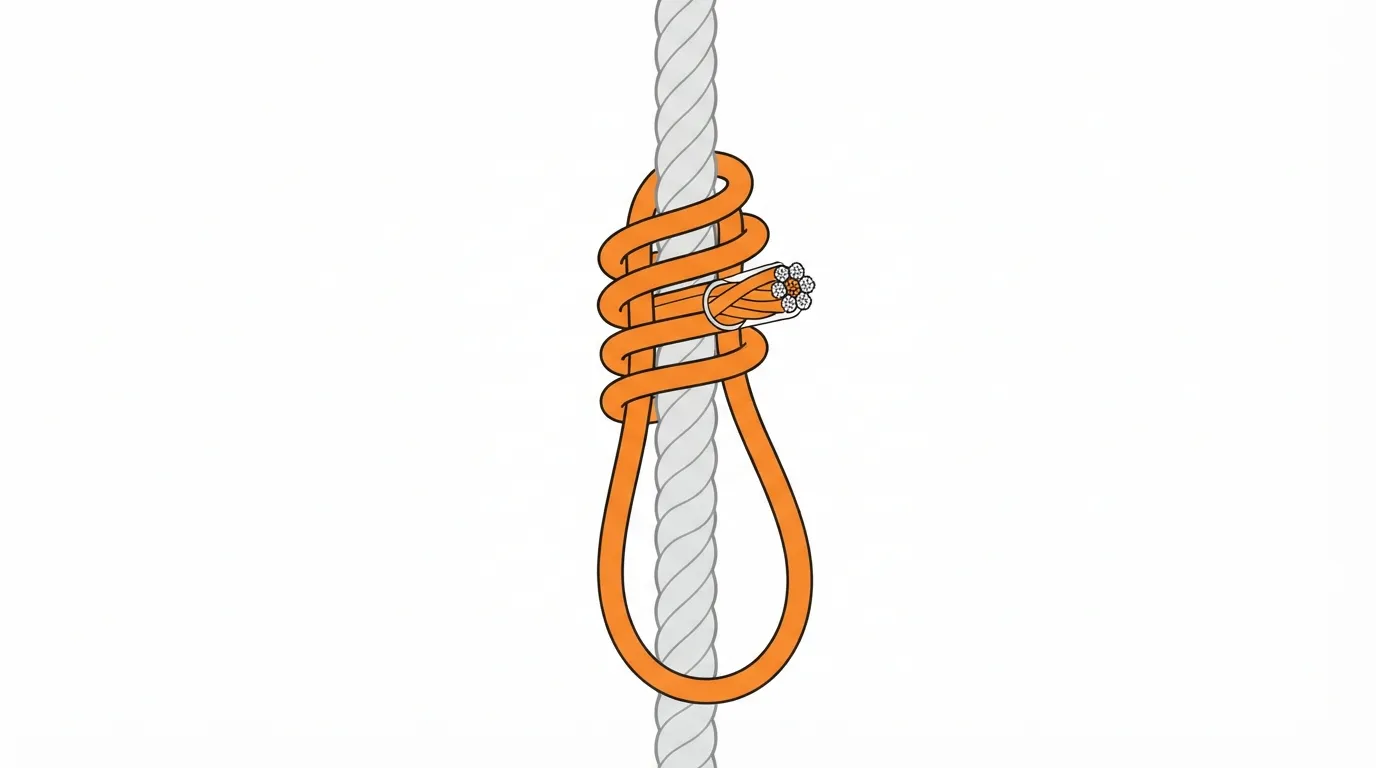
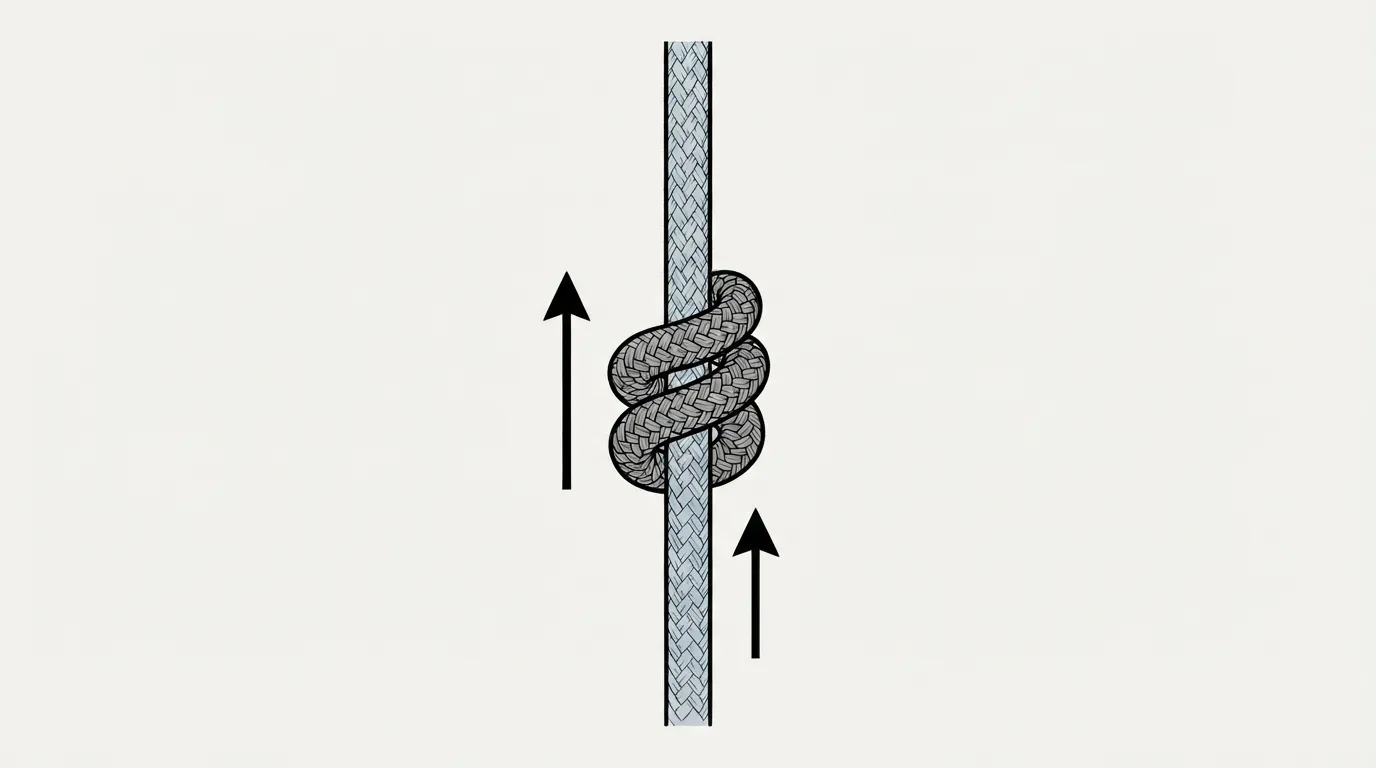
4. The Prusik
Invented by Austrian mountaineer Karl Prusik and published in a mountaineering manual in 1931, this friction hitch is tied using a thin cord around a thicker main rope: it slides freely by hand but locks instantly as soon as weight is applied.
What it’s used for: ascending a fixed rope (one loop for your foot, one for your harness, alternating as you climb), backup safety while rappelling below the descender, tensioning and adjusting a tarp ridgeline without damaging it.
When it’s dangerous: it won’t bite on a frozen or icy rope—friction, its sole working principle, vanishes on ice. Also, a Dyneema cord melts at low temperatures: never use a standard Dyneema cord for a friction hitch unless it’s specifically designed for high heat.
How to remember it: wrap the cord loop 3 times around the main rope through its own loop, keeping the wraps neat, parallel, and tight side by side.
How to untie it: push the barrel of wraps down (toward the bridge) to loosen the coils; never pull perpendicularly.
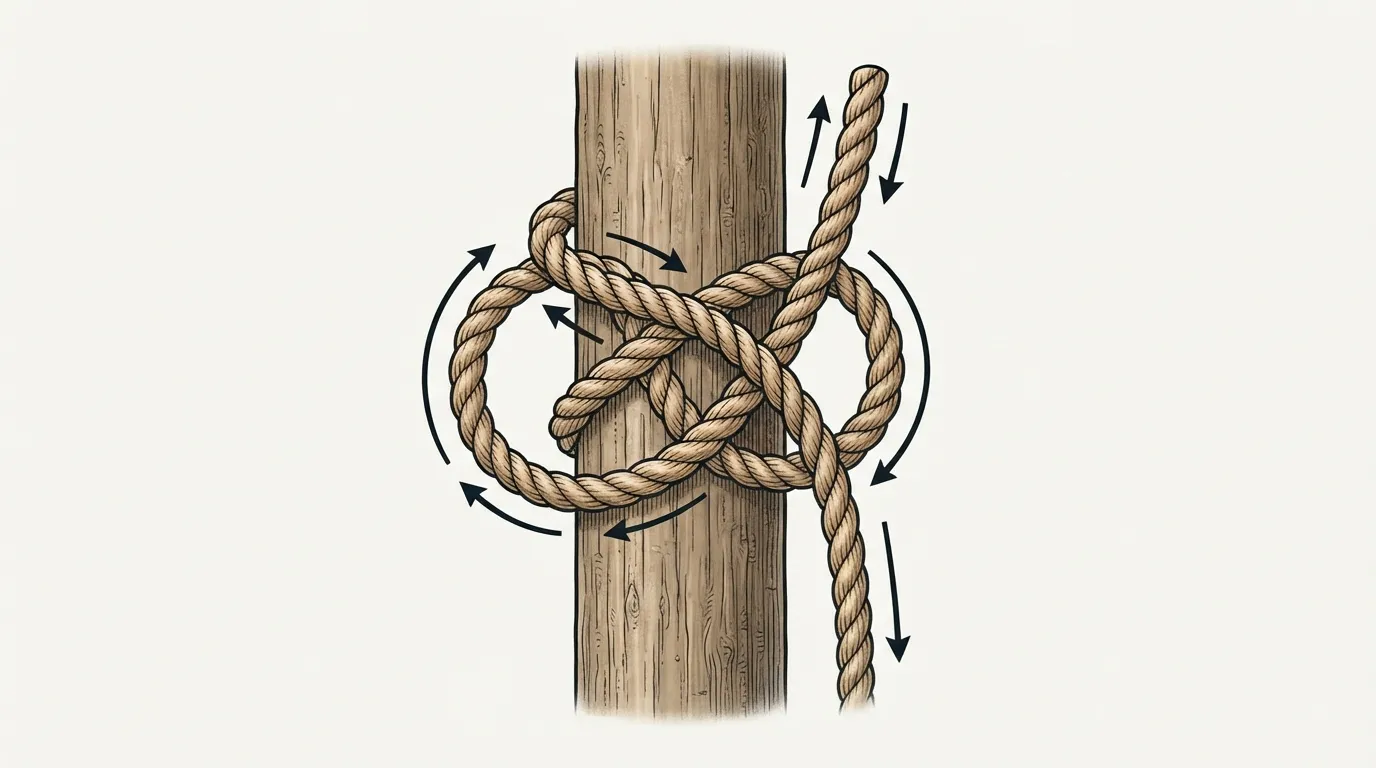
5. The Clove Hitch (and Round Turn with Two Half-Hitches)
The clove hitch attaches a rope quickly to a post, spar, or carabiner, and serves as the standard starting point for all Scout lashings (square, diagonal, tripod).
What it’s used for: fast and adjustable tie-off, starting and finishing lashings, adjustable self-belay at an anchor without opening the carabiner.
When it’s dangerous: on its own, it can slip if the tension fluctuates or changes direction—a classic marina incident involves a boat drifting away from a dock because the clove hitch holding it slipped under the tugging of wind and waves. Never rely on it alone to secure an important load: always back it up with half-hitches.
How to remember it: form two identical loops in the air, slide one behind the other, drop them over the post together, and pull tight.
How to untie it: it generally comes undone with a light touch, even after use—which is precisely why you shouldn’t trust it alone under dynamic loads.
The round turn and two half-hitches fixes this flaw: make a full turn around the support, then tie two successive half-hitches around the standing line. Far more reliable for long-term mooring, yet still easy to untie.
6. The Taut-Line Hitch (“Tent Guyline Knot”)
This is the most used and least named knot in all of camping: the one that adjusts the tension of a tent or tarp guyline without needing a plastic slider.
What it’s used for: adjusting guyline tension, mooring lines that must adjust with the tide, tie-down straps.
When it’s dangerous: on extremely slick or stiff synthetic ropes (like polypropylene), it might fail to bite—add an extra coil inside the loop in that case (Midshipman’s hitch).
How to remember it: make two wraps inside the loop around the standing line on the load side (these form the brake), then one wrap outside to lock it in—the assembly slides by hand but jams under load.
How to untie it: simply slide the coils to loosen it, without ever needing to untie it completely between uses.
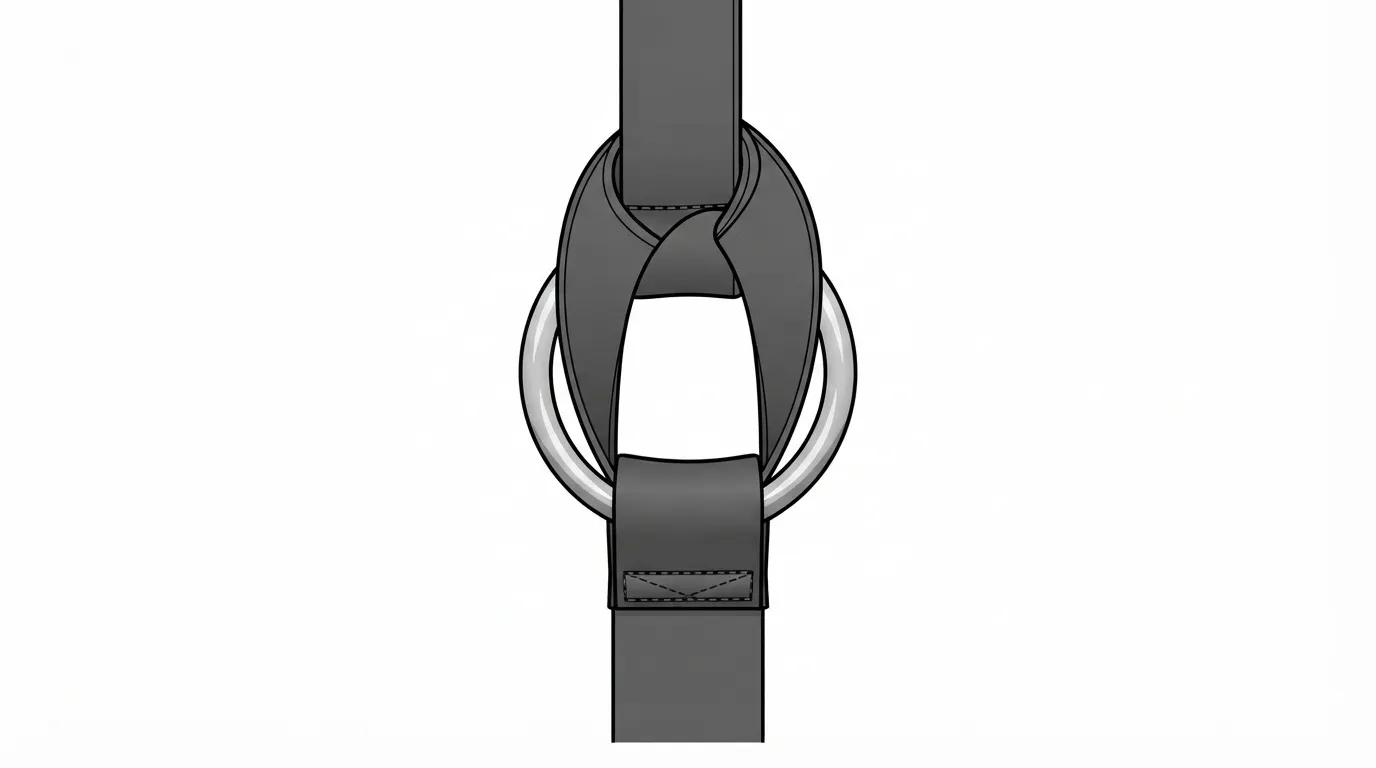
7. The Lark’s Head (Cow Hitch)
The lark’s head (or cow hitch) secures the middle of a rope to a ring or strap in one easy move: fold the cord in half, pass the bight through the ring, and feed both working ends through the loop.
What it’s used for: quickly attaching a strap to an anchor point, starting a hammock suspension, attaching a luggage tag or keychain—it’s also the fundamental knot of macramé when repeated.
When it’s dangerous: it is the weakest knot in this top 10 in terms of pure holding power—the tight bend concentrates stress—and it can slip if only one of the two ends carries the load instead of both together.
How to remember it: picture a loop plunging through a ring, then wrapping back to “swallow” its own two strands.
How to untie it: it usually unties effortlessly once tension is released by simply pushing the bight back out.
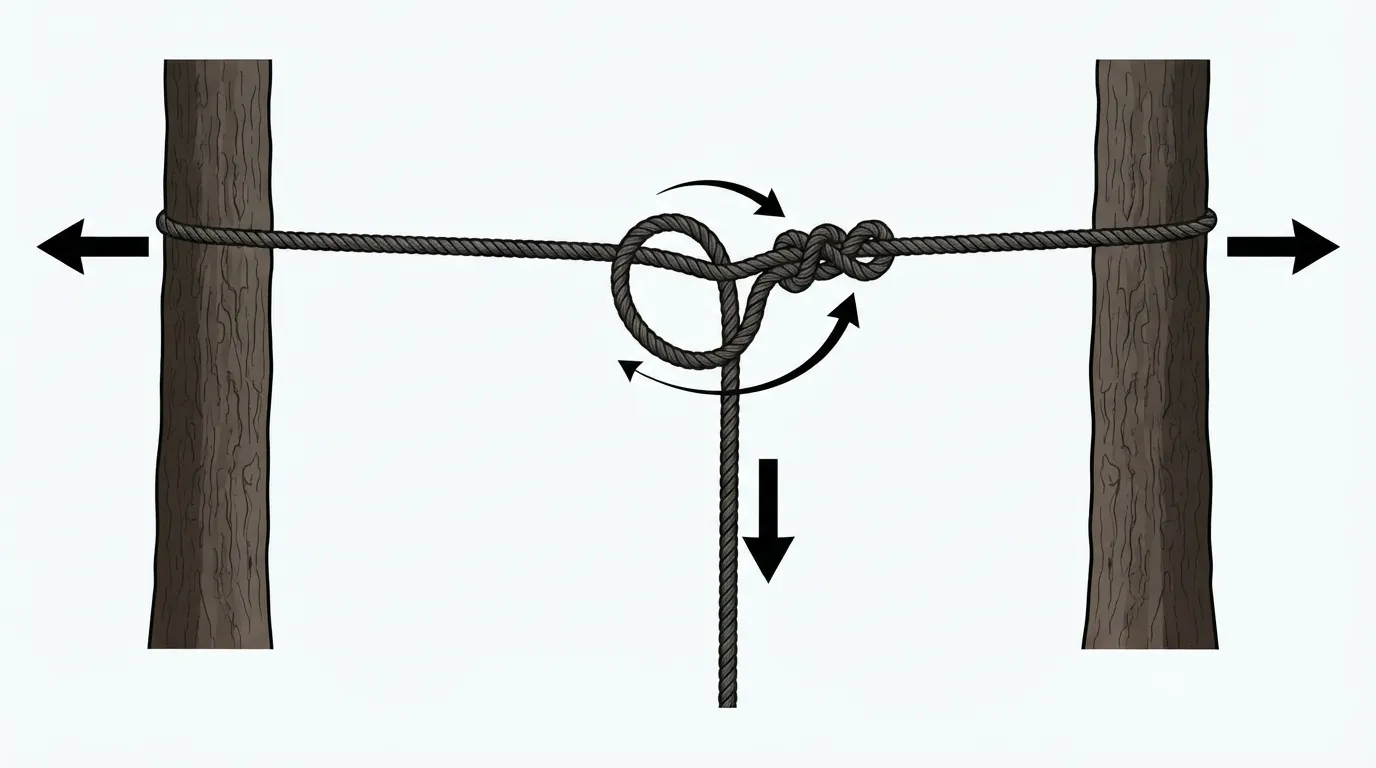
8. The Trucker’s Hitch
The trucker’s hitch turns a rope into a simple pulley system: in theory, a 3-strand setup like this triples your mechanical advantage—in practice, rope-on-rope friction (instead of a rolling pulley) eats up much of that benefit, resulting in an actual force multiplier of around 1.6x.
What it’s used for: pulling a tarp ridgeline rock-hard, securing loads on a roof rack or trailer, lowering and raising a bear bag.
When it’s dangerous: if poorly locked off, the tension loop can “capsize” (flip inside out and release suddenly) under heavy load—always lock it off with two tight half-hitches.
How to remember it: tie an inline slip knot or directional figure-eight in the middle of the rope to act as an improvised pulley; run the working end around your anchor point, pass it back through the loop, and pull hard before locking it off.
How to untie it: undoing the two half-hitches releases all tension instantly—step out of the way of the snapping line.
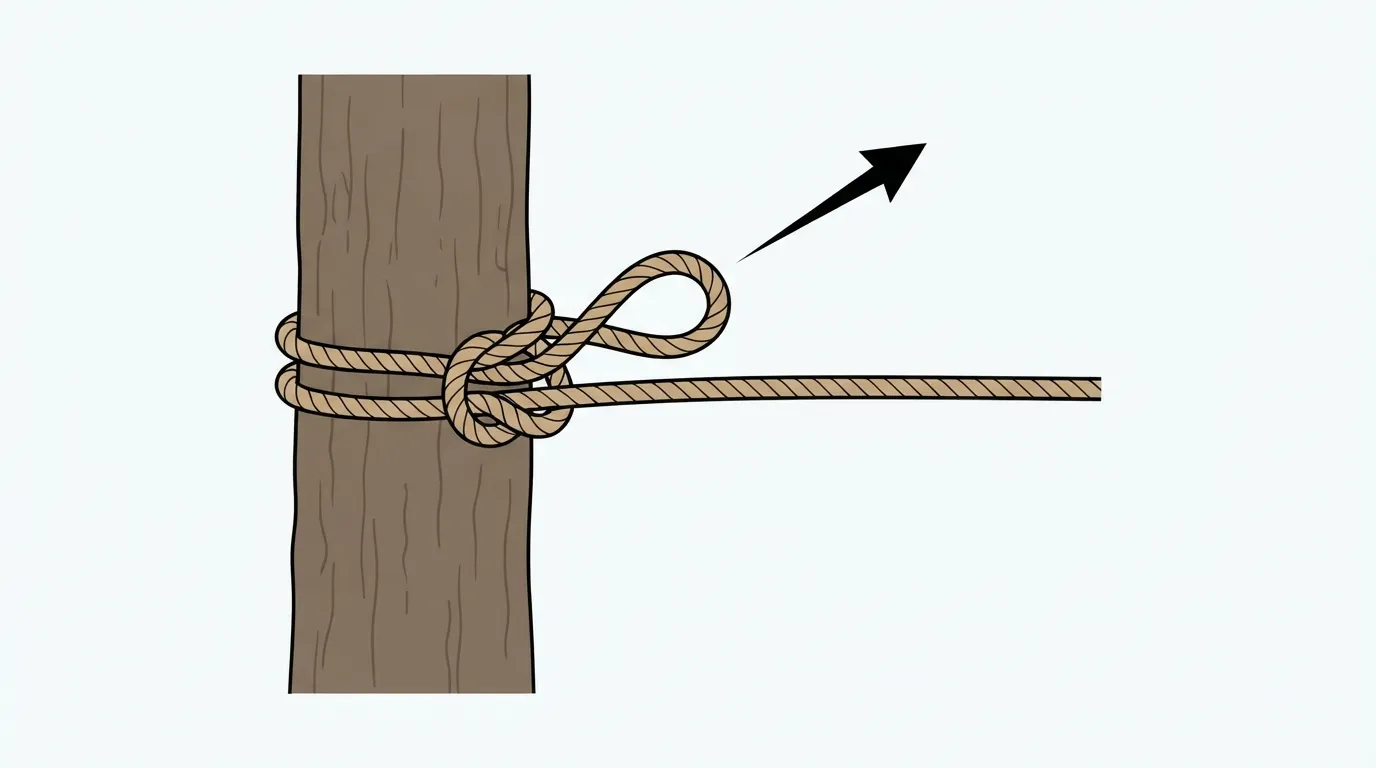
9. The Siberian Hitch (Evenk Knot)
Also known as the Evenk knot, this quick-release hitch originates from the nomadic peoples of Siberia (including the Nenet) who needed to pitch and strike camp in extreme cold, wearing thick mittens or with semi-frozen hands.
What it’s used for: tying a tarp ridgeline or guyline that you need to release in a single motion, without picking at complex knots with numb fingers.
When it’s dangerous: it is only moderately secure—never use it for a critical load or life safety; it is designed to come undone fast, not to hold at all costs.
How to remember it: pass the working end around the tree, wrap it around your gloved hand, sweep under and over both lines, and pull a bight back through—the movement resembles a small salute with the hand holding the rope.
How to untie it: one quick tug on the free tail, and the entire knot falls apart instantly, even under tension—that’s its main selling point.
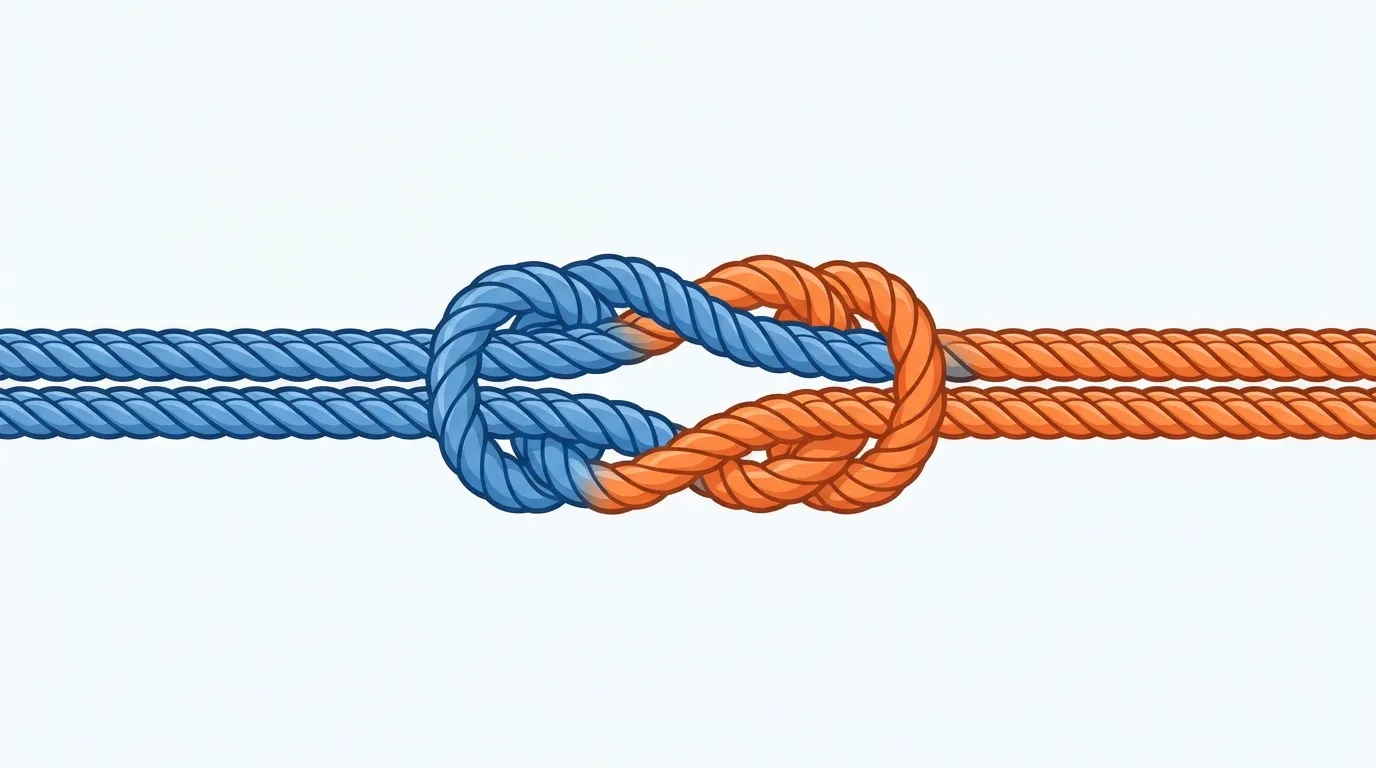
10. The Reef Knot (Square Knot)—and Why It Kills
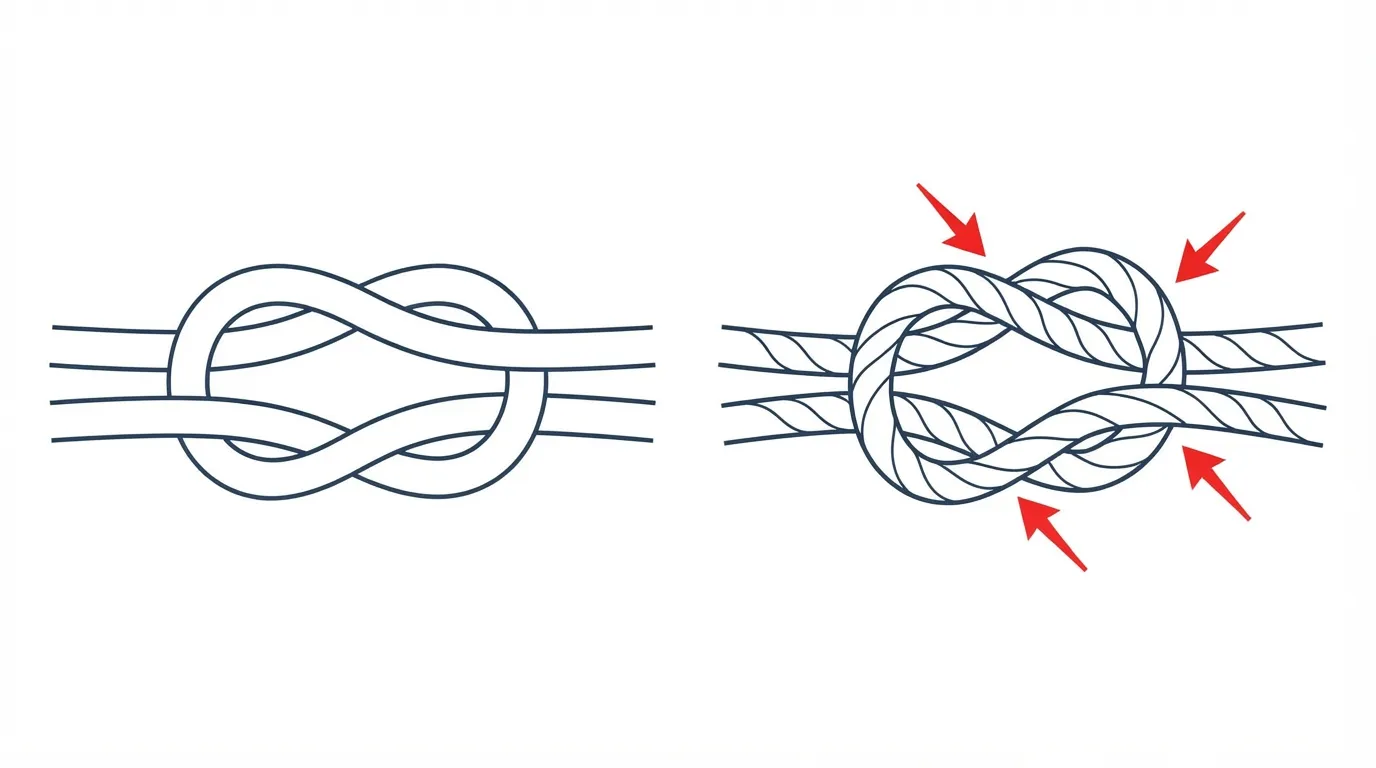
The reef knot (or square knot) has always been used for tying up parcels, securing bandages, or reefing a sail. It is not meant to join two load-bearing ropes, and Clifford Ashley himself wrote that “misuse of the square knot has caused more deaths and injuries than all other knots combined.”
What it’s actually for: tying a package, securing a bandage, joining two ends of the same cord around an object—never for suspending weight or joining two separate ropes.
When it’s dangerous: joining two ropes of different diameters, materials, or flexibility with a reef knot creates a high risk of it “capsizing”—turning into a slip knot and popping open—especially under shock loads or fluctuating tension. To join two ropes, even of different diameters, the correct knot is the sheet bend, the very first knot in Ashley’s book and one of the three in the IGKT challenge alongside the bowline and clove hitch.
How to remember it: “right over left, then left over right”—the two passes must be tied in opposite directions; otherwise, you get a granny knot, which slips far more easily.
How to untie it: a “slipped” version (where one working end is folded into a bight rather than pulled all the way through) collapses with a simple pull on the free end.
| Bowline | Clove Hitch | Taut-Line | Trucker's | Reef Knot | |
|---|---|---|---|---|---|
| Reliable fixed loop | ✅ | ❌ | ❌ | ❌ | ❌ |
| Quick adjustable tie-off | fair | ✅ (with half-hitches) | ✅ | fair | ❌ |
| Continuously adjustable tension | ❌ | ❌ | ✅ | ✅✅ | ❌ |
| Unties easily after heavy load | ✅ | ✅ | ✅ | ✅ | fair |
| Joining two ropes | ❌ | ❌ | ❌ | ❌ | ❌ (dangerous) |
Knot systems: putting it together
A single knot gets a specific job done. Two or three knots used together in the right order pitch a complete shelter.
The tarp ridgeline: a trucker’s hitch at each end for main tension, with one or two prusik loops slid onto the line to hang the tarp or adjust its position without touching the main tension knot—the most popular combination in lightweight bushcraft because it separates the “pull tight” function from the “adjust position” function.
The bear hang: several methods exist, including the “PCT method” popularized on the Pacific Crest Trail—a weighted throw-bag goes over a high branch with a carabiner, and the rope is pulled and locked off so the food bag hangs suspended away from the trunk and out of reach, with no knot accessible from the ground.
Lashings: a square lashing binds two poles at right angles using tight wraps followed by “frapping” turns (perpendicular wraps that pull the first ones tight)—the foundation of any tripod or Scout camp table structure. A diagonal lashing does the same for poles crossing in an X shape, preventing the frame from racking into a parallelogram under load. Both typically start and finish with a clove hitch.
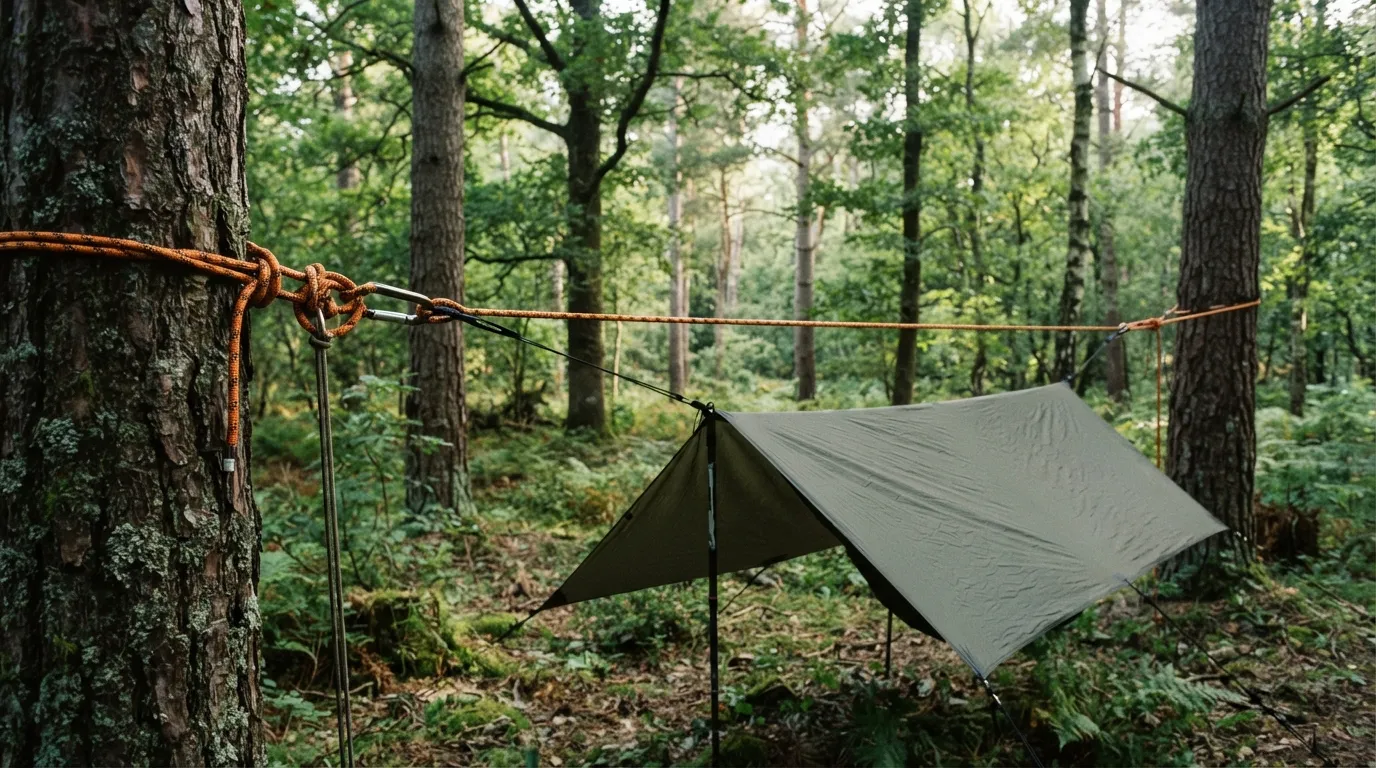
Hammock suspension: wide tree-hugger straps, which protect tree bark, are usually wrapped around the trunk and locked using a lark’s head or a carabiner loop; fine adjustment is made with a continuous friction loop, marketed under the name Whoopie Sling, which operates on the exact same friction principle as the prusik.
Shoelaces that stay tied
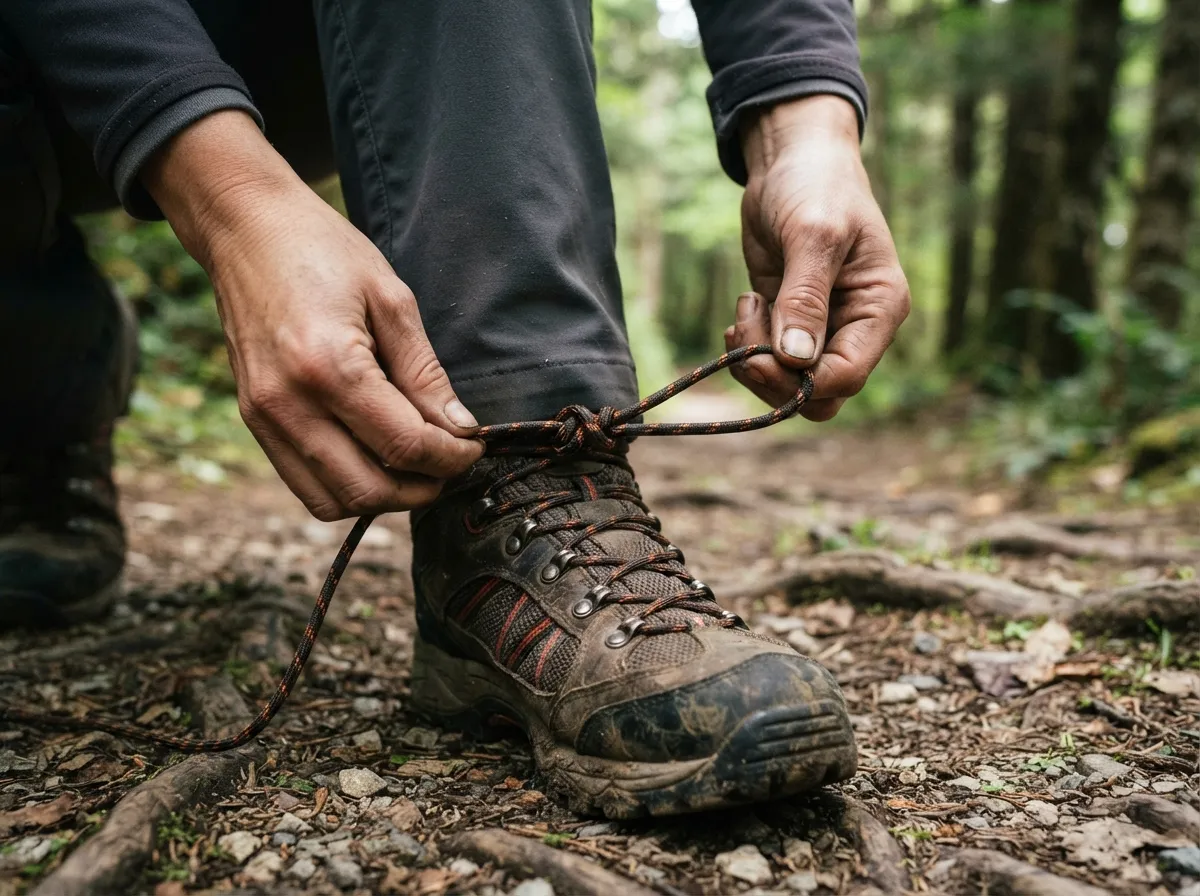
A standard double bow shoelace knot comes undone on its own while walking, especially on smooth, round laces. The solution documented and patented in 1999 by Australian engineer Ian Fieggen, known as the Ian’s Knot (or Ian’s Secure Shoelace Knot), involves forming the standard bow knot, but wrapping it twice around the center instead of once. The resulting knot looks virtually identical to a standard bow—tied just as fast—but holds significantly better because the double turn increases friction, while remaining easy to undo with a firm tug on the loose ends.
Everyday cordage
You don’t need to be on an expedition to carry cordage. Unwaxed dental floss, thin and tough, makes excellent improvised suture thread or snare whipping. Nylon fishing line, nearly invisible and very strong for its weight, makes great tripwire or lightweight emergency cordage. Shoelaces, backpack webbing straps, and leather belts are, in increasing order, sturdier and harder to replace if sacrificed—save the belt for absolute last resort.
For a full breaking-strength comparison chart—from dental floss up to 9 mm climbing rope—along with the exact strength loss for each knot tied on 550 paracord, check out the cordage database.
Care and common mistakes
Ropes degrade even if they’re never used. Nylon absorbs water and loses 10 to 15% of its strength when wet. UV rays break down synthetic fibers over time—a rope left in full sun for months ages faster than one used regularly and stored in the dark. Dirt and fine grit work their way between the fibers, acting like sandpaper every time the rope bends: stepping on a climbing rope forces micro-particles of rock into the core, grinding away at it from the inside out—a form of damage that is invisible from the outside. Sharp edges (rock, metal, ice) can shear through a loaded rope instantly where slow wear would have only weakened it: never run a loaded line across a sharp edge without protection. Finally, a frozen wet rope stiffens, loses elasticity, and can snap cleanly under impact rather than stretching—friction hitches like the prusik stop working altogether on a icy sheath.
A general-purpose utility rope has an average shelf life of about 5 years even without visible damage; beyond that, a thorough inspection is mandatory, and any rope subjected to a severe shock load (a hard fall or sudden drop of a heavy weight) should be retired immediately, even if it looks fine on the surface.
Frequently asked questions
What is the single most useful knot to learn first?
The bowline, because it creates a reliable fixed loop that won’t slip under load while remaining easy to untie once unloaded. It’s the first knot taught in most sailing and mountaineering schools, and a mandatory skill for various professional fields (aviation ground crew, firefighters).
Why should you never use a reef knot to join two ropes?
Because it can “capsize” (flip inside out and slip untied instantly) if the two ropes differ in diameter, material, or flexibility, or if the load fluctuates. Clifford Ashley, the leading authority on knots, attributed more injuries and deaths to the misused reef knot than to all other knots combined. The sheet bend is the correct choice for joining two ropes.
How much strength does a knot reduce in a rope?
Generally between 20 and 45% depending on the knot and material, and sometimes even more on stiff modern materials like Dyneema. The tight bend inside the knot places uneven strain on the outer fibers, creating a predictable point of failure.
How can I remember how to tie a bowline?
Use the classic mnemonic: “the rabbit comes out of the hole, goes around the tree, and goes back down the hole.” The initial small loop is the hole, and the working end is the rabbit that emerges, loops around the standing line (the tree), and dives back down into the same loop.
Does a prusik hitch work in all weather conditions?
No: it relies entirely on friction between the accessory cord and the main rope. That friction disappears on a frozen or icy rope. Furthermore, a Dyneema cord melts at low friction temperatures and should never replace a heat-resistant accessory cord made specifically for friction hitches.
Do I need to memorize dozens of knots to be self-sufficient outdoors?
No. The standard reference encyclopedia lists 3,857, but virtually all outdoor needs (anchoring, loops, joining lines, tensioning, lashings) are covered by mastering ten core knots thoroughly rather than half-knowing fifty.
Key takeaways
- Ten knots mastered by heart are worth far more than dozens half-remembered: the bowline, figure-eight, double fisherman’s, prusik, clove hitch, taut-line, lark’s head, trucker’s hitch, Siberian hitch, and reef knot cover almost everything.
- A knot always reduces a rope’s strength by 20 to 45%—the load concentrates on the outer fibers of the small bend radius it creates.
- The reef knot is for tying packages, never for joining two load-bearing lines: use a sheet bend instead.
- You can make your own cordage from retted linden, nettle, or bramble, twisted into a two-strand reverse-wrap.
- A system (ridgeline, hammock, bear hang) works best when one knot provides main tension and a separate knot handles fine adjustment.
Going further
- Clifford W. Ashley, The Ashley Book of Knots (1944)—the ultimate reference, featuring 3,857 illustrated knots.
- Wikipedia — List of knots—an index categorized by knot family (loops, stoppers, hitches, lashings).
- International Guild of Knot Tyers (IGKT)—the “Six Knot Challenge” for practicing core essentials.
- Cordage database—breaking strengths, weight, and water resistance for 17 types of cordage and 8 knots tied on 550 paracord.
Sources for this module (28)
- Wikipedia — Ashley Book of Knots
- Wikipedia — List of knots
- Wikipedia — Bowline
- Wikipedia (FR) — Nœud de chaise
- Wikipedia — Trucker's hitch
- Wikipedia — Prusik
- Wikipedia — Clove hitch
- Wikipedia (FR) — Nœud de cabestan
- Wikipedia — Taut-line hitch
- Wikipedia — Cow hitch (lark's head)
- Wikipedia — Siberian hitch
- Wikipedia — Reef knot
- Wikipedia (FR) — Nœud plat
- Wikipedia — Double fisherman's knot
- Wikipedia — Sheet bend
- Wikipedia — Ian Knot
- Wikipedia — Square lashing
- Wikipedia — Bear bag
- Wikipedia — Hammock camping
- Wikipedia — Paracord
- Wikipedia — Rope
- Wikipedia — Tilia (écorce de tilleul, bast fibre)
- Wikipedia — Sinew
- Edelrid — Strength reduction of textile materials by knots
- Mors Kochanski, Bushcraft: Outdoor Skills and Wilderness Survival
- Wikipedia — Constrictor knot
- Wikipedia — Monkey's fist
- /donnees/cordages — Quelle corde pour quel usage ?
Continue in "Cross-cutting skills"
Knife, axe, saw: tools and the techniques that prevent injuries
The 'best knife' doesn't exist: only the one that fits your hand and your task—and the movements that keep you from getting hurt.
The Kit: What Should Be in Your Pockets, Backpack, and Car
What you carry on you saves you when you lose your pack: the kit hierarchy and essential checklists you shouldn't improvise.

Reading the sky: predicting the weather without a phone
Cirrus clouds, halos, shifting breezes, an altimeter watch that 'climbs' while you stand still: your phone has no service, but the sky is still broadcasting.