Field proteins: fishing, traps, insects, cooking
Large game is the stuff of dreams, but it's crickets, set lines, and snails that actually feed a lost survivor.
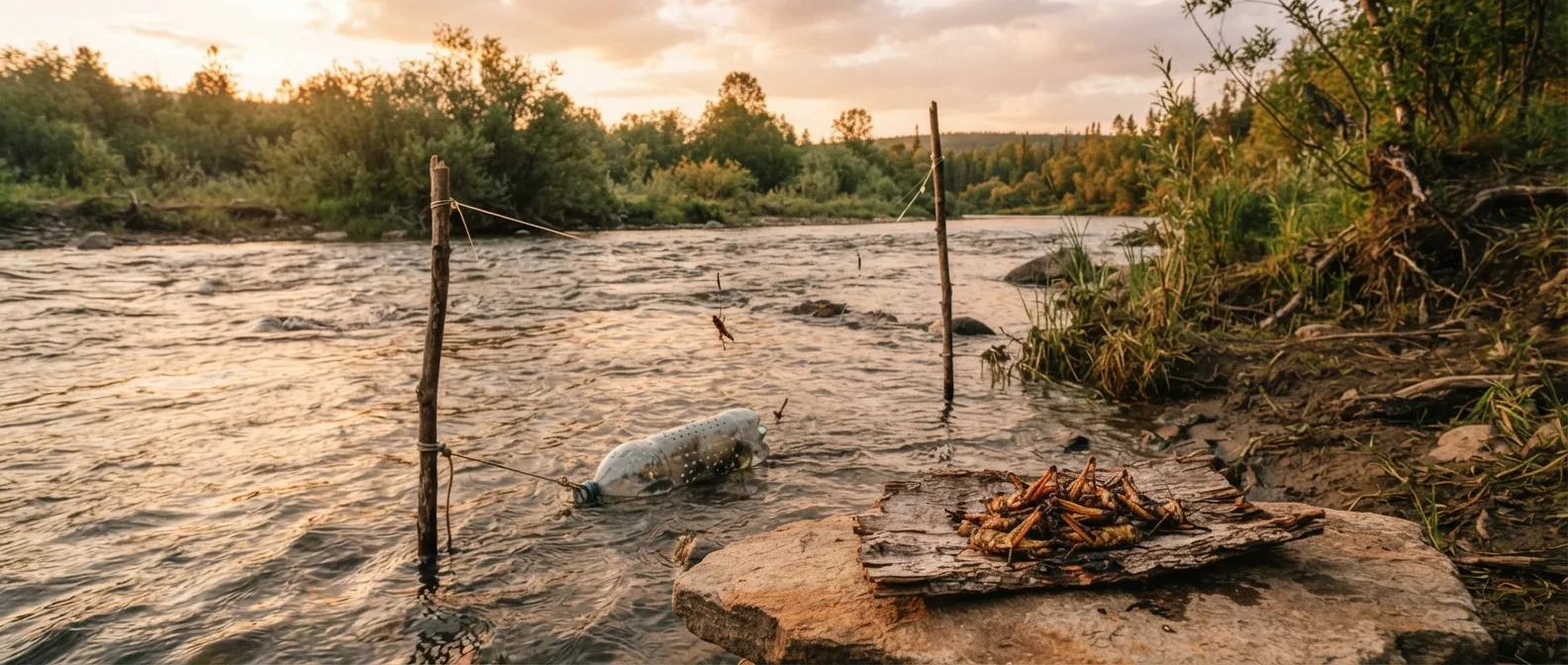
Day three. You have water, a solid shelter, and a stomach that’s starting to rumble loudly. You saw a deer this morning forty meters away, and spent two hours following it for nothing. Meanwhile, in the grass around your camp, hundreds of grasshoppers were going nowhere fast.
This module is about just that: where to find proteins that let themselves be caught, how to get them without exhausting yourself, and what can kill you on a full stomach.
Don’t hunt, gather proteins
The US Army Survival Manual, FM 21-76, opens its chapter on food procurement with a sentence that goes against everything you see in movies: “Unless you have the chance to take large game, concentrate your efforts on the smaller animals, due to their abundance.” It goes on to add: “Several well-placed traps have the potential to catch much more game than a man with a rifle is likely to shoot.”
It’s a matter of energy balance. Hunting means spending guaranteed calories for an uncertain return. A trap, a set line, or a fish trap work while you sleep. An insect can’t run faster than your hand. Cultures living without supermarkets know this: among the Hadza of Tanzania, honey accounts for 10 to 20% of their calories on its own, while meat is just a variable seasonal bonus. In Central Australia, the Pitjantjatjara people would slice open a kangaroo carcass to check its fat before keeping it—because lean meat is worthless, as we’ll explain below.
Hence the hierarchy in this module, ranked from best to worst yield: insects and grubs, snails and worms, eggs, passive fishing (set lines, traps, fish weirs), land traps, shellfish and crustaceans, small vertebrates (frogs, snakes, rodents), and at the very bottom, big game.
Insects: the protein that doesn’t run
FM 21-76 states that insects provide “65 to 80 percent protein compared to 20 percent for beef.” The stat is accurate, but it compares two different things: the insect value is calculated on dry matter, whereas beef is measured fresh. Wikipedia’s nutrition table shows that 100 g of dried house cricket contains 69 g of protein and 458 kcal; mealworms offer 45 g of protein, 37 g of fat, and 550 kcal; migratory locusts deliver 48 g of protein and 559 kcal. In short: protein, but also plenty of fat—which is precisely what a survivor lacks most.
What to eat
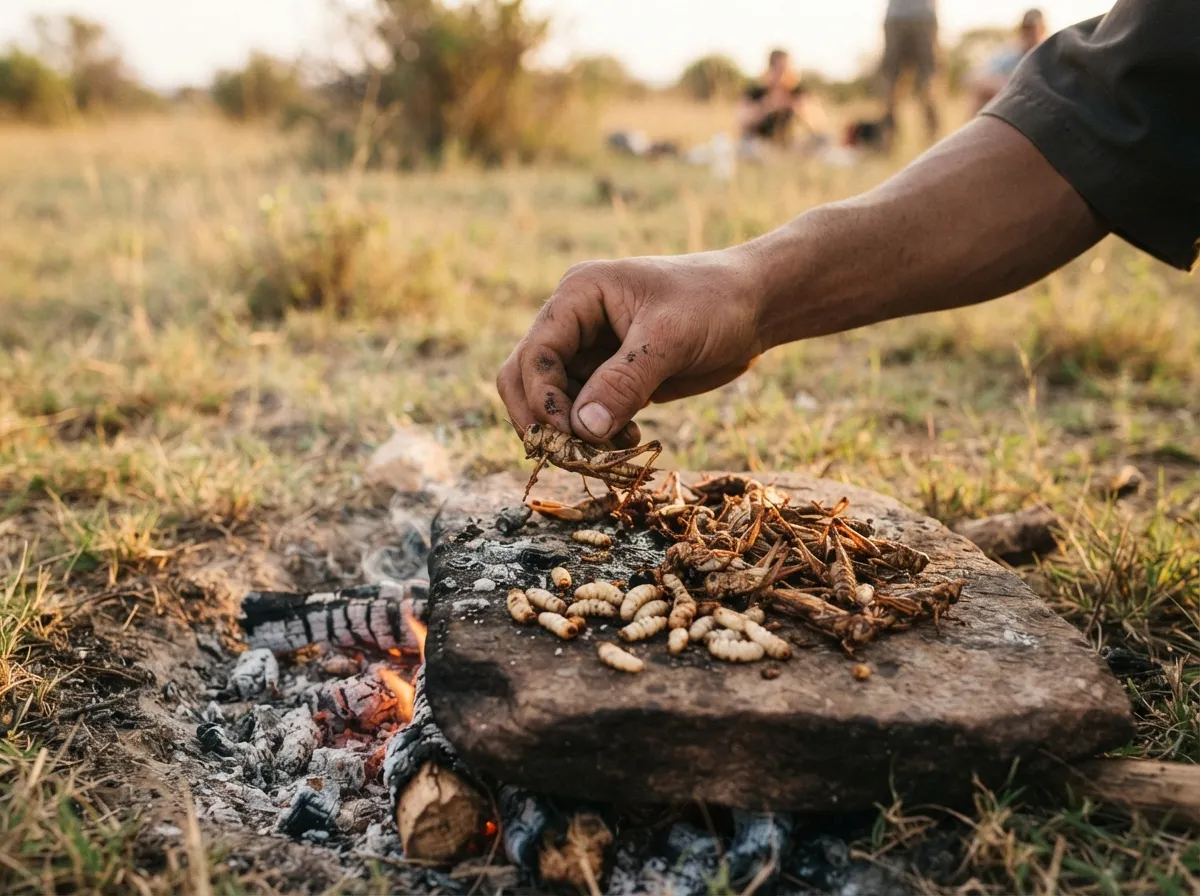
- Crickets, grasshoppers, locusts: the easiest targets. Catch them early in the morning when the cold makes them sluggish. Remove the spiny hind legs and wings, and cook them: the manual warns that hard-shelled insects, beetles, and grasshoppers “will have parasites.”
- Grubs (wood-boring grubs in rotting logs, beetle larvae): FM 21-76 describes them as “bland,” which is actually a good sign. Central Australian Aborigines dig up the witchetty grub, a cossid moth larva living in the roots of the witchetty bush: 15% protein, 20% fat, about 1,170 kJ per 100 g, tasting like raw almonds, or “crispy-skinned chicken” once cooked over hot ashes.
- Ants and termites: rotting logs are “excellent places to look for ants, termites, beetles, and grubs.” Some ant species store honey in their abdomens: in Australia, women dig up to two meters deep to harvest honeypot ants.
- Earthworms: FM 21-76 describes them as “an excellent source of protein.” A 2023 New Zealand study measured 54% protein and 19% fat in dry Eisenia andrei powder—along with accumulated soil cadmium and arsenic. Purging is mandatory: drop them in clean water for a few minutes to flush their digestive tracts, then cook.
- Collect at dawn in a meadow, when they are too cold to jump. A sock or bag held open through wet grass can yield dozens.
- Pull off the head with a firm tug if you want to pull the digestive tract out with it, then remove the hind legs and wings.
- Roast on a flat stone beside hot coals, or skewer on a twig until crispy. Never eat them raw.
- Grind any excess into a paste: FM 21-76 suggests pounding insects together and mixing them with edible plant foods.
What to leave alone
FM 21-76 provides a short checklist: “all adults that sting or bite, hairy or brightly colored insects, caterpillars, and insects with a strong odor,” as well as “spiders and common disease carriers like ticks, flies, and mosquitoes.” Bright colors serve as a chemical warning (aposematism); caterpillar hair is often irritating; a strong smell signals a defensive chemical.
Snails, frogs, eggs
Snails. Garden snails and Burgundy snails are free meat, but they eat everything, including toxic plants: purge them by fasting for several days before cooking, and in a survival situation, boil them thoroughly. The hidden threat is a parasite: Angiostrongylus cantonensis, the rat lungworm, transmitted by raw snails and slugs. In 2010, an Australian teenager, Sam Ballard, swallowed a slug on a dare: he suffered a 14-month coma, paralysis, and died in 2018. Always cook them thoroughly. In France, gathering Burgundy snails is prohibited from April 1st to June 30th, and only specimens with a shell larger than 3 cm may be harvested.
Frogs, not toads. FM 21-76 makes it clear: “Do not confuse toads with frogs.” Toads secrete bufotoxin from their parotoid glands behind their eyes; if ingested, it causes cardiac distress and can kill within 6 to 24 hours. Identify toads by their warty skin, short legs, and waddling walk instead of hopping. Catch frogs at night using a flashlight: the light in their eyes “stuns them” and highlights their reflection. In France, common frogs and pool frogs are partially protected (decree of November 19, 2007, Art. 5): maiming and commercial sale are banned, while capture is strictly regulated by local department rules. And leave fire salamanders alone: they produce samandarin, a neurotoxic alkaloid.
Eggs. FM 21-76 offers a clever wild harvesting trick: don’t take all the eggs from a nest. Remove all but two or three, mark the remaining ones, and the bird will keep laying to complete its clutch. Return later to collect the fresh, unmarked ones while leaving the marked ones behind.
Improvised fishing
FM 21-76 sums up the value of fishing in one line: “They are usually more abundant than mammal wildlife, and the ways to get them are silent.” It adds two key rules on fish behavior: fish feed heavily right before a storm and barely at all afterward when the water turns muddy; at night, light draws them in.
The stealth hook: the gorge hook
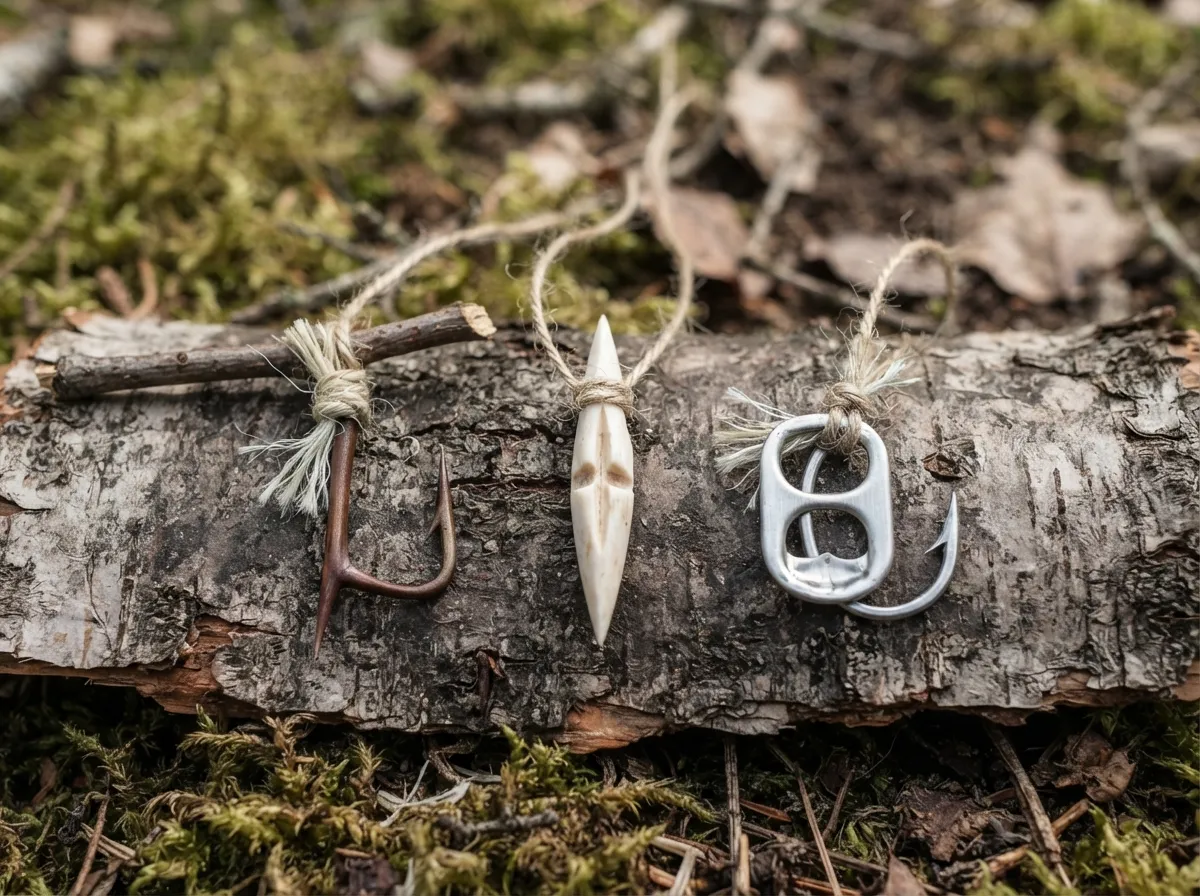
The oldest fish hook in human history isn’t curved. The gorge is “a small piece of wood, bone, metal, or other material, sharpened at both ends and notched in the middle where the line is attached” (FM 21-76). Thread the bait lengthwise, parallel to the line. The fish swallows the whole package; when you pull, the stick turns crosswise in its throat.
- Carve a 2 to 3 cm sliver of bone, hardwood, or a thorn, sharpened at both ends, with a small notch in the center.
- Tie your line inside the notch using thread pulled from clothing, inner strands from gutted paracord, or nettle fiber.
- Thread a worm or grasshopper along its entire length so the gorge stays parallel to the line.
- Give it slack: Field & Stream stresses, “feed slack to a feeding fish until the bait has been completely eaten.” If you set the hook instantly, the stick pulls out straight. Wait about thirty seconds, then pull steadily.
Other makeshift hooks include: a hawthorn thorn left attached to its twig, a safety pin, a nail, or a soda can pop-tab bent and filed to a sharp point. FM 21-76 also suggests a 2.5 cm wooden hook with a bone point lashed to it in a V-shape.
Fishing without being there
The set line (“stakeout” in FM 21-76): two flexible sticks driven into the streambed, a line stretched between them just below the surface, and several baited drop lines spaced apart “so they cannot tangle around the stakes or each other.” Set it in the evening, check it in the morning.
The bottle trap: cut off the top third of a plastic bottle, invert the spout back into the body like a funnel, weigh it down with stones, add bait, and submerge it in the current with the opening facing downstream. Minnows and small crayfish enter and can’t find their way back out. In saltwater, FM 21-76 describes the tidal fish weir: “pick a location at high tide and build the trap at low tide,” using a low stone wall angled toward the shoreline to trap fish as the tide recedes. This method has been used in Ireland for 8,000 years, and a 14,000-year-old weir is being studied off Haida Gwaii.
By hand, at night, under light
American noodling—sticking your arm into a muddy bank hole so a catfish bites your hand, then pulling it out by the gills—is dramatic and risky: snapping turtles, snakes, and drowning are real dangers. The gentler European equivalent is trout tickling: slide your hand under the belly of a trout resting under a bank, stroke it until it goes still, then scoop it out in one motion. Shakespeare mentioned it, and the practice is mostly illegal in the UK today—precisely because it works so well.
At night, light attracts fish; FM 21-76 recommends “chop fishing”: stunning them with the back of a heavy blade, never the sharp edge, “or you will cut them in two and lose them.” Crayfish also come out at night: tie a scrap of offal to a string, then lift them out slowly before they let go.
Traps: snare, figure-4, Paiute, Ojibwa bird pole
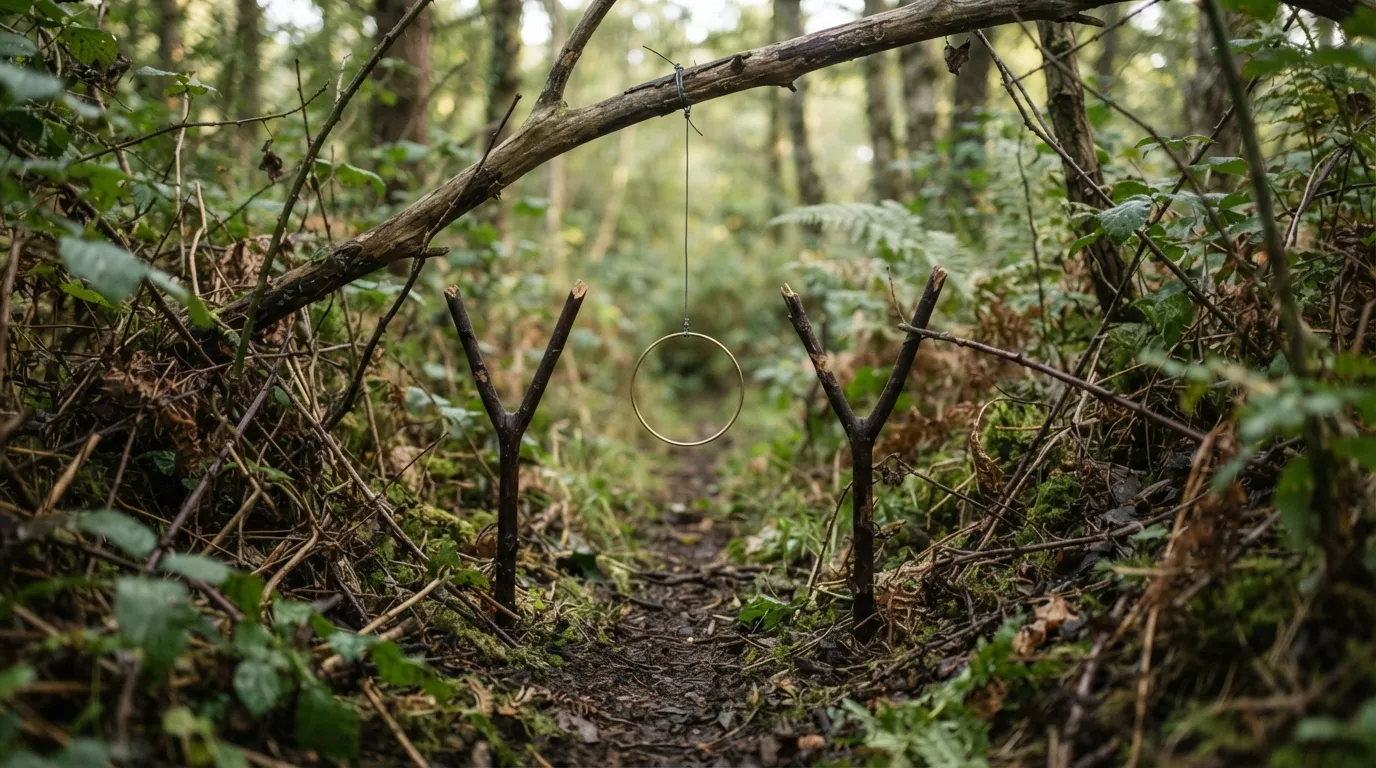
A successful trap relies on three elements: a proven location, a sensitive trigger, and zero human scent. FM 21-76 instructs survivors to scout for “runs and trails, tracks, droppings, chewed or rubbed vegetation,” carve trap components away from the site, avoid using freshly cut green wood (bleeding sap releases scent), and mask human smell using mud from rotting leaf litter or campfire smoke. Always funnel: build a brush barrier that narrows the path to just wider than the target animal, because “few wild animals will back up.”
The snare
Use brass or copper wire (“red metals slip smoother”), make a small eyelet loop at one end, and feed the main line through to create a slip noose. For a rabbit, aim for a main loop about 15 cm in diameter. Standard settings recommended by experienced trappers: suspend the loop at head height (18 to 22 cm off the ground for a fox per regulatory texts, or a hand’s width high for a rabbit), secure it to a stake or sturdy root, and place it directly over a run identified by fresh droppings and fur caught in brambles. FM 21-76 warns that a head loop “must never be set low enough for an animal to step through,” and notes that cordage slips loose easily compared to wire: “wire is therefore the best choice.”
Figure-4 and Paiute: deadfalls
The figure-4 is a trigger made from three notched sticks held together by opposing pressure to support a heavy deadfall stone. The vertical upright features a flat screwdriver-like tip at the top and squared sides; the diagonal member has a notch that rests on that tip; the horizontal bait stick hooks onto the upright via a side notch. Cuts must be crisp and clean: “if you have studied the mechanism well, and carved crisp edges at right angles, you shouldn’t have trouble.” Stone weight requirement: “roughly five times the weight of the target animal,” set on hard ground—never soft dirt that cushions the blow.
The Paiute deadfall swaps part of the intricate wood carving for a 20 cm cord and a small toggle wrapped 180° around the upright stick. The result: higher sensitivity, faster release, and it is “much less prone to jamming.” A trapper on the Bushcraft USA forum reported jumping from a 20% to roughly 95% catch rate simply by rounding off contact points and reducing cord tension. For both designs, keep this critical safety rule in mind: “the trap will crush anything that trips it, including children, pets or toes.”
The Ojibwa bird pole
A bird trap that requires no bait whatsoever. Take a 1.8 to 2.1 m pole sharpened at the top, drill a small hole 5 to 7.5 cm below the tip, insert a light 10 to 15 cm perch stick loosely into the hole, attach a counterweight “roughly equal to the weight of the target species” to a cord passing through the hole, and spread a snare loop across the perch stick. When a bird lands, the perch drops, the weight falls, and the loop snaps shut around its feet. FM 21-76 adds a practical warning: “if the weight is too heavy, it will cut the bird’s feet off, allowing it to escape.” Set this up in open terrain away from tall trees, near feeding grounds or water sources.
Shellfish, crustaceans, rodents, snakes
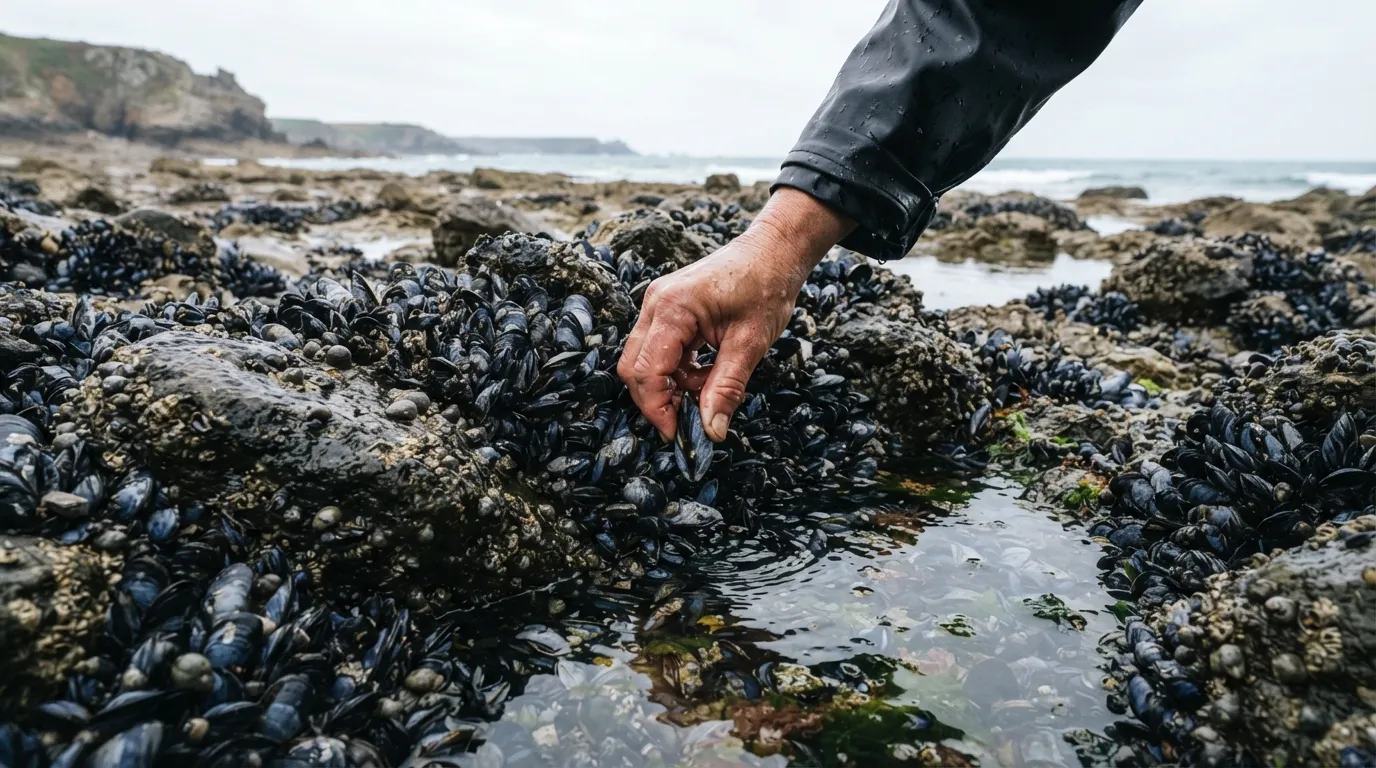
Shellfish. FM 21-76 offers two explicit warnings: “Mussels may be poisonous in tropical zones during the summer!” and “Do not eat shellfish that are not covered by water at high tide!” The danger comes from plankton: dinoflagellates (Alexandrium) produce saxitoxin, which filter-feeding bivalves accumulate in their tissues. It resists both heat and acid—cooking will not neutralize it—and initial tingling sensations begin 10 to 30 minutes after eating, potentially leading to respiratory paralysis with no known antidote. Along the French coastline, the REPHYTOX network monitors three toxin families (diarrhetic, amnesic, paralytic), prompting prefectures to close shellfish harvesting areas almost every summer; mussels are the primary vector. Simple rule: in summer, unless local health advisories explicitly clear the area, avoid wild mussels.
Crustaceans. Crabs and lobsters are best caught at night using bait. Crayfish can be spotted under rocks during the day and caught at night using a baited string. Before cooking, purge and “de-vein” crayfish by pulling out the central tail fin to strip the digestive tract, which avoids a bitter taste.
Rodents and rabbits. Every part is edible, but handle them with gloves: tularemia, spread mainly by hares across Europe, can penetrate intact skin and causes 41 to 121 human cases per year in France. Never harvest a slow, visibly sick animal. During field dressing, FM 21-76 advises checking the liver and heart for parasites: a healthy liver appears “smooth, moist, and dark red or purple”; a spotted or discolored liver must be discarded, though the muscle meat remains safe to eat.
Snakes. All snakes are edible. FM 21-76 instructs: “first cut off its head and bury it,” then slit the skin 15 to 20 cm down and peel it back like a sock. Cut at least 10 cm behind the head—poison glands sit right behind the eyes—and remember that a severed head retains a bite reflex for hours. Cook snake meat like small game: chop into sections and boil or roast.
What kills you on a full stomach
Protein poisoning (rabbit starvation)
Arctic explorer Vilhjalmur Stefansson documented this phenomenon in polar regions: a person eating exclusively lean game—rabbit, caribou, deer—without fat or carbohydrates develops “diarrhea within a week, along with headaches, fatigue, and a vague feeling of illness,” followed by an overwhelming craving for fat. The human liver can only process roughly 285 to 365 g of protein per day before urea builds up; exceeding ~35% of daily calories from protein causes system breakdowns. In 1928, Stefansson replicated the study under clinical supervision at Bellevue Hospital: on a zero-fat diet, severe diarrhea returned even faster than in the Arctic, vanishing as soon as animal fat was reintroduced. The US Army Air Force explicitly warned pilots: “under no circumstances limit yourself to a meat diet of rabbit.”
Toxic livers
FM 21-76 notes: “the polar bear and bearded seal have toxic levels of vitamin A in their livers.” Five hundred grams of polar bear liver delivers a lethal dose of acute vitamin A toxicity to humans, which is why Inuit hunters never consume it. Sled dog livers likely caused the death of explorer Xavier Mertz in January 1913 in Antarctica: after his partner Ninnis fell into a crevasse, Mertz and Mawson ate their remaining dogs, “including their livers”; Mertz suffered severe skin sloughing off his legs, went delirious, and died; Mawson watched the soles of his own feet peel off. Certain Arctic animals store 10 to 20 times more vitamin A in their livers than terrestrial species: never eat the liver of an Arctic predator.
Parasites
Trichinella parasites infect the muscle tissue of wild boar, bears, walruses, and horses. In 2020, two cases occurred in France after eating undercooked wild boar from the Pyrénées-Orientales; a Corsican outbreak infected 14 people from raw figatellu sausage. The French Ministry of Agriculture offers unequivocal advice: the only absolute defense is cooking meat “to 71 °C, until gray at the core”; “freezing, salting, and smoking are not reliable sterilization methods.” This holds especially true for Trichinella britovi and nativa, which survive freezing conditions. FM 21-76 adds: always cook freshwater fish thoroughly, boil scavenger birds for “at least 20 minutes,” and consume raw fish only when caught in open ocean waters far from freshwater runoff.
Processing, cooking, preserving
Gut quickly, cook thoroughly. Fish: strip out the gills and the dark blood vessel running down the spine, gut anything over 10 cm, and cook “skin on” in water if possible—“fat deposits lie right beneath the skin,” and broth captures all the nutrients. Meat: bleed, gut, inspect the liver and heart, keep the tongue (boiled), brain, and organ meats.
Cooking without cookware. FM 21-76 suggests wrapping a whole fish in a shell of wet clay, burying it in hot coals, and cracking it open once the clay hardens. A flat stone placed beside a fire makes an ideal griddle. A container carved out of wood, bark, or an animal stomach turns into a cooking pot using stone boiling: drop fire-heated stones into liquid, replacing them as they cool—a survival technique documented for 4,800 years in North America. The manual stresses one vital warning twice: “do not use rocks with air pockets, such as limestone and sandstone. They may explode.” Avoid wet river rocks for the same reason.
Earthen pit ovens. The Maori hāngī method: dig a pit 50 to 100 cm deep, heat andesite or basalt stones for 3 to 4 hours over a fire until they reach 600–700 °C, clear out the coals, lay food directly over the hot stones, and bury the entire pit under earth for 2 to 4 hours. Similar traditional pit ovens include Chilean curanto, Hawaiian kālua, Peruvian pachamanca, and Tahitian ahima’a. For a solo survivor, this requires massive amounts of firewood: save this labor-intensive method for processing large game.
| Smoking | Drying | Pemmican | |
|---|---|---|---|
| Method | Hardwood smoke, low heat | Air, sunlight, 6 mm strips | Pounded dried meat + rendered fat |
| Processing time | Overnight to two days | Several days of fair weather | Drying then blending |
| Shelf life | 1 week (overnight) to 2-4 weeks (2 days) | Weeks if thoroughly dried | Years (Boer War emergency rations) |
| Pitfall | Resinous softwoods ruin the meat | Flies, ambient moisture | Requires fat—cannot use lean rabbit |
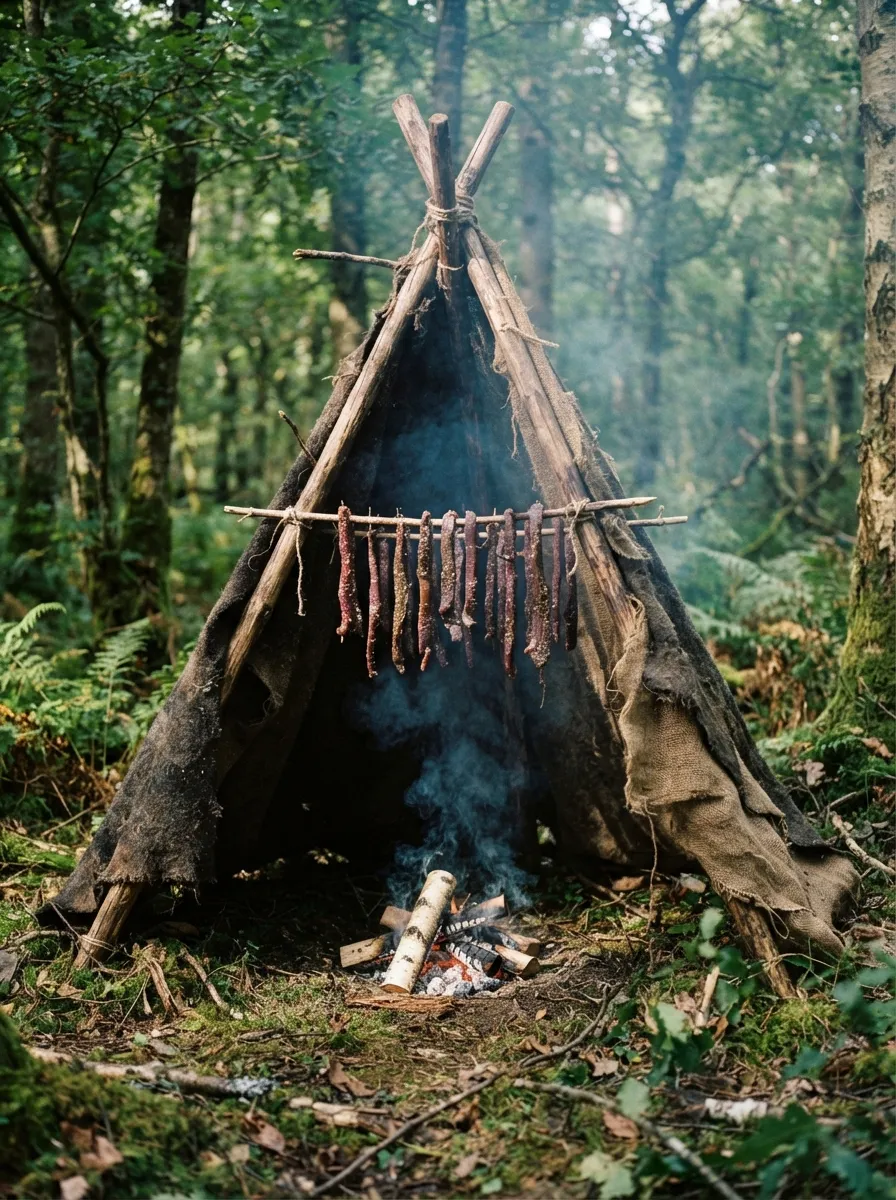
Smoking. “The intent is to produce smoke, not heat.” Build a tripod out of three poles, wrap a poncho around it, start a low fire using damp hardwood, and hang thin strips of meat so they don’t touch. A single night of smoking preserves meat for about a week; two full days extends shelf life to two to four weeks. Finished meat turns into “hard, dark, brittle sticks” eaten as-is. Never use resinous evergreens like pine or fir—their heavy soot ruins food.
Drying. Cut 6 mm strips along the grain, hang them on a rack exposed to sun and wind, and cover them to block blowflies. Meat is fully dried when it turns brittle and no longer feels cool to the touch.
Pemmican. Dry meat until brittle (five pounds of fresh meat yields one pound dried), pound it into a fine powder, mix it in equal parts by weight with rendered fat (and optional dried berries), then pack it tightly into raw-hide pouches. British Boer War field rations remained “perfectly edible after decades,” prompting polar explorer Robert Peary to state that its value on Arctic expeditions could never be overstated.
Frequently asked questions
Which insects are safe to eat in a survival situation?
Crickets, grasshoppers, and locusts are the easiest to catch, especially early in the morning when cold weather makes them sluggish. Always cook them to kill internal parasites. Avoid stinging or biting species, hairy caterpillars, brightly colored insects, foul-smelling bugs, spiders, ticks, flies, and mosquitoes.
How do I fish without a rod or professional tackle?
Use a gorge hook—the oldest hook design in human history. It consists of a simple stick sharpened at both ends, threaded lengthwise inside bait. When pulled, it turns crosswise inside the fish’s throat, provided you give the fish time to swallow it first. Passive methods like set lines rigged overnight or bottle fish traps work continuously while you sleep, yielding far better energy returns than active rod fishing.
Can I eat every part of an animal I catch?
No, certain organs carry severe risks: polar bear and bearded seal livers contain lethal levels of vitamin A, which even Inuit hunters discard. However, when dressing lean game, consume the entire carcass—including the brain, bone marrow, healthy liver, and heart—to get essential fats that lean muscle meat lacks.
Why is eating only lean meat dangerous in a survival scenario?
Consuming exclusively lean meat leads to protein poisoning, commonly known as “rabbit starvation” (documented by explorer Vilhjalmur Stefansson). If protein accounts for more than ~35% of daily calories without fat or carbohydrates, the human liver cannot process the excess urea, triggering severe diarrhea, debilitating headaches, and eventual starvation within days. You must supplement lean meat with animal fat or wild carbohydrates like tubers and acorns.
Are survival traps like snares or figure-4 deadfalls legal in France?
No, setting traps is illegal outside genuine life-or-death survival emergencies. Snares are restricted to licensed trappers using standardized gear, while improvised deadfalls have no legal standing. The sole exception is the legal defense of “state of necessity” under Article 122-7 of the French Penal Code, applicable only when someone is genuinely lost and facing imminent danger—never during recreational bushcraft outings.
How do I preserve meat in the wild without a refrigerator?
Cold-smoking meat overnight preserves it for roughly one week, while two full days of smoking extends shelf life up to four weeks—provided you burn non-resinous hardwoods. Drying thin meat strips in sun and wind, or making pemmican (pounded dried meat mixed in equal parts with rendered fat), keeps meat edible for weeks, or even years in the case of pemmican.
Summary
- Energy balance dictates survival food gathering: insects, passive fishing, and traps yield far more calories than they cost to set up, whereas tracking big game almost always drains your energy.
- Insects: avoid bright colors, hairs, strong odors, stinging bugs, flies, and ticks. Strip wings and spiny legs, and always cook them.
- The most effective fishing happens unattended: gorge hooks with slack line, set lines, bottle fish traps, and tidal weirs.
- Traps succeed based on placement (fresh animal runs, natural funnels, scent masking) rather than complex trigger mechanics; setting them in France is illegal outside true survival emergencies.
- What kills you on a full stomach: eating exclusively lean meat, polar bear or seal livers, undercooked wild boar, summer mussels, and raw land snails.
Going further
- FM 21-76 / TC 3-21.76, Chapter 8 “Food Procurement”—free US Military manual, English, source material for much of this guide.
- John “Lofty” Wiseman, SAS Survival Handbook—see the “Food” chapter for field trapping and butchering game.
- Ray Mears, Extreme Survival (BBC)—episodes covering wilderness fishing and primitive trapping techniques.
- FAO, Edible insects: future prospects for food and feed security (2013)—the definitive reference report on human insect consumption.
Sources for this module (40)
- FM 21-76 US Army Survival Manual, ch. 8 « Food Procurement » (texte intégral)
- Wikipedia — Protein poisoning (rabbit starvation, Stefansson)
- The Prepared — Rabbit starvation: why you can die with a stomach full of lean meat
- Hektoen International — Rabbit starvation (protein poisoning)
- Wikipedia — Hypervitaminosis A (foie d'ours polaire, de phoque barbu)
- Wikipedia — Xavier Mertz (Far Eastern Party, foies de chiens de traîneau)
- Ministère de l'Agriculture — Sanglier cru ou peu cuit : risque de trichinellose
- Wikipedia — Trichinosis
- Wikipedia — Paralytic shellfish poisoning (saxitoxine)
- Chiffres clés de la mer et du littoral 2024 — Toxines algales (REPHYTOX)
- Wikipedia — Angiostrongylus cantonensis (escargots et limaces crus)
- Wikipedia — Insects as food (table nutritionnelle, risques)
- Lonama — Insectes comestibles : nutrition, écologie, guide pour débuter (chiffres FAO)
- Wikipedia — Witchetty grub
- Wikipedia — Honeypot ant
- Wikipedia — Bogong moth
- Field & Stream — Survival fishing: how to make a gorge hook
- Wikipedia — Fish weir
- Wikipedia — Noodling
- MeatEater — The beginner's guide to catfish noodling
- Wikipedia — Gigging (grenouilles à la lampe)
- Outdoor Life — How to rig a Paiute deadfall trap, step by step
- Practical Self Reliance — How to make a figure 4 deadfall trap
- Bushcraft USA — Paiute deadfall variation tutorial
- RECOIL Offgrid — 6 trap triggers for survival
- Les chasseurs de Fragny — Le collet : généralités et astuces
- ASPAS — J'ai trouvé un collet devant un terrier, est-ce légal ?
- Wikipédia — Chasse au collet
- Légifrance — Code pénal, article 122-7 (état de nécessité)
- Légifrance — Arrêté du 19 novembre 2007, amphibiens et reptiles protégés
- Ministère de la Transition écologique — Pêche en eau douce
- Wikipédia — Helix pomatia (ramassage réglementé)
- Wikipédia — Crapaud commun (bufotoxine)
- Wikipédia — Tularémie (lièvres, 41 à 121 cas par an en France)
- Wikipédia — Écrevisse de Louisiane (statut en France)
- Wikipedia — Hāngī (four enterré maori)
- Wikipedia — Pemmican
- Wikipedia — Smoking (cooking)
- Wikipedia — Stone boiling
- Kavle et al. 2023, Foods — Earthworm (Eisenia andrei) as an alternative food source
Continue in "The fundamentals"

Mindset: the key to everything
Before fire, before water, before shelter: what happens in your head during the first ten minutes.

Water: Finding, collecting, and making it drinkable
Three days without water is the popular myth. The real question is where it's hiding and what's inside it.
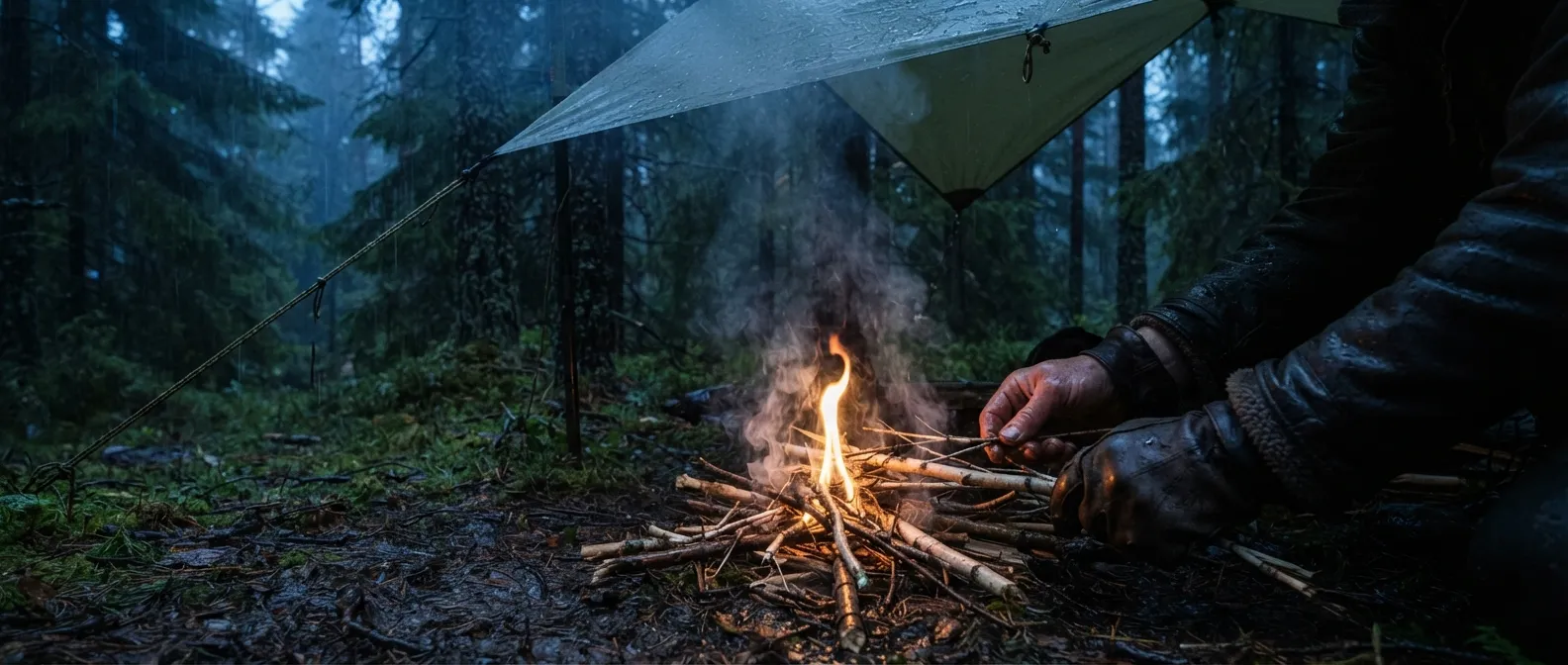
Fire: light it anywhere, keep it always
In the rain, on the snow, without a lighter: the physics of fire, techniques that work, and those that only work in the movies.