First aid far from help
When the ambulance is six hours away on foot, what you do in the first ten minutes decides everything.
It is 3:40 PM, you are four hours away from the last village, and your partner just slipped on a wet rock slab. They aren’t getting up, their leg is bleeding through their pants, and your phone displays “no service”. Here, you are the ambulance, the nurse, and the doctor for the next few hours. This module does not replace training, but it gives you the order of priority, the numbers, and above all, the list of what NOT to do.
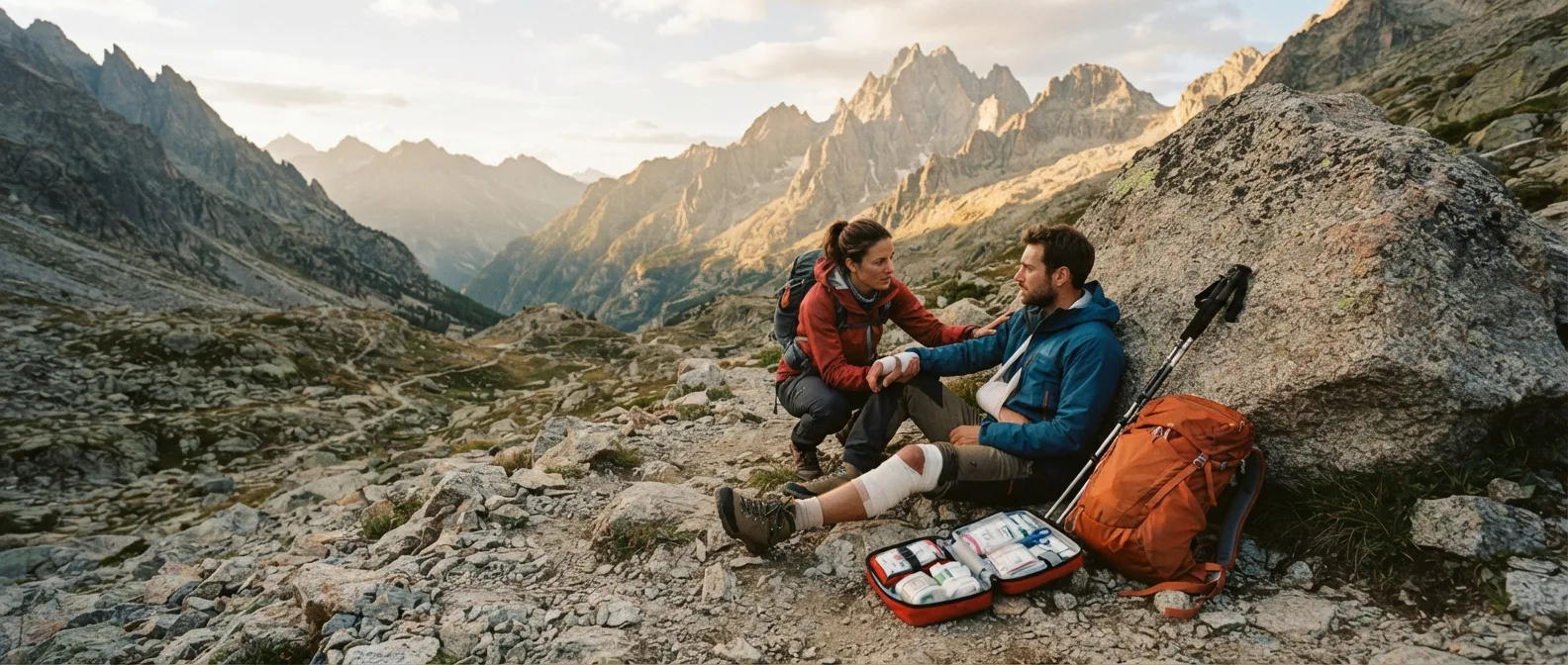
You first, then the one-minute assessment
An injured rescuer means two victims and zero help. Before touching anyone: is the danger that caused the accident still present (falling rocks, current, lightning, snake)? Next, your hands: gloves, a plastic bag, or cloth between you and the blood. Only then, assess the patient. The military replaced the ABCs of traditional first aid courses with MARCH, because in the field, what kills fast is blood pouring out.
- M — Massive hemorrhage: severe or spurting bleeding is treated before anything else, even before breathing.
- A — Airway: is the victim speaking? Their airway is clear. Unconscious but breathing? Recovery position.
- R — Respiration: count thirty seconds, watch if the chest rises evenly on both sides.
- C — Circulation: pulse, skin color, cold sweats, hidden bleeding (back, under clothing).
- H — Hypothermia and Head: an injured person cools down the moment they stop moving, even in summer. Isolate them from the ground, note the time.
The recovery position (described in 1891, adopted by the American Heart Association only in 1992) stops the tongue or vomit from blocking the throat of an unconscious person who is breathing. Another sign you must know: one side of the face drooping, an arm falling weak, slurred speech — the FAST test for a stroke. Nothing to treat on-site, except noting the time of onset and evacuating immediately.
Blood: compression, dressing, tourniquet
Three steps, matching the Stop the Bleed program: press, pack, tourniquet. First, direct pressure with your full hand, without lifting to “check if it’s still bleeding”. To free up your hands, use a pressure dressing: a clean cloth on the wound, a wide wrap wrapped at least twice, pulled tight directly over the bleeding spot. If blood soaks through, add a second layer without removing the first.
If that is not enough, or if a limb is crushed, apply a tourniquet: 5 to 8 cm (2 to 3 inches) above the wound, never over a joint, tightened until the bleeding stops — not just until it hurts, because it will hurt long before that. Write the time on the person’s forehead or on the tourniquet. Never loosen a tourniquet “to let blood pass”: that old habit has bled victims dry in spurts.
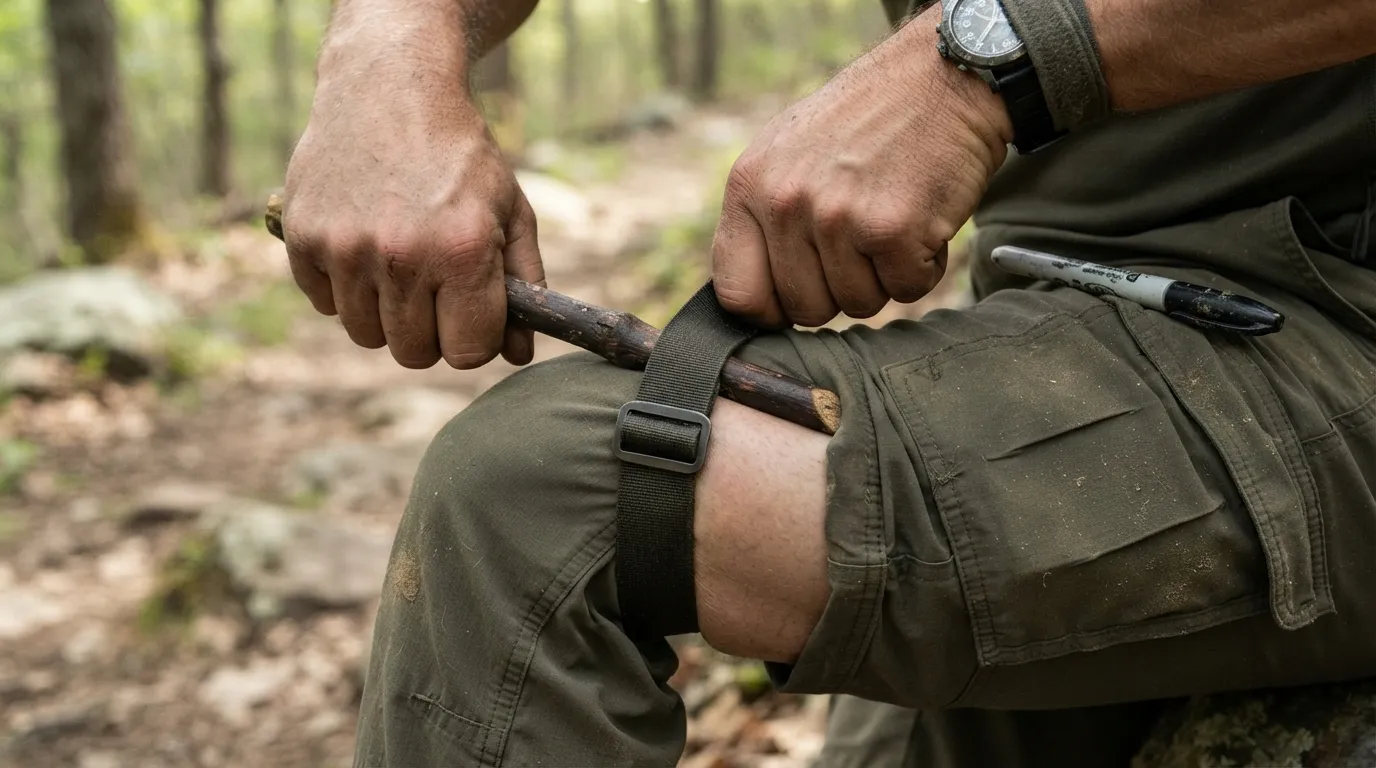
Why doesn’t a belt work? Because pulling by hand will never close a thigh artery: you need a windlass — a stick slipped into the binding and twisted — and a wide band, because a thin cord cuts skin before shutting down the artery. A stiff belt won’t twist; a bandana, backpack strap, or rolled sleeve will. Even then, improvised ones often fail on the thigh: that’s why an 80 g commercial tourniquet belongs in your kit.
Wounds, burns, blisters
Far from civilization, the main threat from a wound isn’t bleeding—it’s infection three days later. What matters is high-pressure irrigation: clean drinking water (water you would drink) pushed through a syringe, a squeezed hydration bladder, or a water bottle with a pinhole poked in the cap. Lots of water, in a strong jet, straight into the wound. The Cochrane review found no evidence that tap water causes more infections than sterile saline. Remove debris with tweezers, clip dead skin, and keep a dry dressing changed daily.
A bite wound is never closed up tightly. Dogs, cats, humans: mouths inject bacteria (including Pasteurella) deep into tissue. Sealing the wound seals in an abscess. Irrigate thoroughly, leave open under a dressing, and seek medical care for antibiotics and rabies risk. Signs that demand immediate descent: spreading redness, heat, pus, red streaks tracking up the limb, fever.
What about superglue? Cyanoacrylate was sprayed on wounded soldiers in Vietnam, and its medical-grade version (FDA approved, 1998) seals small, clean cuts. Hardware store glue irritates tissue, but on a clean, shallow, well-flushed cut, it holds. Never apply it to bites or dirty wounds; medical tape or butterfly bandages pull edges together just as well.
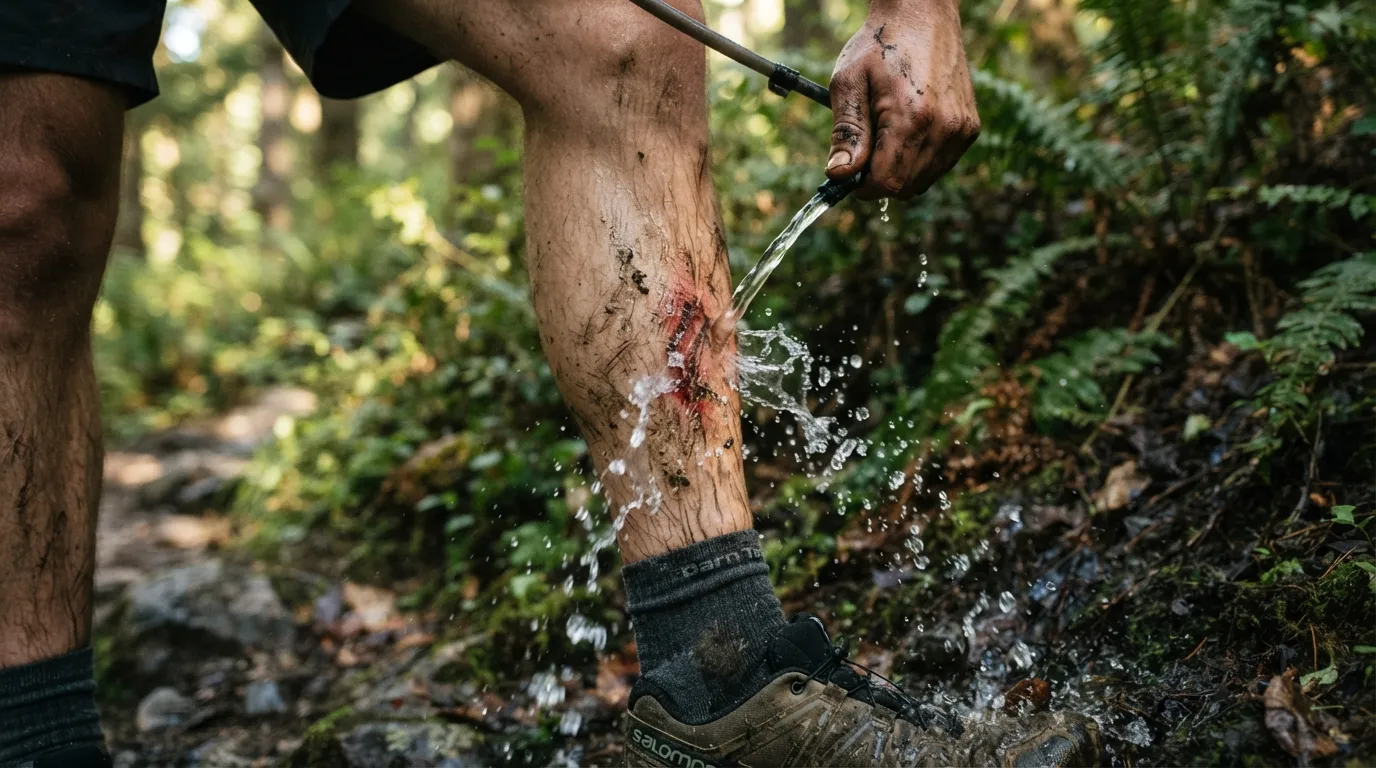
Burns: cool water (15 to 25 °C / 59 to 77 °F, not ice cold) for at least ten minutes. No butter, no toothpaste, no ice; cover with a clean, non-stick wrap. To gauge the burned area:
Blisters: prevent them, don’t try to cure them later. Tape hot spots BEFORE they blister (Leukotape or tough tape), and change socks as soon as they get wet. The Pre-TAPED study on 250 km ultra-marathons set the record straight: tape applied before the race did not stop blisters, with 89% of runners getting them by day two anyway. Nothing replaces broken-in footwear. Drain a large, painful blister using a sterile needle while keeping the roof intact; leave small ones alone under a bandage.
Bones and joints
For an ankle sprain without an X-ray machine: rely on the Ottawa Ankle Rules, which are 98–100% sensitive. Bone tenderness along the bottom 6 cm of the back edge of either malleolus, at the base of the fifth metatarsal, or the inability to bear weight for four steps: suspect a fracture. Otherwise, it is a sprain, and the rule from wilderness schools like NOLS is simple: strap it, lace your boot up tight, and walk out on your own feet before swelling sets in.
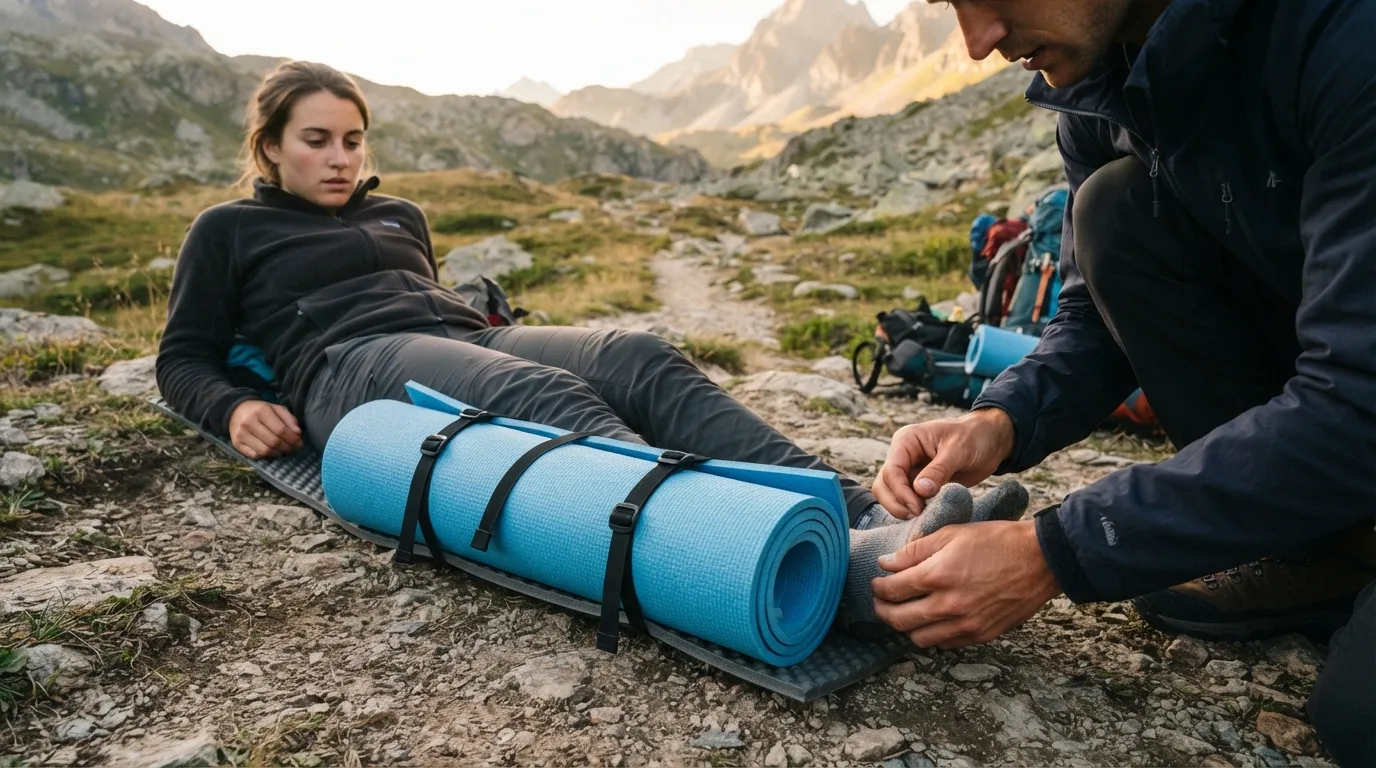
For a suspected fracture, immobilize the joint above and below the injury in the position you found it. The SAM Splint (0.4 mm of aluminum between two foam layers) was invented by a Vietnam surgeon playing with a gum wrapper: flat, it’s soft; folded into a curve, it becomes rigid. The same principle applies to a rolled foam sleeping pad, a stick alongside the tibia, or an emptied pack wrapped around an arm. Fill gaps with spare clothes, secure with bandanas, and check that fingers or toes remain warm and pink.
Dislocated shoulder, a classic ski accident: 97% are anterior, and muscle spasms are what lock the humerus head out of its socket. Pulling hard triggers stronger spasms. The Cunningham technique (2003) does the opposite: patient seated, back straight, arm pressed against their side, elbow bent, placing their hand on your shoulder; you gently massage the biceps halfway up the arm while asking them to pull their shoulder blades back and push their chest out, waiting for them to relax. Once the muscle releases, the bone often slips back into place without pain medication. Attempt nothing if the arm cannot lie against the torso, if the hand is numb, or if pain is excruciating: it might be a fracture.
Cold and water
Hypothermia begins below 35 °C (95 °F), and its early stage deceives people: the victim shivers, grumbles, and refuses to stop. The Swiss staging system breaks it down: Stage 1, conscious and shivering; Stage 2, drowsy, shivering has stopped; Stage 3, unconscious; Stage 4, no vital signs. As soon as shivering stops while it is still cold, the body has stopped heating itself: emergency.
- Ground insulation first: place a sleeping pad under the victim, or the earth will drain their heat faster than the air.
- Dry layer: cut away wet clothes if you can without rolling them around; otherwise, wrap right over them.
- Core heat: place warm water bottles or heat packs wrapped in cloth on the chest, armpits, and groin. Never directly on limbs or bare skin.
- Vapor barrier: wrap a tarp or space blanket around the body so moisture doesn’t soak the outer insulation.
- Insulation layer: sleeping bag, puffy jackets, anything that lofts.
- Outer shell: a second tarp against wind, head covered, face left open.
This isn’t folklore: Norwegian 2024 trials conducted in a −2 °C ice tunnel on wet volunteers used this exact setup. Active heating reduced afterdrop — the continued core temperature drop after moving out of the cold — to 0.3 °C instead of 0.7 °C. A victim who can talk and swallow should drink warm, sugary liquids: sugar is the fuel for shivering.
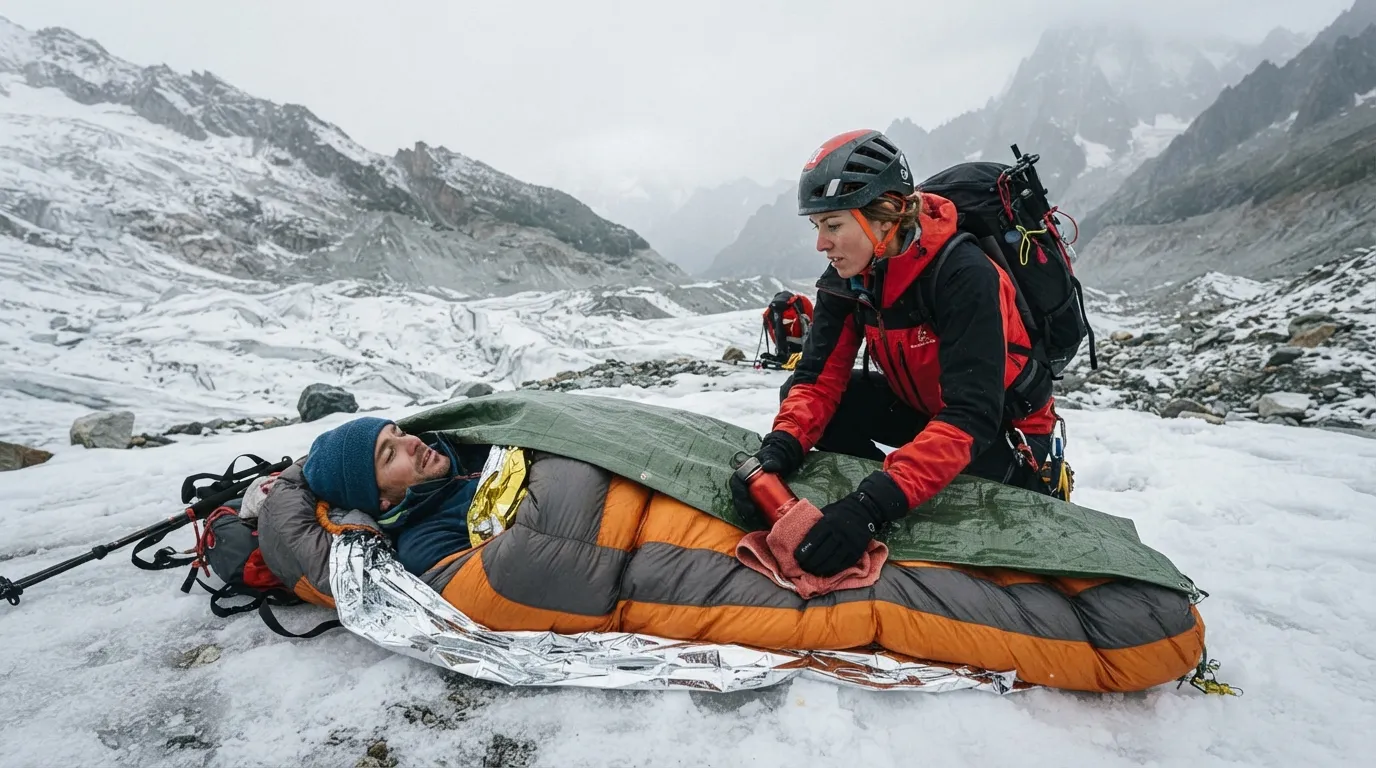
“No one is dead until they are warm and dead.” In 1999, Anna Bågenholm spent 80 minutes trapped under ice in Norway, reaching a core temperature of 13.7 °C (56.7 °F), went 2 hours and 35 minutes without a heartbeat, and returned to work as a radiologist months later. In 2026, a 70-year-old woman admitted to the hospital at 14.0 °C in cardiac arrest recovered with no neurological damage. Never give up on a hypothermic person just because they look dead: insulate them and evacuate.
Frostbite: white, hard, numb toes must only be rewarmed if you are certain they won’t freeze again. Refreezing thawed tissue causes far more destruction than leaving it frozen longer. You can walk on frozen feet to descend, but never on thawed ones. Once sheltered: rewarm in a water bath at 37–39 °C (98–102 °F) until tissue turns soft (about thirty minutes). Clear blisters can be drained, blood-filled blisters must stay intact under dry dressings. “Frostbitten in January, amputated in July”: the line of dead tissue takes weeks to show, so never cut anything in the field.
Cold water doesn’t kill you through hypothermia first. Dr. Gordon Giesbrecht, “Professor Popsicle,” summarized his research into the 1-10-1 rule: 1 minute to regain control of your breathing (below 15 °C / 59 °F, the gasp reflex cuts breath-holding from 60–90 seconds down to seconds), 10 minutes of useful movement, 1 hour before losing consciousness. Drowning victims do not yell or wave their arms: the instinctive drowning response lasts 20 to 60 seconds in total silence. Once pulled out, rescue breaths come first (it is an asphyxia event); forget the Heimlich maneuver or hanging people upside down “to drain water”. A child was successfully revived after 66 minutes in 3 °C water.
Heat, thirst, and gut issues
| Heat exhaustion | Heat stroke | |
|---|---|---|
| Core temperature | under 40 °C (104 °F) | over 40 °C (104 °F) |
| Brain function | intact, tired | confused, incoherent, seizures, coma |
| Sweating | profuse | present during effort, often absent in heatwaves |
| Pulse | fast and weak | fast and strong |
| Action | shade, drink, cool off | cool down BEFORE anything else, evacuate |
| Mortality | near zero | under 5% during exertion, 21–65% during heatwaves in hospitals |
The critical distinction comes down to one thing: brain function. Someone hot, staggering, and talking nonsense is experiencing heat stroke until proven otherwise, and every minute spent above 40 °C damages organs. “Cool first, transport second”: submerge in the coldest water available, or keep them wet and fanned continuously. The fear that cold water “constricts blood vessels” is outdated: colder water cools faster. Give nothing by mouth to a confused victim, and skip paracetamol/acetaminophen: the body’s thermostat isn’t miscalibrated, it is overwhelmed.
Dehydration shows up through dark, infrequent urine and skin pinching that stays tented. Correct it with ORS (Oral Rehydration Salts), the only formula this module gives, proven across millions of cholera cases:
- 1 liter of safe drinking water (boiled or treated, otherwise you reinfect).
- 6 level teaspoons of sugar (about 25 g).
- 1/2 level teaspoon of salt (about 2 g). Taste it: no saltier than tears. Too much salt makes things worse.
- Sip slowly, 200 to 400 mL after every loose stool for adults.
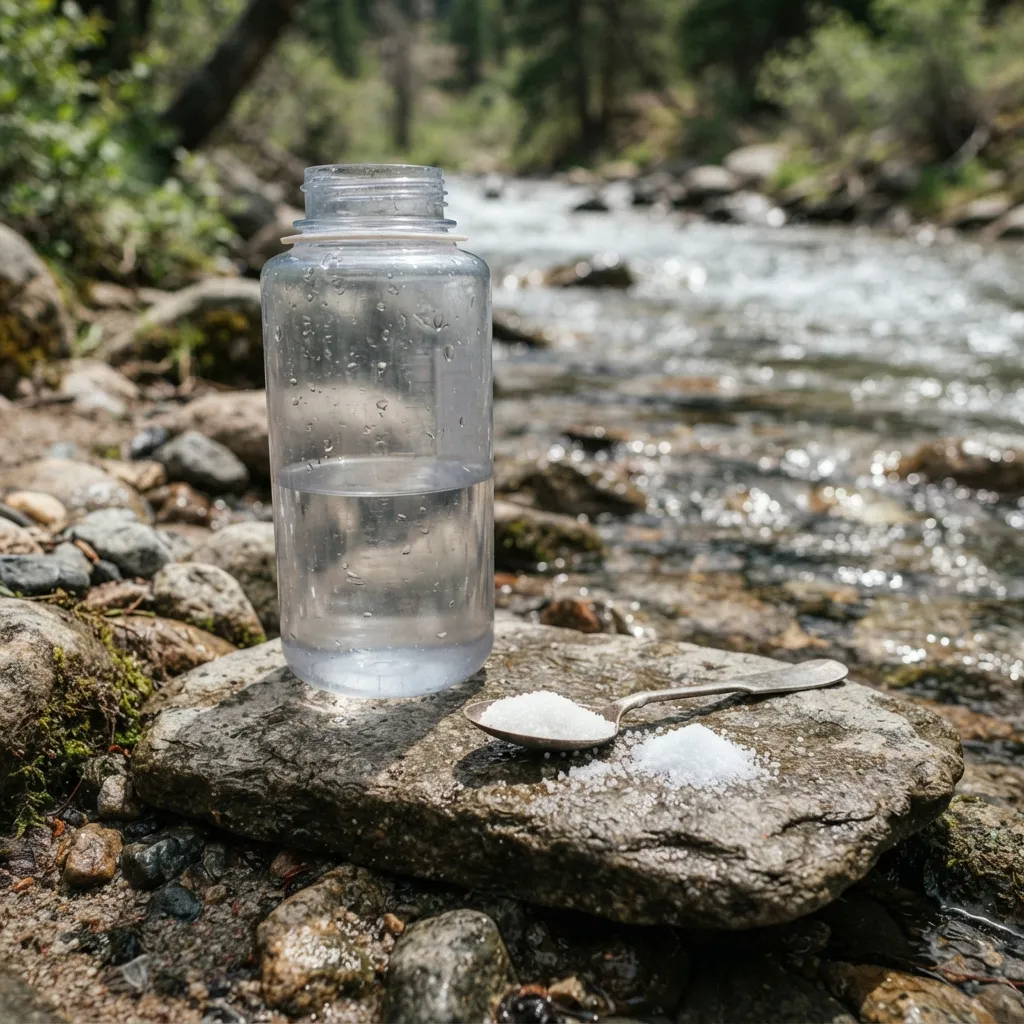
In 1971, in Bangladesh refugee camps, this formula dropped cholera mortality from 30% down to 3.6%. For traveler’s diarrhea: ORS, rest, and evacuate if blood appears in stool, fever spikes, or symptoms persist. The CDC notes that the “boil it, cook it, peel it, or forget it” mantra rarely prevents illness: bad kitchen hygiene is what makes people sick.
Bugs, plants, and altitude
Snakes. In Europe, 25 to 50% of viper bites are “dry” (no venom), and deaths are extremely rare; globally, snakebites cause 5.4 million incidents and 81,000 to 138,000 deaths annually. Management remains unchanged: stay calm, immobilize the limb below heart level, remove rings and watches before swelling begins, trace the edge of swelling with a marker adding the time, and evacuate toward antivenom. No tourniquets, no cuts, no suction, no ice, no alcohol. Australian pressure immobilization is reserved for neurotoxic elapids; on pit vipers, whose venom destroys local tissue, compression concentrates damage.
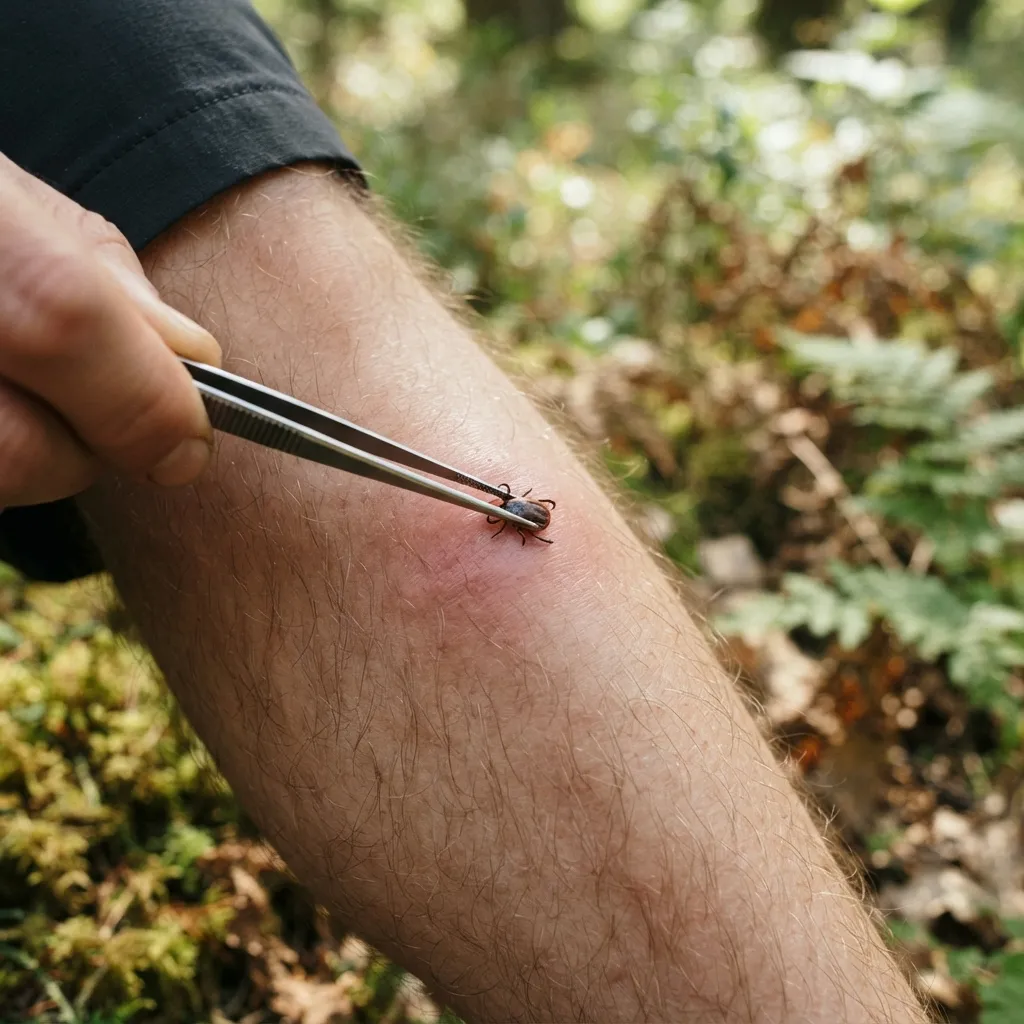
Ticks. Remove straight out using fine tweezers or a tick tool, pulling close to the skin without twisting or crushing. Avoid alcohol, vaseline, lighters, or nail polish, which cause the tick to regurgitate into the wound. Disinfect and monitor for 30 days: erythema migrans (target rash) appears 3 to 30 days later in 70–80% of Lyme cases, expanding up to 30 cm, though it doesn’t always show a bullseye. Removed within 36 hours, a tick rarely transmits disease. Stings with facial swelling, trouble breathing, or dizziness indicate anaphylaxis: WMS guidelines state epinephrine auto-injectors take priority over antihistamines. If the victim has one, help them use it immediately.
Plants. Poison control centers record hundreds of poisonings yearly from misidentification: autumn crocus mistaken for wild garlic, foxglove for comfrey, or arum for sorrel. If a toxic plant was eaten: do not induce vomiting, do not force fluids (milk is not an antidote), save a sample or take photos, and call poison control as soon as you get signal. Activated charcoal works only within an hour, never on a drowsy patient, and does not bind alcohol or iron: it belongs in a hospital setting.
Altitude. Acute Mountain Sickness (AMS) affects 15% of people at 2,000 m (6,500 ft) and 60% at 4,000 m (13,000 ft): headache, nausea, insomnia, appearing 4 to 12 hours after arrival. Three golden rules: any altitude headache is AMS until proven otherwise; never ascend with symptoms; descend immediately if they worsen. Two signs require emergency descent, even at night: inability to walk heel-to-toe in a straight line (cerebral edema / HACE), or a pink, frothy cough with breathlessness at rest (pulmonary edema / HAPE). Preventive drugs require a prescription beforehand; ginkgo biloba does not work.
When everything stops, and what’s in your pack
Wilderness CPR raises a question urban first aid never faces: when do you stop? Chest compressions at 100–120 per minute, 5 to 6 cm deep, 30 compressions to 2 breaths; for adults, hands-only CPR works just as well. But CPR rarely restarts a stopped heart on its own—a defibrillator does, and you don’t have one. Avalanche guidelines state: non-hypothermic victim, 30 minutes without return of spontaneous circulation, you can stop. Do not start if the chest is frozen solid, if injuries are incompatible with life, or if continuing puts the group in danger. Keep going while evacuating if the victim is severely hypothermic or pulled from icy water.
Three minor issues that can derail a trip. Eye injuries: blink, flush copiously with clean water (NHS advises twenty minutes), pull the top lid over the bottom one, never pull out an embedded object. Knocked-out tooth: handle by the crown, do not scrub the root, reinsert in its socket if possible, or store in milk or under the tongue, never in plain water—see a dentist within an hour. Splinters: wood or thorn splinters infect far worse than glass; remove quickly along the entry angle.
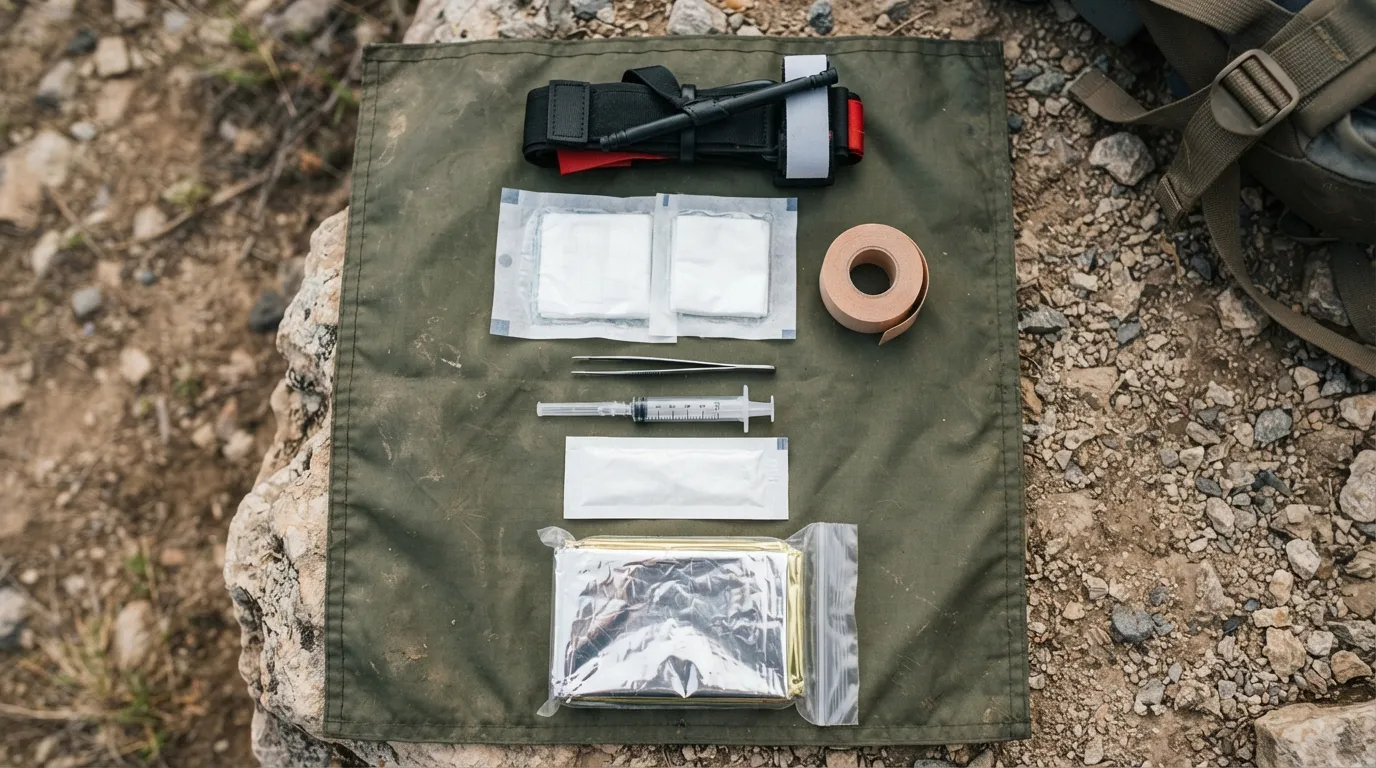
Everything else can be improvised: a bandana becomes a pressure bandage, sling, tourniquet, or finger splint; a tarp becomes a burrito wrap, litter, or shelter; a trekking pole becomes a windlass, splint, or crutch. What cannot be improvised is the sequence of actions: a two-day Wilderness First Aid (WFA) course is the single best gear investment you can make.
Frequently asked questions
How do I stop severe bleeding without medical gear?
Treat flowing blood before anything else, even before checking breathing: apply firm, direct hand pressure without lifting. Wrap a tight pressure dressing to free your hands. If bleeding persists, apply a wide tourniquet using a stick as a windlass, tightening it until bleeding stops completely, and write down the application time.
Will a tourniquet cause someone to lose their limb?
That reputation stems from World War II when tourniquets remained locked on for hours. Recent evidence from combat medicine shows tourniquets applied before hemorrhagic shock deliver the best survival outcomes, with low complication rates when applied correctly under two hours. Never loosen a tourniquet “to let blood flow”—that old habit causes fatal blood loss.
What should you do for a snakebite?
Stay calm, immobilize the limb below heart level, remove rings or watches before swelling starts, and trace the swelling edge with a pen marking the time. Never apply a tourniquet, cut the skin, suck the wound, or apply ice: those actions worsen tissue damage without removing venom.
How do you rewarm a hypothermic victim safely?
Wrap them in a “burrito” setup: insulation under the body, wrapped heat sources applied to the torso (never directly on skin or limbs), followed by a moisture barrier and insulating outer layers. Do not rub them, shake them, or stand them up abruptly: below 30 °C, the heart is unstable and sudden movements can trigger fatal ventricular fibrillation.
How do you tell heat stroke apart from simple heat exhaustion?
The deciding factor is brain function: a person who staggers, acts confused, or speaks incoherently with a high body temperature is experiencing heat stroke. Cool them down immediately before trying to move them. Heat exhaustion leaves mental function intact, accompanied by heavy sweating and a fast but weak pulse.
How do you mix a homemade oral rehydration solution (ORS)?
The WHO formula for 1 liter of clean water is simple: six level teaspoons of sugar (about 25 g) and half a level teaspoon of salt (about 2 g), sipped slowly. It should taste no saltier than tears; this formula helped drop cholera death rates from 30% to 3.6% in 1971 refugee camps.
Key takeaways
- MARCH: severe bleeding comes first, and an injured person loses heat the moment they stop moving.
- A tourniquet is tightened until bleeding stops, timed, and left in place; a belt won’t work, but a bandana with a stick windlass will.
- Flush wounds using high-pressure drinking water; never close a bite wound.
- Wrap hypothermic victims in a burrito and handle them like glass; they aren’t dead until they are warm and dead. Only rewarm frostbite if there is zero risk of refreezing.
- Confusion + heat = heat stroke; cool them before moving. Snakebites: immobilize and note the time—no tourniquets, no suction, no ice. Call emergency services the second you get signal.
Going further
- Paul S. Auerbach, Medicine for the Outdoors (Elsevier): the definitive guide by the founder of the Wilderness Medical Society.
- Wilderness Medical Society practice guidelines (hypothermia, frostbite, altitude, heat illness, drowning, bites), free at wms.org.
- Take a standard First Aid / CPR course, followed by a Wilderness First Aid (WFA) certification.
- Stop the Bleed program (stopthebleed.org): press, pack, tourniquet training.
Sources for this module (21)
- Wilderness Medical Society — Accidental Hypothermia, 2019 Update (Dow, Giesbrecht et al.)
- Wilderness Medical Society — Frostbite, 2024 Update (McIntosh et al.)
- Wilderness Medical Society — Pit Viper Envenomations, 2026 Update
- Wilderness Medical Society — Acute Altitude Illness, 2024 Update (Luks et al.)
- Wilderness Medical Society — Drowning, 2024 Update
- Wilderness Medical Society — Heat Illness, 2024 Update
- Wilderness Medical Society — Basic Wound Management in the Austere Environment, 2014
- Synthèse 2025 des recommandations WMS altitude/froid/avalanche (Int J Environ Res Public Health)
- Parker-Cote & Meggs, First Aid and Pre-Hospital Management of Venomous Snakebites, 2018
- Gharraei et al., Keep Cool but Don't Freeze: William J. Mills and frostbite, WEM 2024
- Cochrane — Honey as a topical treatment for wounds
- Cochrane — Water for wound cleansing
- CDC — First aid for venomous snakebites
- CDC — What to do after a tick bite
- Croix-Rouge française — Les gestes de premiers secours
- Centres antipoison français — conduite à tenir
- ANSES — Plantes toxiques : confusions et intoxications
- Lipman et al., Pre-TAPED : paper tape et ampoules en ultra-trail, WEM 2014
- Kano et al., survie après arrêt cardiaque à 14,0 °C, Resuscitation Plus 2026
- Wikipédia — Solution de réhydratation orale (recette OMS)
- Wikipedia — Cunningham technique, Hypothermia, Snakebite, Tourniquet, Lightning injury
Continue in "The fundamentals"
Mindset: the key to everything
Before fire, before water, before shelter: what happens in your head during the first ten minutes.
Water: Finding, collecting, and making it drinkable
Three days without water is the popular myth. The real question is where it's hiding and what's inside it.
Fire: light it anywhere, keep it always
In the rain, on the snow, without a lighter: the physics of fire, techniques that work, and those that only work in the movies.