🌵 Parry's agave
Agave parryi · Asparagacées
🔍 Identify it without mistakes
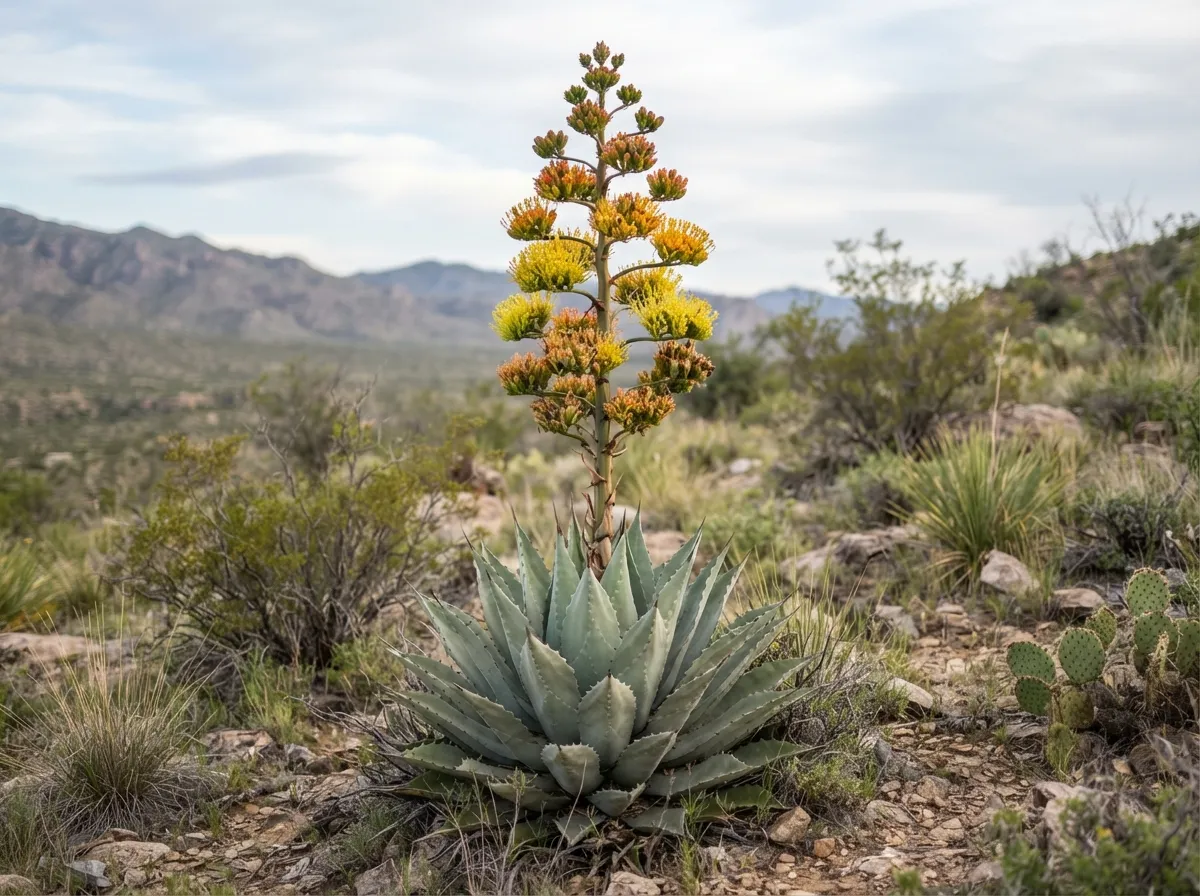
Succulent plant forming a compact rosette of thick, fleshy, blue-gray leaves. The leaf margins often have small teeth and end in a sharp, black terminal spine. It blooms only once in its lifetime (monocarpic plant), sending up a dramatic 3 to 6 m flower stalk in just a few weeks before dying.
- compact rosette of thick, blue-gray fleshy leaves
- hard, black terminal spine on every leaf
- teeth sometimes present along the leaf margins
- single, massive flower stalk produced at the end of the plant's life (5–30 years depending on species and climate)
⚠️ Not to be confused with
To tell them apart: when cut open, an aloe leaf reveals a translucent, gelatinous gel; an agave leaf is fibrous and pulpy with no gel, oozing an irritating sap. Agave forms a much larger, rigid rosette with hard marginal teeth and a sharp black terminal spine, whereas aloe has soft teeth and a non-prickly tip
🍽️ Eating it
Preparation : slow, prolonged cooking is essential (12 to 48 hours) in a pit heated by hot rocks — an ancestral technique documented throughout the Southwest and Mexico. This process converts the complex, indigestible fructans of the raw heart into digestible sugars and breaks down irritating compounds. The young flower stalk, harvested before flowers open, is cooked the same way and eaten like a sweet vegetable. Flowers should be blanched before eating.
💊 Healing with it
sap and pulp traditionally used externally on wounds and insect bites; roots used traditionally as soap (saponins, similar to yucca)
Level of evidence : traditional use — USDA Forest Service — Agave species profiles; Southwestern ethnobotanical literature
⚠️ fresh sap and raw leaves contain calcium oxalates and other irritating compounds that cause a burning sensation and contact dermatitis in some people; raw, uncooked hearts are indigestible and can irritate the digestive tract — long cooking is mandatory before consumption
🪓 Other bushcraft uses
- leaf fibers (including sisal, from a related species) spun into cordage, nets, and sandals
- fermented sap used as a traditional beverage in several Mesoamerican cultures (the origin of pulque, and historically of tequila from Agave tequilana, a distinct species)
- ready-to-use natural needle made by snapping off the terminal spine with its attached fibers
No entry replaces a certain identification in the field, or medical advice. When in doubt: don't eat it. If ingestion is suspected: poison control or 112/911.