🧄 Wild leek (ramps / ail des bois)
Allium tricoccum · Amaryllidaceae
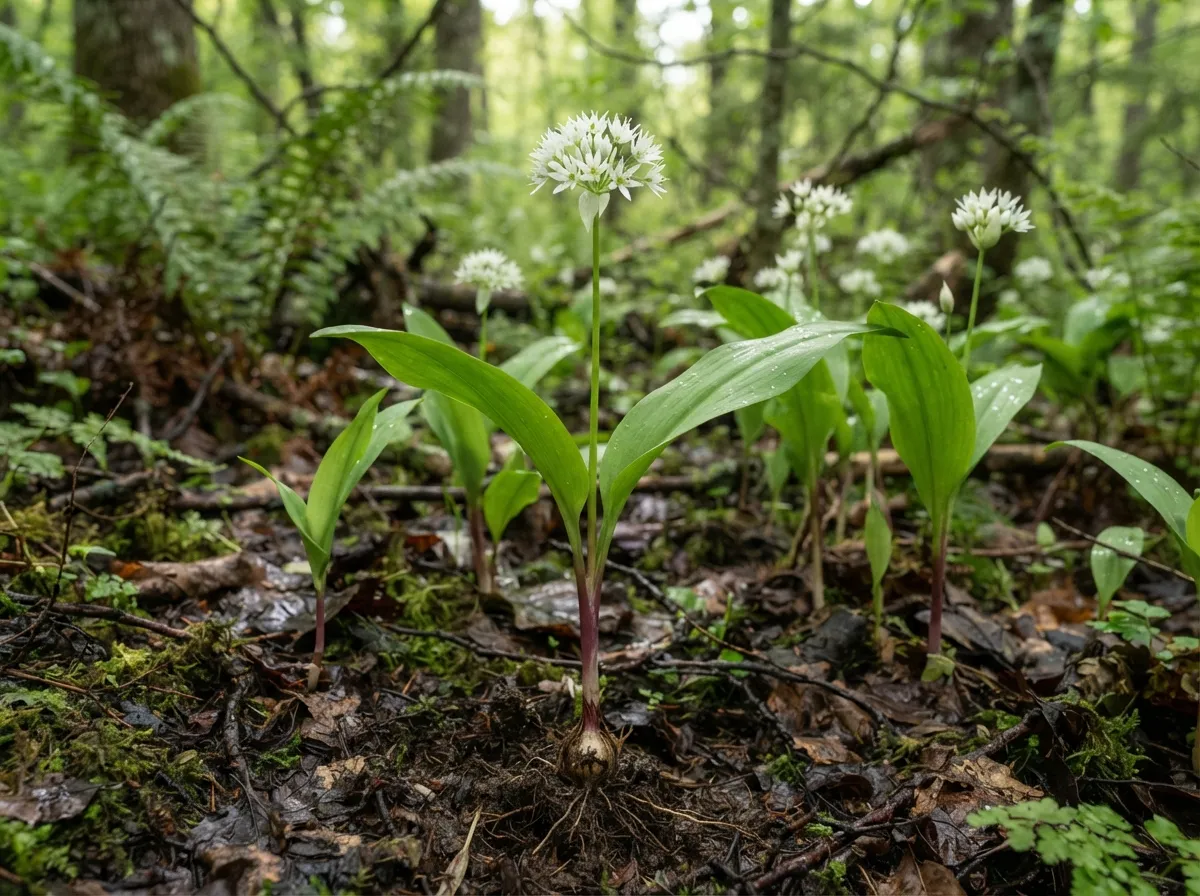
🔍 Identify it without mistakes
Understory bulbous plant forming large spring colonies, featuring two or three broad, smooth, tender green leaves and a pinkish-white bulb that gives off a strong garlic-onion smell as soon as you crush it — a crucial identification criterion. The leaves disappear before summer blooming (a subtle white umbel appears on a bare stem in summer, once the leaves have withered).
- clear garlic/onion smell when leaf or bulb is crushed
- 2-3 broad, smooth leaves, base often tinged with red-purple
- leaves gone by the time it blooms (July)
- dense colonies on rich forest floor
⚠️ Not to be confused with
To tell them apart: lily of the valley has NO garlic or onion smell when crushed — this is your decisive field test, to be done systematically before any harvest
To tell them apart: young false hellebore shoots can look like wild leeks before smelling them, but their leaves are pleated like an accordion with pronounced parallel veins, and they have no onion/garlic odor whatsoever
🍽️ Eating it
Preparation : raw in salads or pesto, sautéed like a leek, pickled, or dried for winter; the bulb has the strongest flavor, while the leaf is milder
💊 Healing with it
traditionally used as a spring tonic rich in vitamins after winter, and as a poultice against insect bites
Level of evidence : traditional use — Native American Ethnobotany Database (Moerman, University of Michigan)
⚠️ harvesting the whole bulb kills the plant and the colony regenerates very slowly (a decade or more) — many wild populations are declining due to commercial overharvesting; opt for cutting a single leaf per plant rather than pulling up the bulb
🪓 Other bushcraft uses
- major spring resource for many Eastern Indigenous nations, including as the first fresh food after winter
Sources (3)
No entry replaces a certain identification in the field, or medical advice. When in doubt: don't eat it. If ingestion is suspected: poison control or 112/911.