🧄 Wild garlic
Allium ursinum · Amaryllidaceae
🔍 Identify it without mistakes
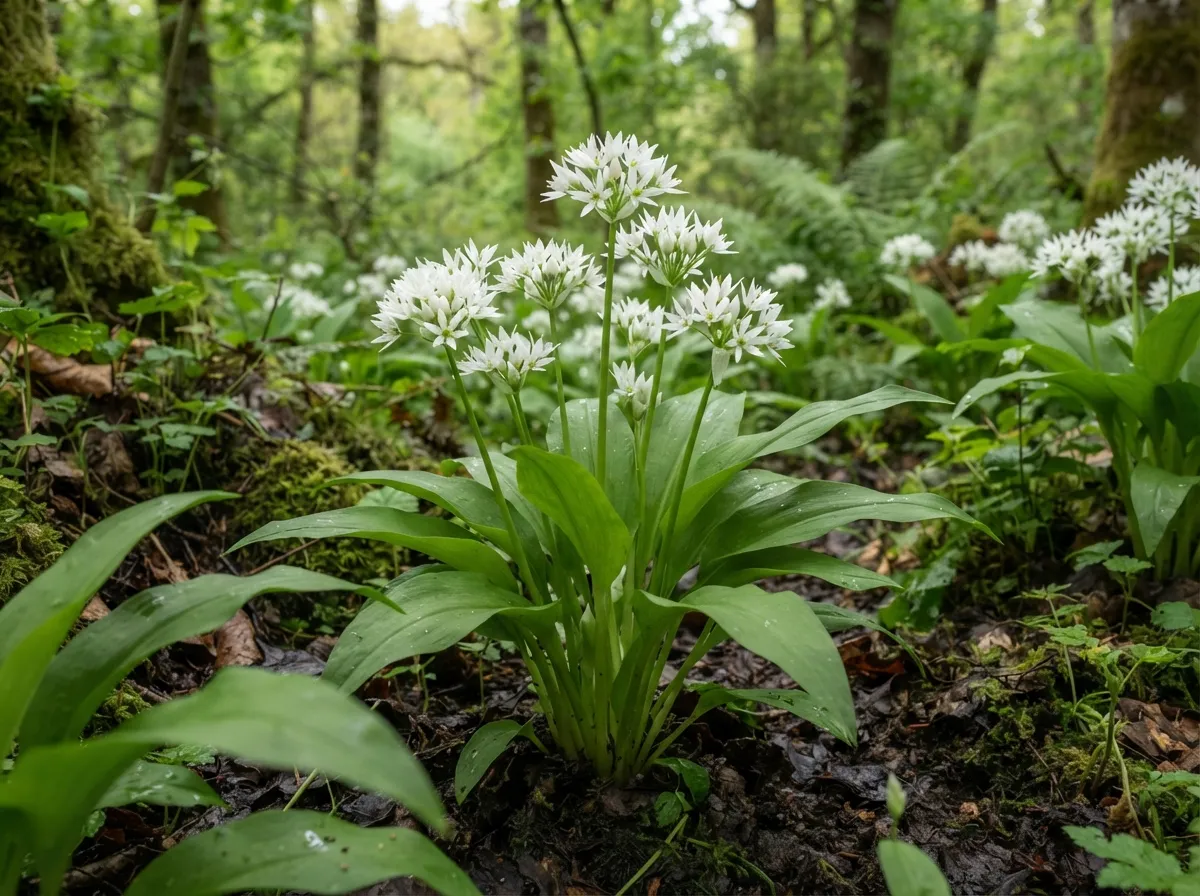
Dense carpet of shiny green lanceolate leaves blanketing damp undergrowth in spring, each leaf supported by its own stem growing directly from the ground (no common stem). The intense garlic smell released as soon as you crush a leaf is the ultimate safety criterion, to be checked systematically before any harvest.
- strong and immediate garlic smell when crushed — mandatory test
- shiny matt green lanceolate leaves, each on its own stem growing from the ground
- umbel of star-shaped white flowers at the top of a triangular stalk, May-June
- often very dense single-species carpet in damp undergrowth
- no visible bulb on the surface (small, white, buried bulb)
⚠️ Not to be confused with
To tell them apart: lily of the valley is completely odorless (no garlic smell), its 2-3 leaves sprout from a common sheath at the base and not individually from the ground, and its upper surface is dull while wild garlic's is shiny
To tell them apart: meadow saffron is odorless, its leaves are stiffer, shinier, fleshier, clustered in 3-6 directly at the base without an individual stem, and sprout from a dark, round bulb
To tell them apart: broad arrowhead-shaped leaf, often spotted with black, no garlic smell, very different netted venation
🍽️ Eating it
Preparation : raw and chopped in pesto, butter, or salads; cooked quickly in soups or as a garnish, rapidly loses its flavor with long cooking
approx, European compilations (German database Souci-Fachmann-Kraut cited by several sources)
💊 Healing with it
traditionally used as a digestive aid, mild hypotensive, and gentle intestinal antiseptic, with properties similar to cultivated garlic but less clinically documented
Level of evidence : traditional use — herbal medicine compilations (Wikiphyto, PFAF)
⚠️ always check the smell before eating (risk of fatal confusion with lily of the valley or meadow saffron); may interact with anticoagulant treatments just like cultivated garlic
🪓 Other bushcraft uses
- ecological indicator of ancient woodland and undisturbed rich soil
Sources (3)
No entry replaces a certain identification in the field, or medical advice. When in doubt: don't eat it. If ingestion is suspected: poison control or 112/911.