🧄 Garlic mustard
Alliaria petiolata · Brassicaceae
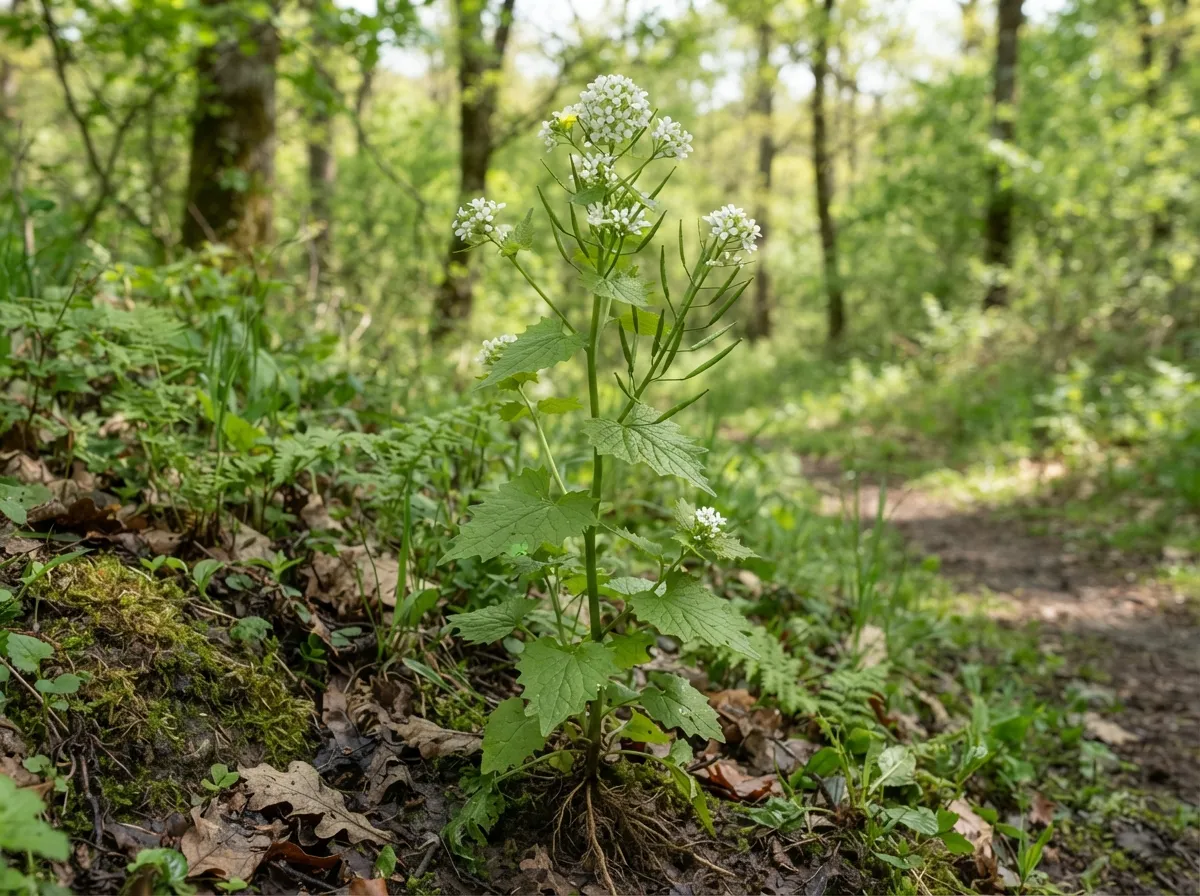
🔍 Identify it without mistakes
Biennial of forest edges and hedgerows whose absolute identification key is olfactory: crushing a leaf releases a distinct garlic smell, even though it actually belongs to the cabbage family and has no botanical relation to garlic. In its first year, it forms a rosette of heart-shaped leaves; in its second year, it produces a flowering stalk with small, white cross-shaped flowers typical of the Brassicaceae family.
- distinct garlic smell when leaves are crushed (decisive key feature)
- heart-shaped, coarsely toothed leaves, forming a rosette in the 1st year
- small white flowers with 4 cross-shaped petals (typical Brassicaceae), 2nd year
- fruits in long erect siliques, like wild mustard
- angular stem, often slightly hairy at the base
⚠️ Not to be confused with
To tell them apart: only garlic mustard gives off a clear garlic smell when crushed; ground ivy smells like peppermint, while violets have no strong smell
🍽️ Eating it
Preparation : raw leaves and flowers in salads or pesto (garlic flavor without the heat); does not tolerate long cooking well, which makes it lose its aroma and develop bitterness; grated root works as a horseradish substitute
💊 Healing with it
traditionally used as an antiseptic and mild vermifuge, rich in sulfur compounds similar to those found in garlic
Level of evidence : traditional use — ethnobotanical compilations (PFAF)
⚠️ no major known contraindications at food doses
🪓 Other bushcraft uses
- classified as an invasive plant in North America where it inhibits the germination of surrounding trees (allelopathic effect) — a textbook example of a plant that is useful in Europe but harmful elsewhere
No entry replaces a certain identification in the field, or medical advice. When in doubt: don't eat it. If ingestion is suspected: poison control or 112/911.