🌿 Wild Angelica (Woodland Angelica)
Angelica sylvestris · Apiaceae
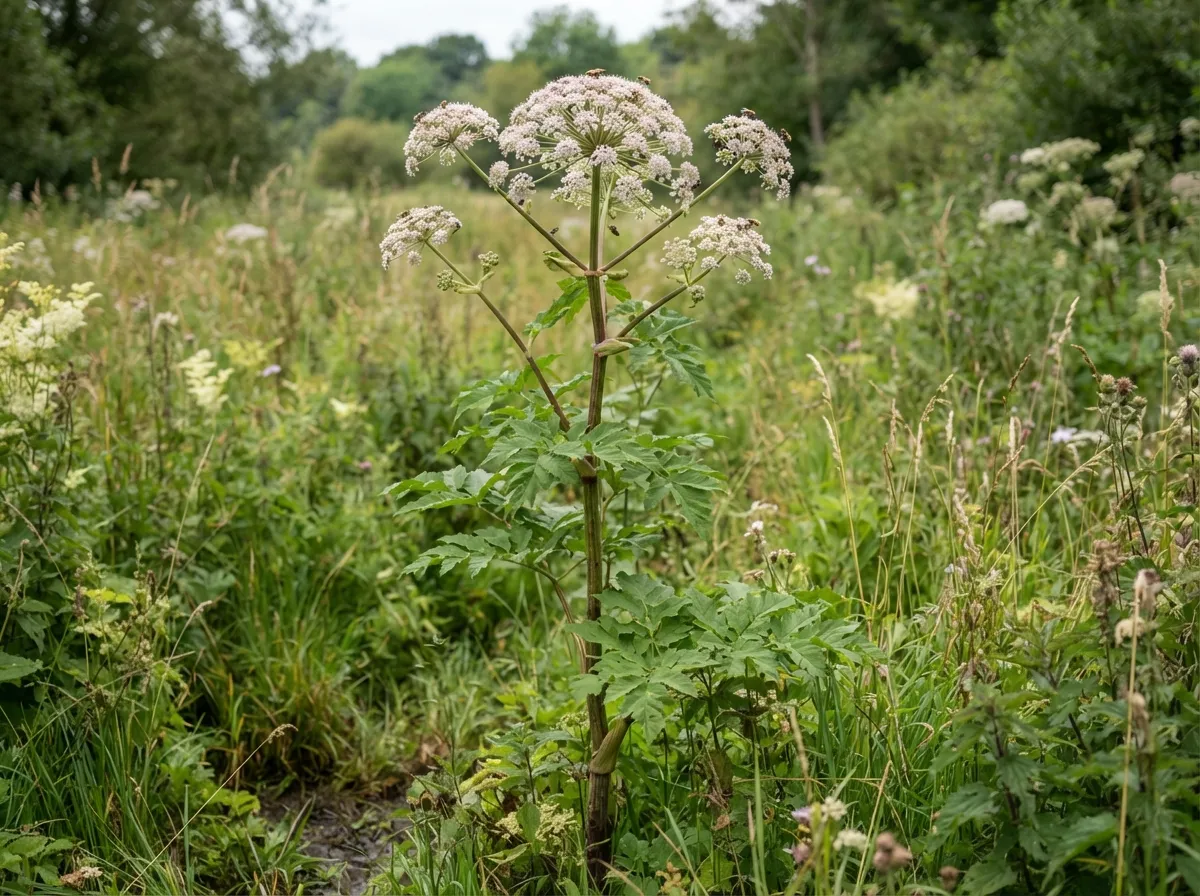
🔍 Identify it without mistakes
Large, robust Apiaceae of damp places, smaller and more common cousin of garden angelica cultivated for its candied stems. Stem often tinged with purple-violet, hollow, grooved, very thick at the base of the leaves (characteristic swollen sheath wrapping around the stem). Large, slightly domed, pinkish-white umbel. Like all large Apiaceae, it requires strict identification before any harvesting.
- hollow, grooved stem, often tinged with purple-violet, leaf base forming a swollen sheath encircling the stem
- leaves 2-3 times divided, oval toothed leaflets, smaller and less divided than those of hogweed
- large, globose pinkish-white umbel, 20-40 rays
- strong and pleasant aromatic smell (aniseed-musky) when crushed, never unpleasant
- smaller size than cultivated garden angelica, thinner stem (2-4 cm in diameter vs 5-8 cm)
⚠️ Not to be confused with
To tell them apart: wild angelica has a smooth stem (never hairless and spotted like hemlock), a very swollen leaf sheath, and a pleasant smell; if in doubt about a large Apiaceae near water, always check for the absence of purple spots and test the smell before harvesting
To tell them apart: garden angelica is more massive, green stem (not purplish), even more swollen sheath, almost spherical umbel
🍽️ Eating it
Preparation : peeled young stems, cooked or candied like those of garden angelica (but more fibrous); leaves as flavoring; harvest only after positive identification excluding any toxic Apiaceae from the same environment
💊 Healing with it
traditionnellement utilisée comme digestive et carminative, propriétés proches mais moins documentées que celles de l'angélique officinale
Level of evidence : traditional use — compilations ethnobotaniques (PFAF)
⚠️ photosensitizing like many Apiaceae: avoid sun exposure after handling the sap; not recommended during pregnancy
🪓 Other bushcraft uses
- hollow stems traditionally used as straws or small whistles by country children, once hollowed out and dried
No entry replaces a certain identification in the field, or medical advice. When in doubt: don't eat it. If ingestion is suspected: poison control or 112/911.