🟠 Sea buckthorn
Hippophae rhamnoides · Éléagnacées
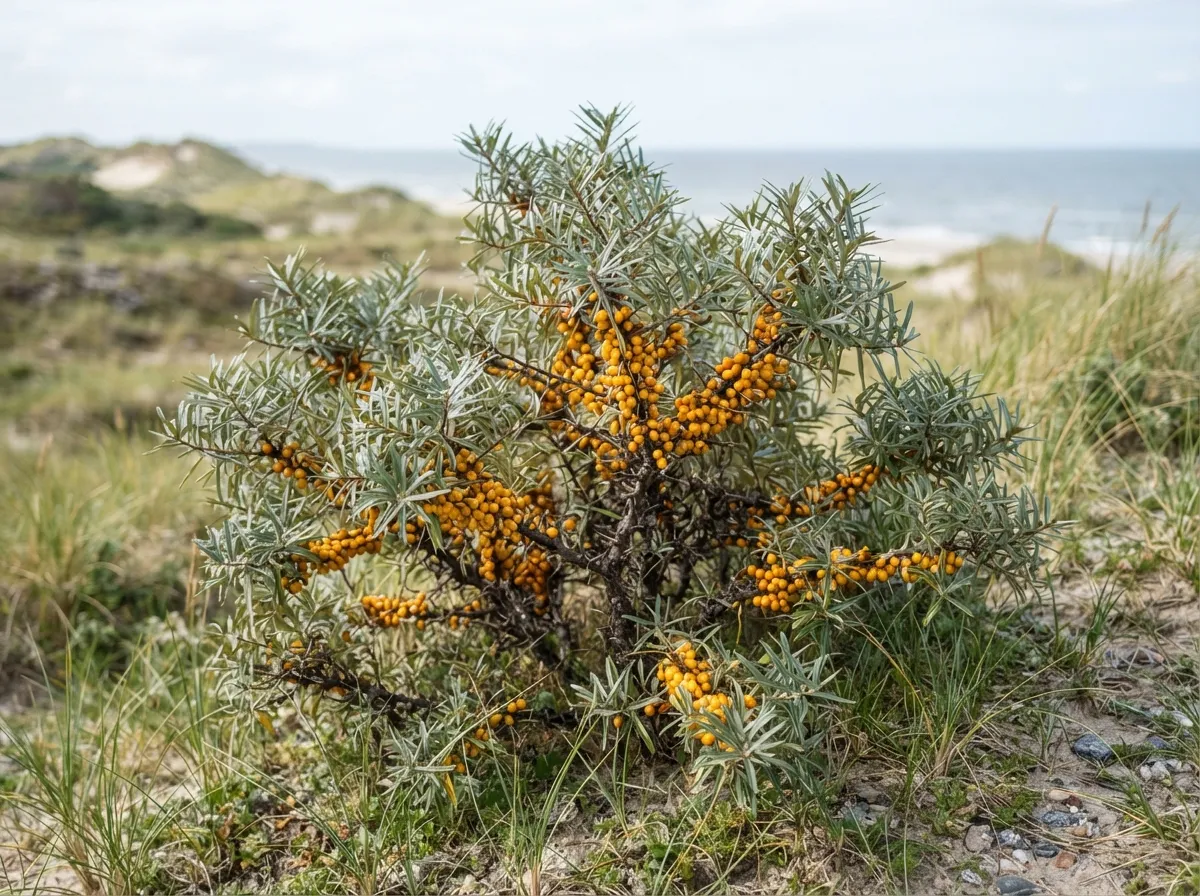
🔍 Identify it without mistakes
Thorny shrub with very characteristic silvery foliage (narrow leaves, grey-green above, scaly silver underneath) that colonizes coastal dunes and mountain river alluviums. Its small, bright orange berries, packed tightly along the branches, are one of the richest known wild fruit sources of vitamin C in Europe—though extremely sour and hard to pick without crushing, as they cling tightly to the wood.
- narrow, lanceolate leaves, grey-green above and silvery-scaly underneath
- thorny branches, often silvery as well
- bright orange, small berries (6-8 mm), extremely abundant and packed tightly along the branches
- dioecious shrub (separate male and female plants), only female plants bear berries
- colonizes open and unstable environments: coastal dunes, mountain river alluviums
⚠️ Not to be confused with
To tell them apart: sea buckthorn has narrow, silver-grey foliage that is scaly underneath and orange berries packed directly against the silvery thorny wood; firethorn has glossy, dark green oval leaves with serrated edges and orange-to-red berries borne on short individual stalks in clusters, without the silvery foliage
🍽️ Eating it
Preparation : berries are very sour, rarely eaten raw as is; juice, syrup, jam, or jelly after light cooking; harvesting is often done by cutting entire branches and freezing them, which makes detaching the berries much easier than picking by hand
content varies greatly depending on variety and measurement method, ranging from 150 to over 900 mg/100 g according to sources; order of magnitude
💊 Healing with it
traditionally used and studied for its antioxidant properties (carotenoids, flavonoids, vitamin E) in addition to its very high vitamin C content
Level of evidence : limited studies — PMC — Anti-Oxidant and Anti-Enzymatic Activities of Sea Buckthorn Fruits
⚠️ no major known contraindications at culinary doses
🪓 Other bushcraft uses
- nitrogen-fixing roots (thanks to a symbiosis with Frankia bacteria) making it a pioneer plant used in ecological engineering to stabilize eroded dunes and banks
Sources (2)
No entry replaces a certain identification in the field, or medical advice. When in doubt: don't eat it. If ingestion is suspected: poison control or 112/911.