🟤 Knotted wrack
Ascophyllum nodosum · Fucacées
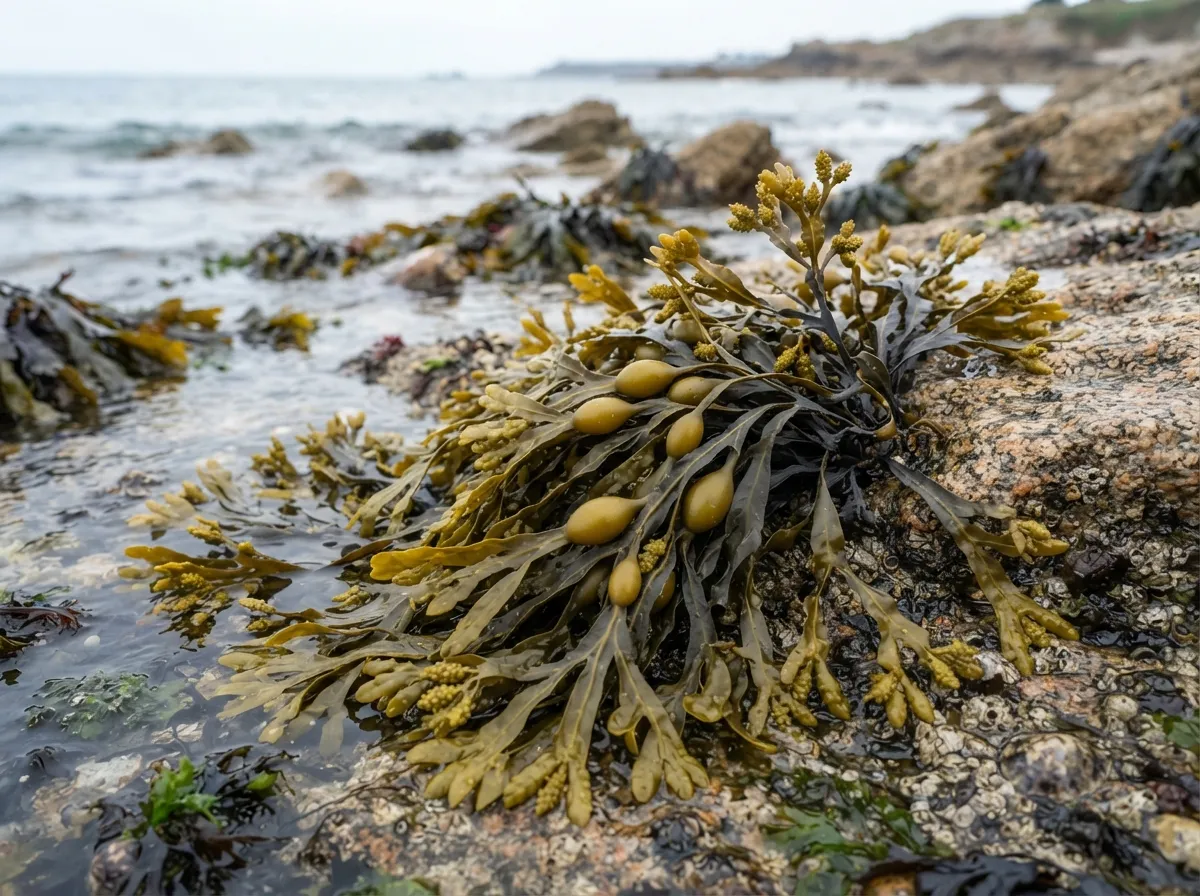
🔍 Identify it without mistakes
Large, long-lived perennial brown seaweed forming flexible ribbons punctuated by large, single, isolated egg-shaped swellings (unlike fucus, which has them in pairs), giving it its name 'knotted'. Often dominates large mats on sheltered rocks of the mid-intertidal zone.
- olive-brown to golden ribbon-like frond, not regularly fork-branched like fucus
- large, single, egg-shaped swellings (vesicles) along the ribbon, one at a time and not in pairs
- grows in sheltered sites (low wave exposure), forming dense mats that often dominate the mid-intertidal zone
⚠️ Not to be confused with
To tell them apart: bladder wrack bears its air vesicles in pairs on either side of a visible midrib; knotted wrack has isolated swellings, one by one along a ribbon without a distinct midrib
🍽️ Eating it
Preparation : less commonly used fresh in cooking than dried and ground into powder or granules, used as an iodized seasoning or supplement; young tips can be blanched and added to stews
💊 Healing with it
little direct traditional medicinal use in France; widely studied and harvested for its extracts (fucoidans, alginates) in cosmetics and as agricultural biostimulants rather than in human herbal medicine
Level of evidence : limited studies — PMC — Ascophyllum nodosum: Biochemical Composition, Antiradical Potential, and Human Health Risk
⚠️ like other brown seaweeds, notable iodine content to monitor in case of thyroid conditions; avoid harvesting in harbor areas (heavy metals); professional harvesting is regulated in Brittany as well as in Maine (quotas, minimum sizes)
🪓 Other bushcraft uses
- major industrial harvesting for alginates and agricultural biostimulants (foliar fertilizers based on ascophyllum extracts)
Sources (3)
No entry replaces a certain identification in the field, or medical advice. When in doubt: don't eat it. If ingestion is suspected: poison control or 112/911.