🥭 Pawpaw
Asimina triloba · Annonacées
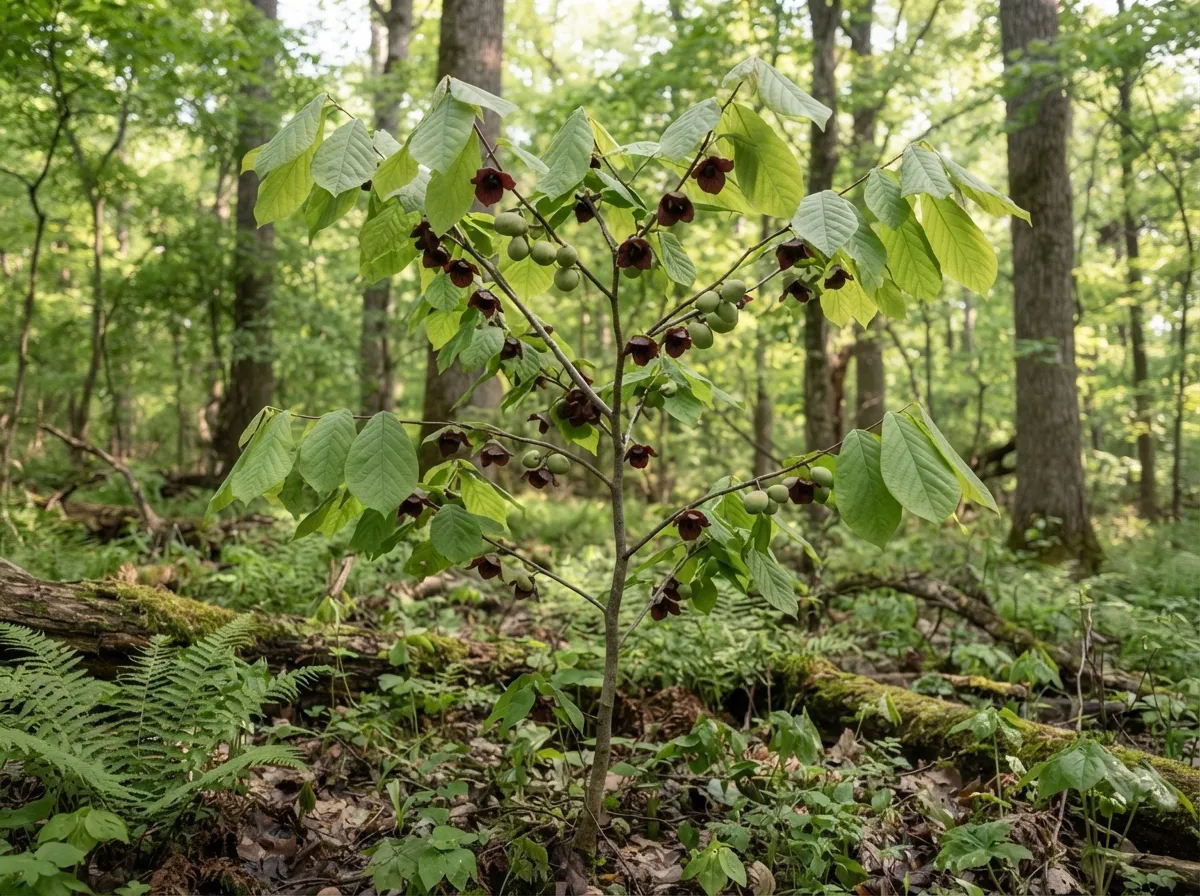
🔍 Identify it without mistakes
Small understory tree with large, teardrop-shaped leaves, the only member of the tropical Annonaceae family (soursop and custard apple family) hardy to the temperate climate of eastern North America. Foul-smelling drooping purple flowers bloom in spring before the leaves appear; smooth-skinned green fruits grow in small clusters, resembling a short mango, ripening in late summer.
- alternate, teardrop-shaped leaves, 15-30 cm, foul bell-pepper smell when crushed
- dark purple 6-petaled flowers, foul-smelling (pollinated by flies)
- greenish-yellow fruit shaped like a small mango, 8-15 cm
- grows in clonal colonies under the forest canopy
⚠️ Not to be confused with
To tell them apart: the large, foul-smelling teardrop leaf, the foul-smelling dark purple flowers, and the large greenish-yellow fruit shaped like a short mango are not found on any other temperate North American understory tree
🍽️ Eating it
Preparation : eat raw when fully ripe (the skin yields to gentle pressure, like a ripe avocado); spit out the large black inedible seeds; the pulp works great in ice cream, bread, and smoothies just like banana, which it often replaces in adapted recipes
💊 Healing with it
no notable established traditional medicinal use; conversely, the bark and seeds have documented use as a natural insecticide/pesticide among certain Indigenous nations
Level of evidence : traditional use — Potts et al., "Annonacin in Asimina triloba fruit: implication for neurotoxicity", PubMed 22130466
⚠️ the pulp itself contains low amounts of acetogenins (including annonacin, averaging 0.070 mg/g in the pulp according to a 2015 LC-HRMS study), neurotoxic compounds linked to neurodegenerative issues under chronic and heavy exposure (by analogy with soursop, Annona muricata); leaves, seeds, and bark contain significantly more and must never be consumed; occasional consumption of ripe pulp remains considered safe in current literature, but daily, prolonged consumption is discouraged as a precaution
🪓 Other bushcraft uses
- inner bark fiber used for cordage by Indigenous peoples and settlers
- seeds and bark used as a traditional natural insecticide
Sources (3)
No entry replaces a certain identification in the field, or medical advice. When in doubt: don't eat it. If ingestion is suspected: poison control or 112/911.