🌳 Black Alder
Alnus glutinosa · Betulaceae
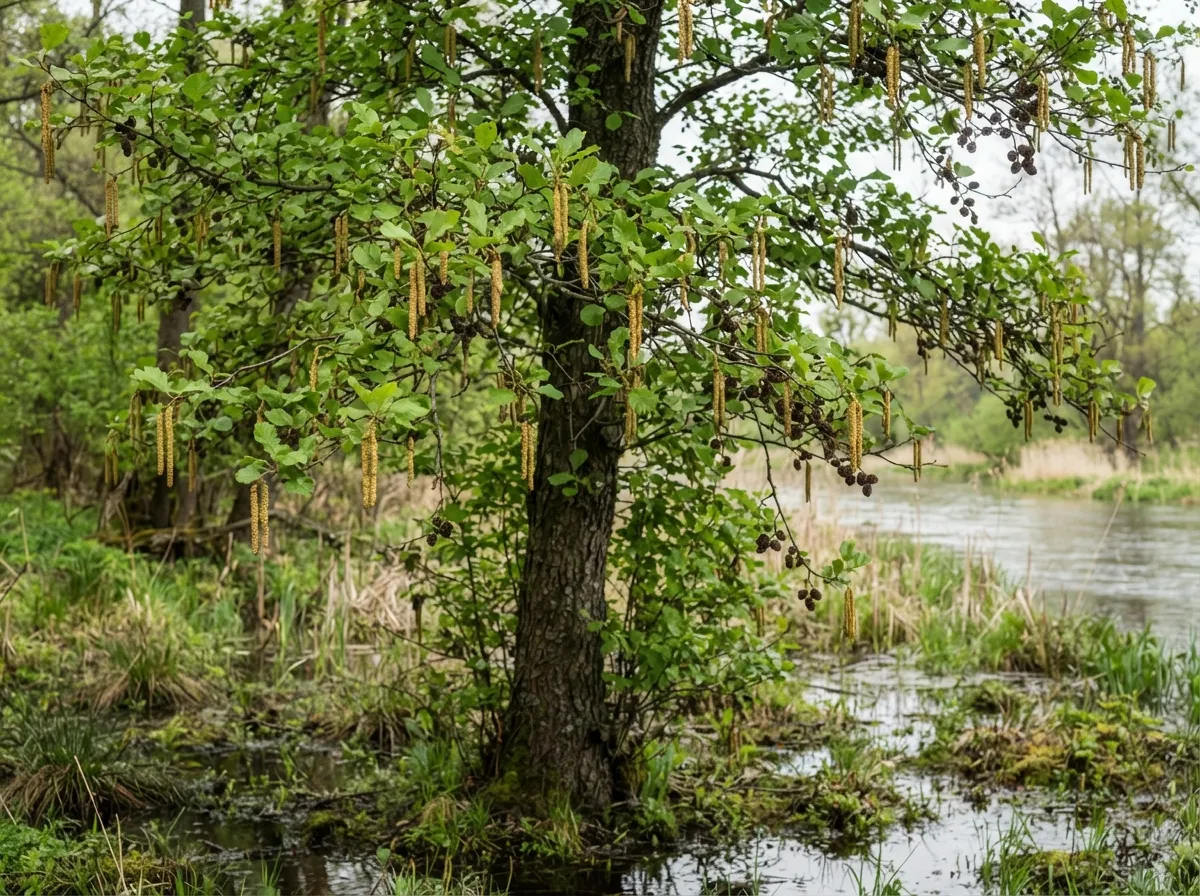
🔍 Identify it without mistakes
Tree that always grows with its feet in the water or along waterways, its roots fixing atmospheric nitrogen through a symbiosis with the bacterium Frankia alni. Rounded leaves with a notched tip (never pointed), sticky to the touch when young (hence "glutinosa"). Bears small woody fruits shaped like miniature cones that persist on the tree all winter — unique among large European deciduous trees.
- rounded leaves with a notched tip (not pointed), sticky to the touch when young
- small woody cone-shaped fruits persisting all winter on the branches
- grey-brown bark cracking into small plates
- always grows with its feet in the water or immediately along waterways
⚠️ Not to be confused with
To tell them apart: alder bears woody persistent small cone-like fruits, absent in hazel; alder leaves are notched at the tip, hazel leaves are pointed
💊 Healing with it
écorce et feuilles riches en tanins, traditionnellement astringentes : gargarisme contre les inflammations de la gorge, cataplasme pour désinfecter les plaies ; feuilles fraîches humides glissées dans les chaussures pour rafraîchir les pieds et limiter les ampoules en marche prolongée
Level of evidence : traditional use — viagallica.com — L'aulne glutineux
⚠️ none known at usual doses
🪓 Other bushcraft uses
- rot-proof wood underwater: unlike almost all other wood, alder hardens and lasts indefinitely when fully submerged — historically used for Venice's pilings and buried water pipes; good wood for anything staying underwater (footbridge piles, filter bases)
- smoking: alder charcoal and chips, non-resinous and with a mild scent, are the gold standard for smoking fish (salmon) and meat
- dyeing: tannin-rich bark provides a brown-black to red dye depending on the mordant, historically used to dye felt, leather, and fabrics
- improvised tanning: bark and young shoots, a source of tannin to quickly tan a hide
- drawing charcoal: alder charcoal, soft and light, used as a charcoal stick substitute
- soil indicator: nitrogen-fixing nodulated roots (symbiosis with Frankia alni) — alder enriches the soil where it grows, a marker to locate a good future spot for subsistence crops
- dry tinder/kindling in winter: persistent woody cones stay out of the water on high branches and catch fire easily even when everything else is soaked
No entry replaces a certain identification in the field, or medical advice. When in doubt: don't eat it. If ingestion is suspected: poison control or 112/911.