🍌 Wild banana tree
Musa balbisiana · Musaceae
🔍 Identify it without mistakes
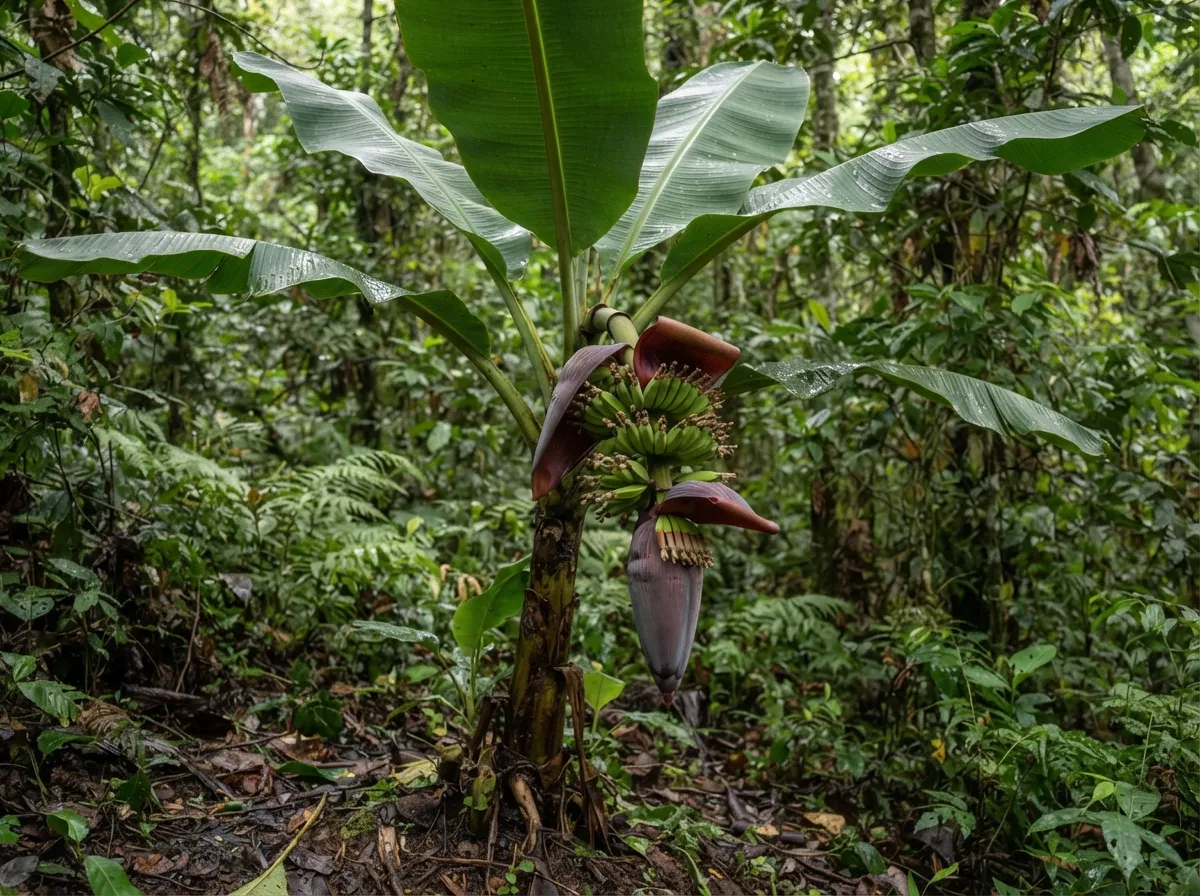
Large giant herb forming a pseudostem made of stacked leaf sheaths, crowned with broad oblong leaves torn by the wind. Unlike cultivated banana trees, the wild fruit is packed with large, hard black seeds and is not sweet or ready to eat raw.
- pseudostem formed from overlapping leaf sheaths
- drooping inflorescence with reddish-brown bracts
- green to bluish fruits packed with hard black seeds measuring 5-8 mm
⚠️ Not to be confused with
To tell them apart: the pseudostem formed by overlapping leaf sheaths and the drooping inflorescence with a large reddish-brown bract unambiguously distinguish the banana tree from any other large broad-leaved tropical herb
🍽️ Eating it
Preparation : cut the pseudostem, strip away the fibrous outer sheaths to reach the tender white heart, slice it thin and boil it to remove bitterness (tannins); the flower (purplish bud) is cooked as a vegetable after removing the bitter bracts; the seeded fruit is cooked thoroughly, and you spit out the seeds
💊 Healing with it
pseudostem sap traditionally used in South Asia for its astringent properties on small cuts; leaves used to wrap and soothe minor burns
Level of evidence : traditional use — South Asian ethnobotanical literature
⚠️ none known
🪓 Other bushcraft uses
- waterproof leaves used as emergency roofing, plates, or food wrapping
- pseudostem sheaths braided into coarse rope
- split pseudostem used as a reservoir for rainwater naturally caught in its core
No entry replaces a certain identification in the field, or medical advice. When in doubt: don't eat it. If ingestion is suspected: poison control or 112/911.