🌿 Greater Burdock
Arctium lappa · Asteraceae
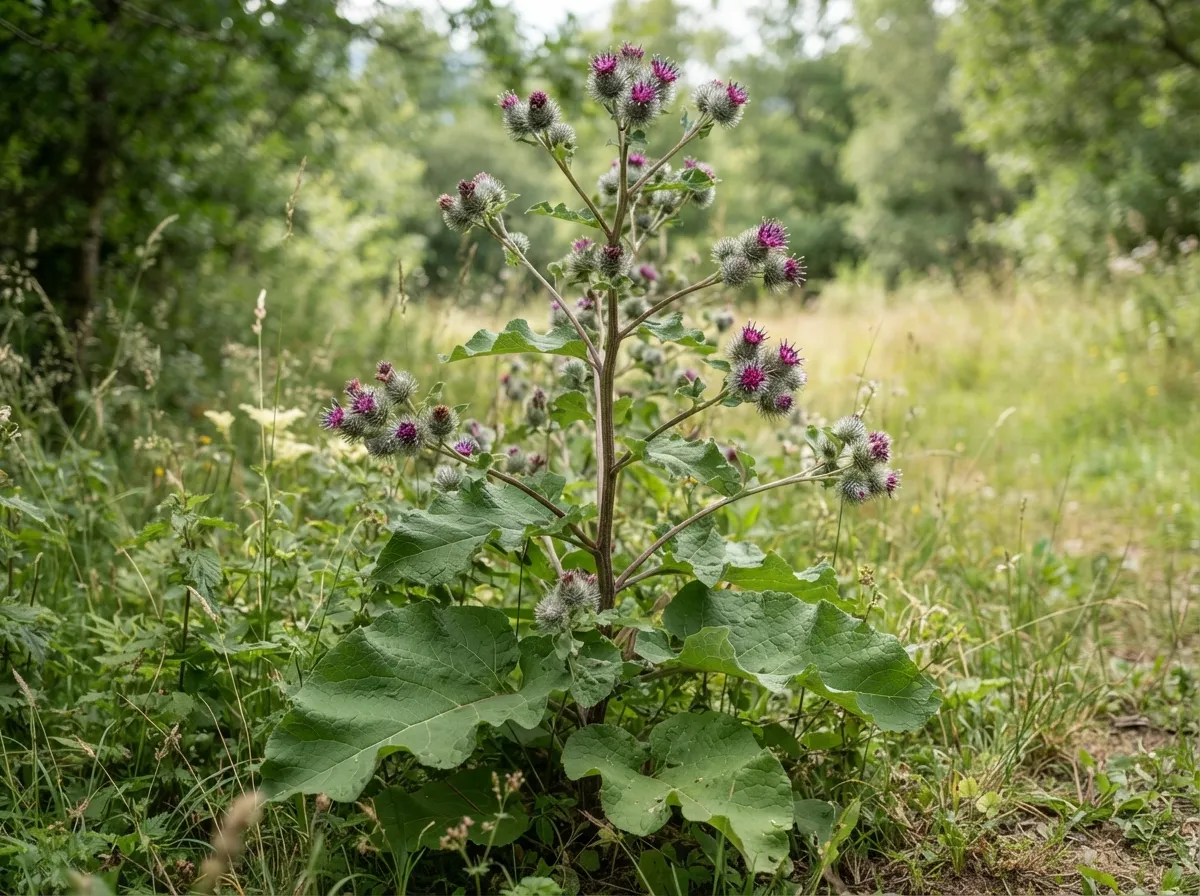
🔍 Identify it without mistakes
Large biennial plant with big heart-shaped leaves, dull green above and cottony-white underneath. In its second year, a sturdy stalk bears purple flower heads surrounded by rigid hooks (the famous hooked bracts that cling to fur and clothing — they inspired Velcro). Long, fleshy taproot in its first year.
- large heart-shaped leaves, white cottony underside
- purple flower heads with hooked bracts (burs)
- hollow, grooved stem
- grey-brown taproot, white flesh, up to 60-90 cm long
- overall large size (up to 1.5-2 m in the 2nd year)
⚠️ Not to be confused with
To tell them apart: burdock has a cottony-white leaf underside and a hollow stalk, foxglove has a more elongated, textured leaf without this cottony feel; if in doubt with an unflowered rosette, do not harvest the root
🍽️ Eating it
Preparation : root peeled and cooked like salsify (Japanese "gobo" is this exact same cultivated plant); young stems peeled of their bitter bark and boiled in water
approx, raw root, close to USDA data for gobo (burdock root)
💊 Healing with it
traditionally depurative and diuretic, used for mild chronic skin conditions (acne, eczema)
Level of evidence : traditional use — ethnobotanical compilations (Fournier, Wikiphyto)
⚠️ possible allergy for people sensitive to Asteraceae (ragweed and wormwood family); avoid during pregnancy as a precaution
🪓 Other bushcraft uses
- hooked bracts inspired the invention of Velcro by Swiss engineer George de Mestral in 1941
- leaves used as a cooling poultice on insect bites
No entry replaces a certain identification in the field, or medical advice. When in doubt: don't eat it. If ingestion is suspected: poison control or 112/911.