🍅 Desert bush tomato (kutjera)
Solanum centrale · Solanaceae
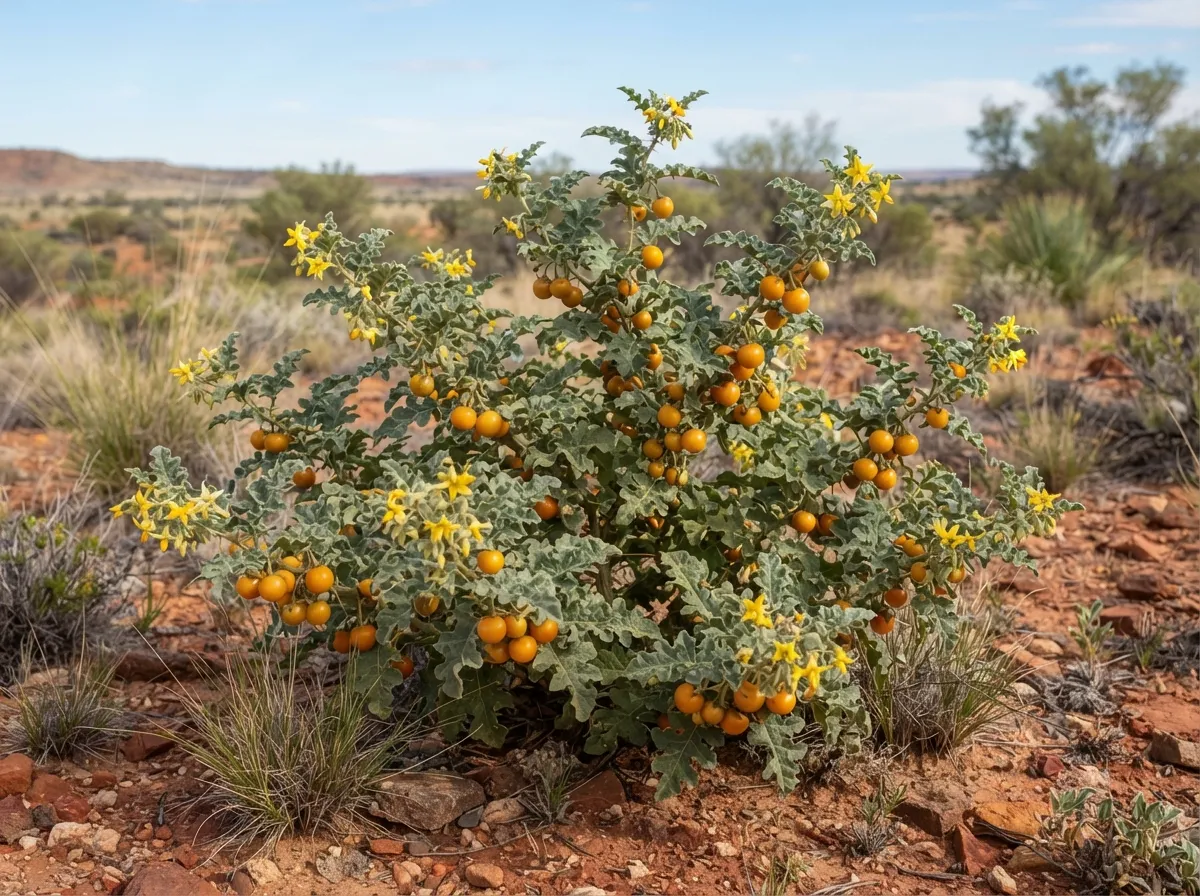
🔍 Identify it without mistakes
A fast-growing, prickly shrub native to central Australia that fruits abundantly the year following a fire or heavy rains, re-sprouting from a dormant rootstock during prolonged droughts. The berries, measuring 1 to 3 cm, dry out naturally on the plant until they look like yellow raisins once ripe—hence the name "desert raisin".
- prickly shrub native to the central Australian desert, grey-green foliage
- 1-3 cm berries turning yellow and drying out naturally on the plant when ripe
- fruit resembles small raisins once ripe and dried
- vigorous regrowth after fire or heavy rain, dormant during prolonged drought
⚠️ Not to be confused with
To tell them apart: only the fully ripe and yellowed berries of Solanum centrale, naturally dried on the shrub, are harvested; unripe green berries of any Solanum species, including S. centrale, contain higher levels of steroidal alkaloids (solanine and related compounds) and must be avoided—traditional identification by Aboriginal peoples of the central desert relies on generations of precise oral knowledge regarding local edible and toxic Solanum species
To tell them apart: the bush tomato grows as a low bushy plant often covered in hairs or fine prickles and its fruit contains numerous small, soft seeds, whereas the quandong grows as a shrub or small semi-parasitic tree and its bright red fruit surrounds a single large, hard, deeply pitted nut
🍽️ Eating it
Preparation : harvested dry directly from the shrub (they dry out naturally like raisins); traditionally skewer-threaded and dried further by central desert peoples (notably the Martu) for transport and storage; nowadays ground into a powder for sauces, seasonings, and baked goods
💊 Healing with it
no major traditional medicinal use documented in the consulted sources, outside of its use as food
Level of evidence : traditional use — Wikipedia — Solanum centrale
⚠️ never consume a wild Solanum berry without absolute certainty about the species' identity and its stage of ripeness—many Australian desert Solanum species remain toxic even when ripe
Sources (1)
No entry replaces a certain identification in the field, or medical advice. When in doubt: don't eat it. If ingestion is suspected: poison control or 112/911.