🔵 Camas (camas)
Camassia quamash · Asparagacées
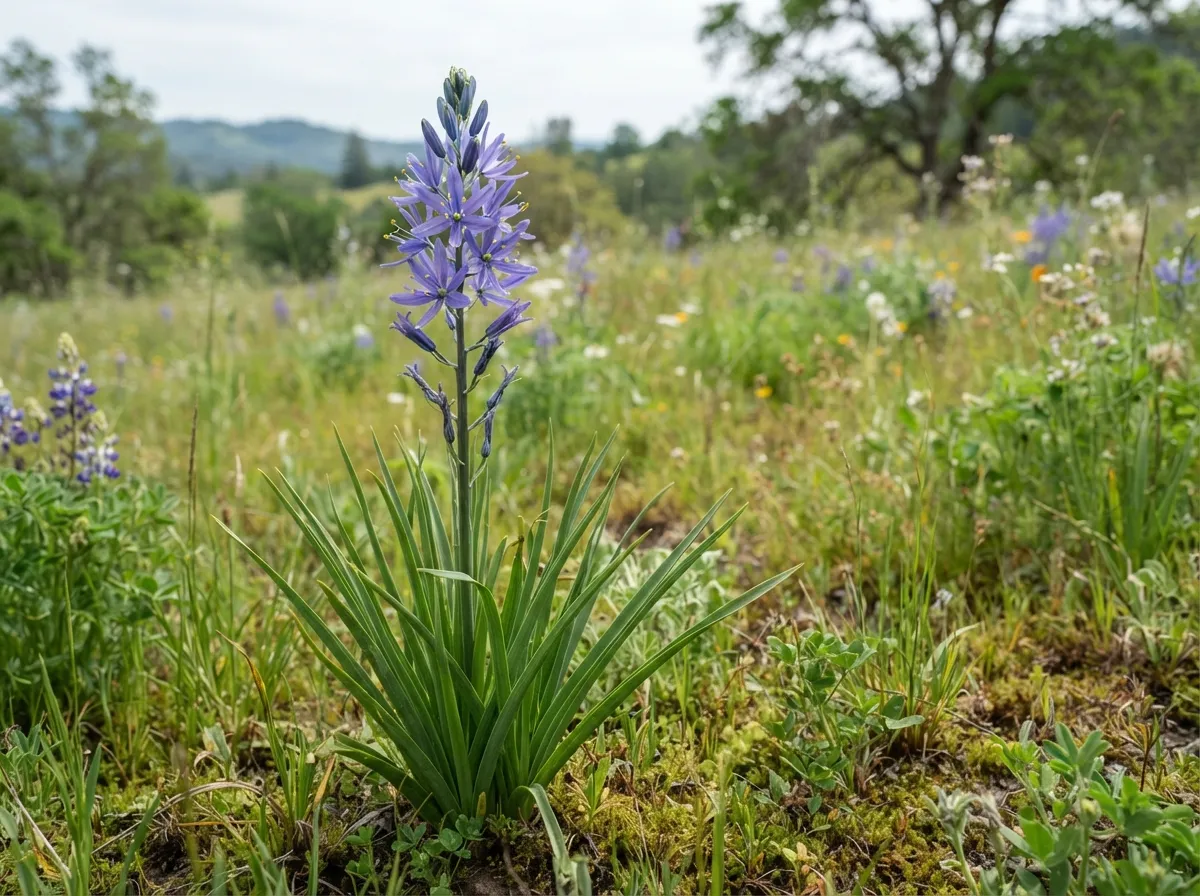
🔍 Identify it without mistakes
A bulbous plant of Western North American wet meadows, with an erect flower stalk bearing a star-shaped cluster of bright blue-violet six-petaled flowers, and grass-like, strap-shaped basal leaves. Sometimes forms spectacular blue carpets in spring across Rocky Mountain and Pacific Northwest meadows — but easily confused in bloom AND out of bloom with the deadly death camas, which often grows in the exact same meadows.
- blue-violet flowers with 6 tepals, never white
- flower stalk 20-70 cm tall
- brownish-black bulb the size of a large button
- grows in dense carpets in wet spring meadows
⚠️ Not to be confused with
To tell them apart: only the flowers can reliably tell them apart — edible camas: bright blue-violet flowers; death camas: creamy-white to greenish-white flowers. OUT OF BLOOM, the bulbs and leaves are virtually impossible to differentiate with certainty: NEVER harvest camas outside its flowering season, and mark edible plants while in bloom to dig them up later
To tell them apart: creamy-white flower (death camas) versus bright blue-violet (camas); out of bloom, no field method allows reliable identification — you must spot and mark edible bulbs while in flower
🍽️ Eating it
Preparation : slow cooking is essential: traditionally pit-cooked for 24 to 48 hours over rock-heated pits, which converts inulin (indigestible carbohydrate) into digestible fructose, giving it a sweet taste; raw or undercooked, the bulb causes severe intestinal gas
💊 Healing with it
no significant documented traditional medicinal use; primarily a food plant
Level of evidence : traditional use — USDA NRCS Plant Guide — Camassia quamash
⚠️ never consume a bulb you haven't personally identified while in bloom: confusion with the deadly death camas is the #1 cause of fatal plant poisoning among camas foragers
🪓 Other bushcraft uses
- major trade currency and economic resource among Western Native Nations (Nez Perce, Salish, Cree, Blackfoot)
- camas meadows were actively managed through controlled burning to promote regrowth — one of the earliest documented forms of Indigenous agriculture in North America
Sources (4)
No entry replaces a certain identification in the field, or medical advice. When in doubt: don't eat it. If ingestion is suspected: poison control or 112/911.