🔴 Cranberry
Vaccinium macrocarpon · Ericaceae
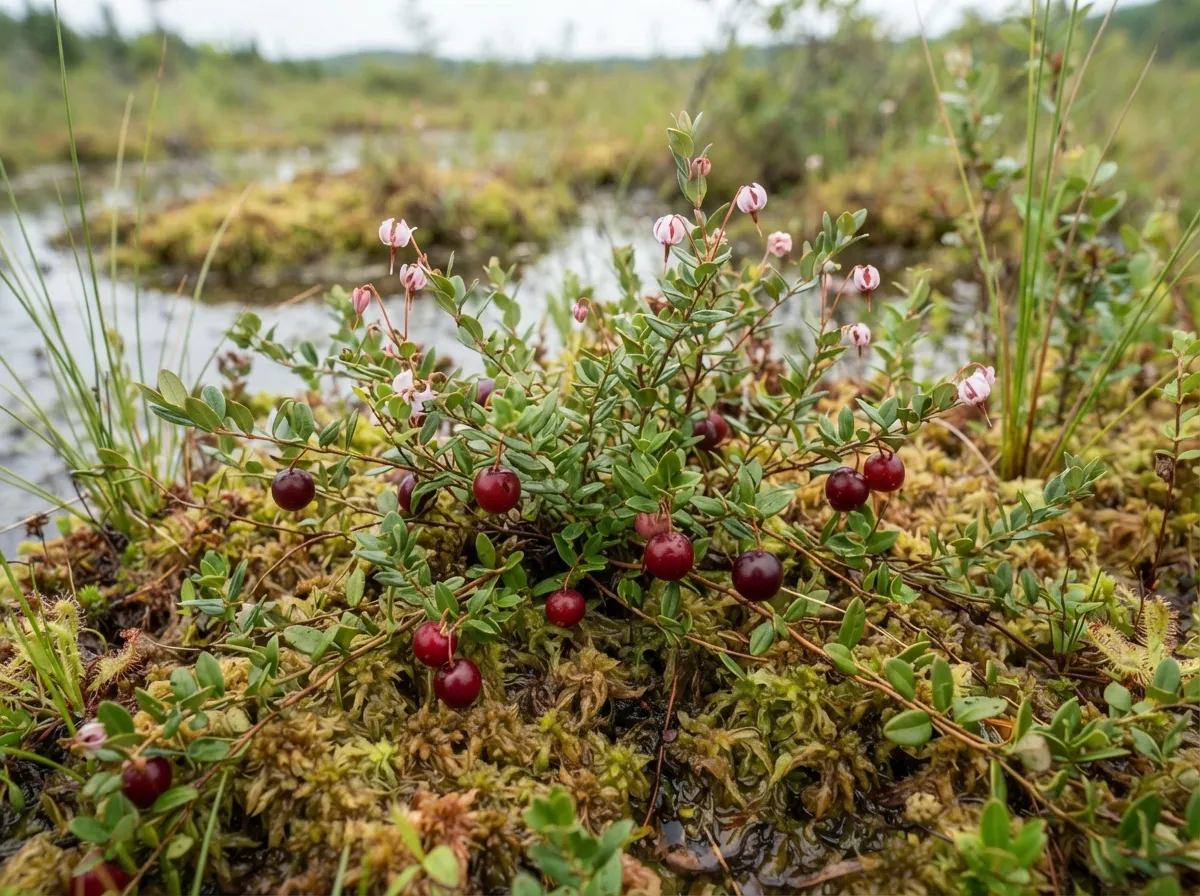
🔍 Identify it without mistakes
Small creeping shrub with threadlike woody stems carpeting the ground of acid bogs, featuring tiny evergreen leathery leaves. Pink flowers with backward-curving petals resemble the head of a crane (hence the name 'crane berry'), followed by large round to oval red berries that float on water when ripe — a property exploited for their commercial harvest by flooding fields.
- creeping threadlike stems carpeting bog ground
- tiny, leathery evergreen leaves
- pink flower with backward-curving petals
- bright red berry that floats on water when ripe
⚠️ Not to be confused with
To tell them apart: cranberry is a woody creeping dwarf shrub with tiny leathery leaves, pink flower with backward-curving petals, and its fruit floats on water; bittersweet nightshade is a climbing herbaceous vine with star-shaped purple flowers with a yellow center, thin leaves often lobed at the base, and its red berries hang in clusters on an aerial stem, never flush with the sphagnum mat
🍽️ Eating it
Preparation : very tart raw, almost inedible as is; best cooked with sugar (sauce, jelly, jam), dried, or as diluted and sweetened juice
USDA FoodData Central, raw cranberries, per 100 g
💊 Healing with it
cranberry juice and extract are traditionally and widely used today to prevent recurrent urinary tract infections, thanks to type-A proanthocyanidins which prevent certain bacteria (E. coli) from adhering to the bladder wall
Level of evidence : solid studies — Cochrane systematic reviews on cranberry and urinary tract infections
⚠️ in large quantities, can interact with oral anticoagulants (warfarin) by increasing bleeding risk — monitoring recommended if on anticoagulant therapy; commercial sweetened juice does not have the same preventive effect as concentrated extract
🪓 Other bushcraft uses
- traditional red dye
- keeps fresh for several months thanks to its natural benzoic acid content, a natural preservative that long allowed it to be transported over long distances without refrigeration
Sources (3)
No entry replaces a certain identification in the field, or medical advice. When in doubt: don't eat it. If ingestion is suspected: poison control or 112/911.