🍒 Carissa (wild Natal plum, num-num)
Carissa edulis · Apocynacées
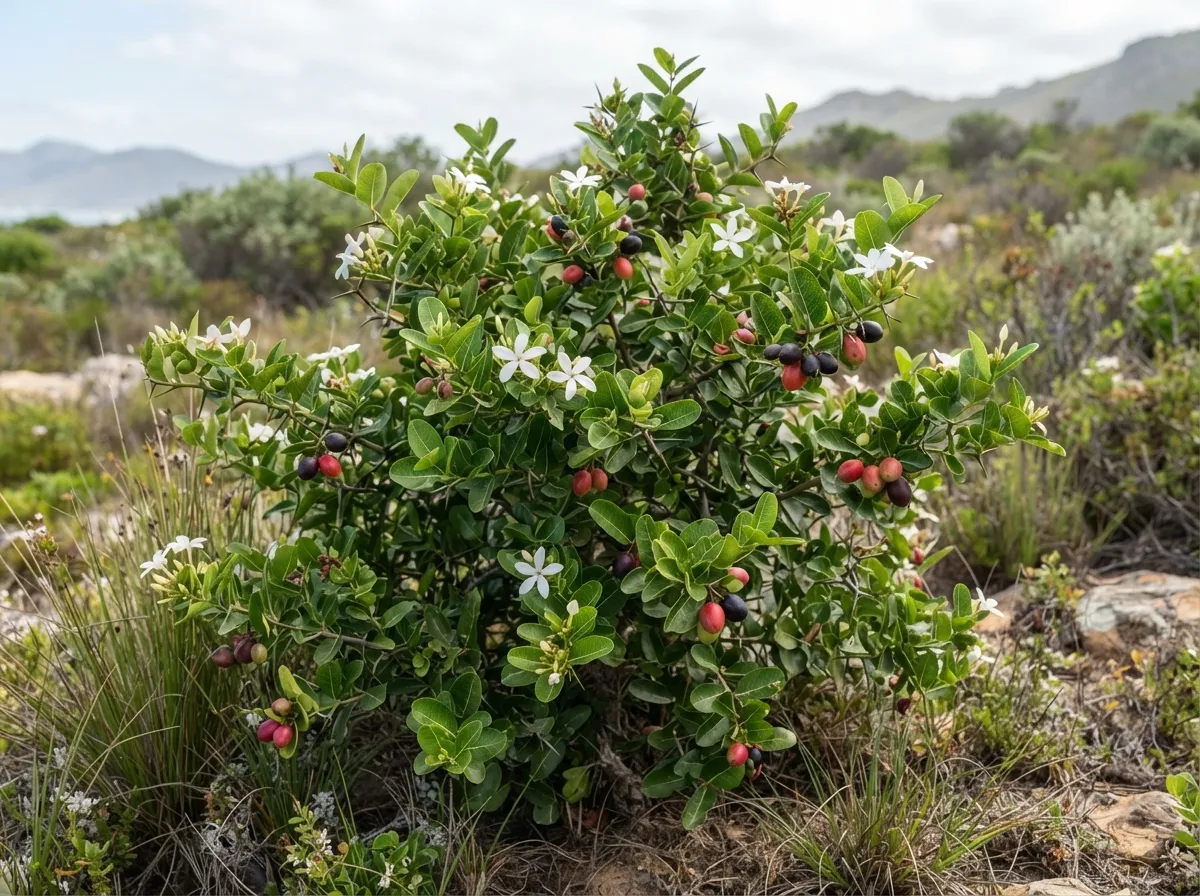
🔍 Identify it without mistakes
Spiny shrub with milky sap, common in East and Southern Africa, producing a small oval fruit that turns from green to red, then to purple-black when fully ripe. Like many Apocynaceae, the entire plant contains white latex, and only the fully ripe fruit — never the leaves, stems, or unripe fruit — is edible.
- shrub with rigid, straight spines, sometimes absent depending on the subspecies
- milky white sap that beads up as soon as a leaf or stem is broken
- oval fruit, 6-11 mm, turning from green to red, then to purple-black at full maturity
- opposite, simple, shiny, leathery leaves
⚠️ Not to be confused with
To tell them apart: only harvest fruits that are completely purple-black, firm yet yielding to the touch; a fruit that is still green, pinkish, or streaked with visible latex should be left on the plant to continue ripening
🍽️ Eating it
Preparation : pick only fully ripe purple-black fruits, wipe off the small amount of residual latex on the skin before eating raw, or cook into jam and juice locally
💊 Healing with it
racines et écorce largement utilisées en médecine traditionnelle est-africaine contre les maux de tête, les douleurs et les infections ; plante médicinale parmi les plus documentées d'Afrique de l'Est
Level of evidence : limited studies — Wikipedia EN / Carissa edulis species profile (NMPPDB) — synthèse ethnobotanique
⚠️ restrict consumption strictly to the fully ripe fruit; leaves, stems, and latex must be avoided for food use
🪓 Other bushcraft uses
- thorny live hedges protecting enclosures and gardens
- hardwood sometimes used for small tools
Sources (2)
No entry replaces a certain identification in the field, or medical advice. When in doubt: don't eat it. If ingestion is suspected: poison control or 112/911.