⚠️ Caulerpa taxifolia ("killer alga")
Caulerpa taxifolia · Caulerpacées
🔍 Identify it without mistakes
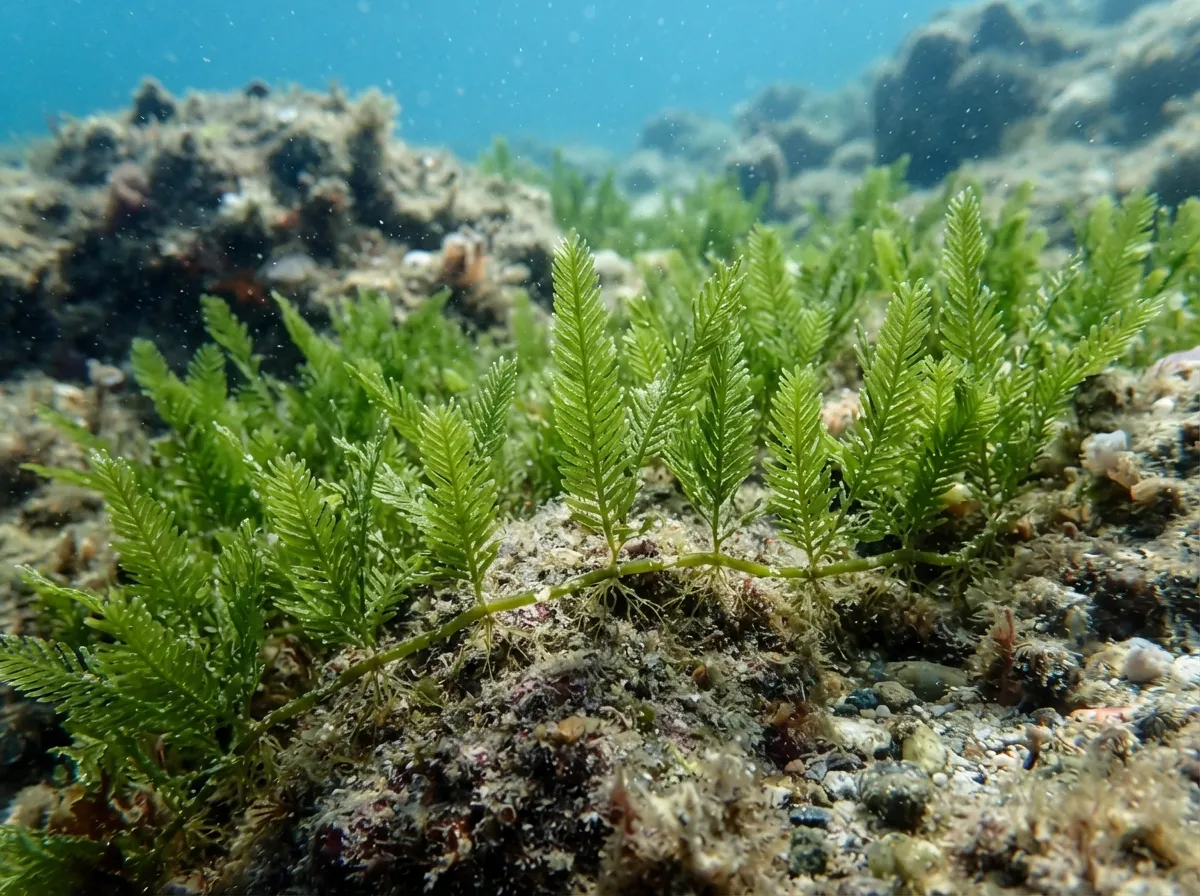
Tropical green alga accidentally introduced into the Mediterranean in 1984 near Monaco, becoming infamously known as the "killer alga" for its ability to blanket the seafloor with creeping rhizomes from which upright fronds sprout, resembling small conifer branches (hence "taxifolia", yew-leaved).
- upright, bright green, feathery fronds, branched into small opposite pinnules resembling yew or conifer twigs
- filiform creeping stolons (rhizomes) connecting the tufts, forming continuous mats on the seafloor
- colonizes rocky or sandy bottoms in dense, monospecific mats, eventually displacing posidonia and other native species entirely
⚠️ Not to be confused with
To tell them apart: the uniform bright green color, regular comb-like pinnules along an upright stem, and especially a dense, continuous single-species mat on the seafloor (without other mixed vegetation) signal caulerpa; at the slightest suspicion, do not harvest or transport it, but report your observation to local authorities
🍽️ Eating it
Preparation : do not consume: although no documented risk to human health has been identified to date, the alga produces toxic metabolites (caulerpenyne, caulerpin) that make it unsuitable for foraging; above all, never transport or discard it elsewhere, as a single fragment is enough to colonize a new site
💊 Healing with it
aucun
Level of evidence : traditional use — GIS Posidonie — Caulerpa taxifolia, les enjeux de son expansion
⚠️ classified as an invasive and regulated species: any observation should be reported to coastal monitoring bodies (GIS Posidonie, DREAL) rather than harvested; the sesquiterpenes and alkaloids it produces (caulerpenyne, caulerpin) are chemical defense toxins whose effect on humans remains poorly characterized
Sources (3)
No entry replaces a certain identification in the field, or medical advice. When in doubt: don't eat it. If ingestion is suspected: poison control or 112/911.