🌲 Western Redcedar
Thuja plicata · Cupressaceae
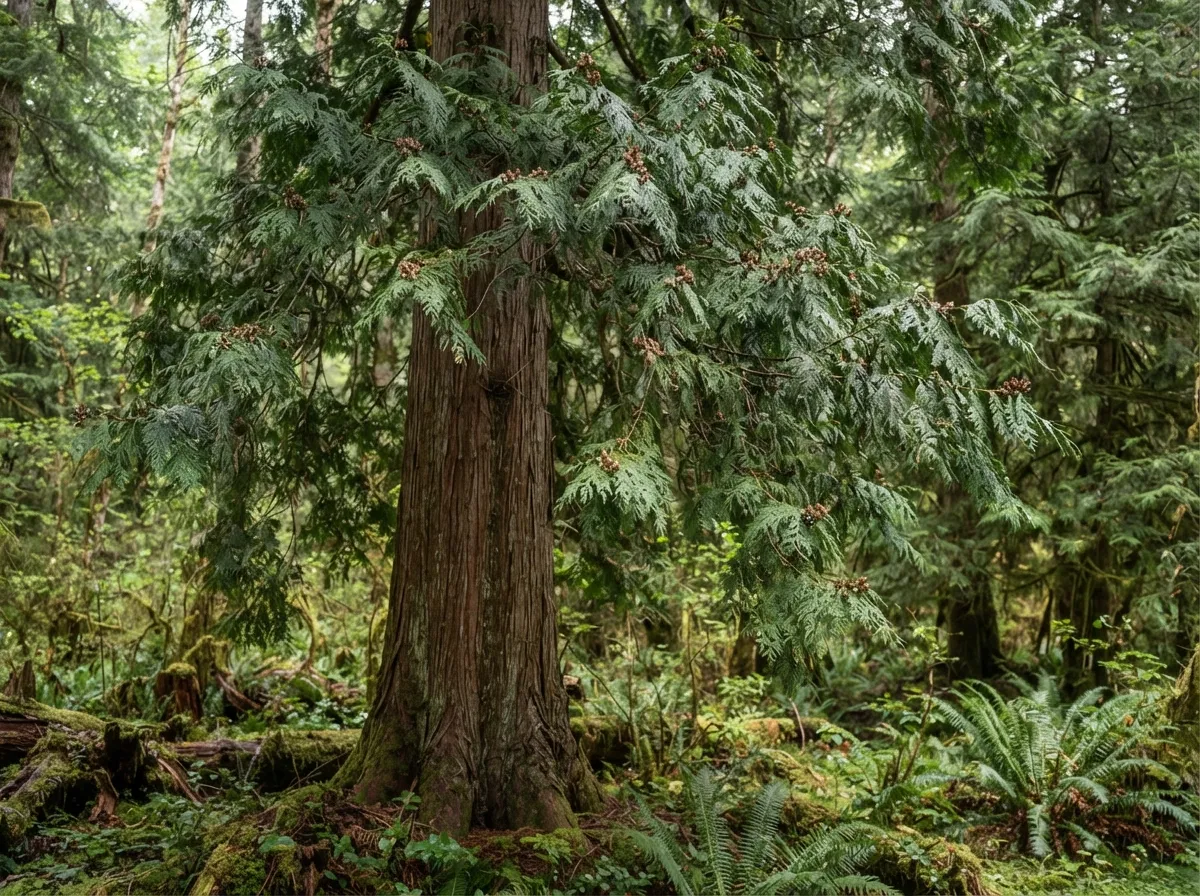
🔍 Identify it without mistakes
Very large conifer native to the North American Pacific Coast, featuring flat, fan-like spray foliage, often marked with white "butterfly" patches on the underside. Fibrous reddish-brown to grey bark that peels off in long vertical strips, easy to strip by hand. Flared buttressed trunk base on older trees.
- flat, fan-like spray foliage, often marked with white "butterfly" patches underneath
- fibrous reddish-brown to grey bark that peels in long vertical strips, easy to strip
- flared trunk base with buttresses on older trees
- distinct aromatic scent when crushed, subtler than eastern arborvitae
⚠️ Not to be confused with
To tell them apart: the Western Redcedar is much larger, grows on the Pacific Coast, and has more fibrous, reddish bark; their natural ranges do not overlap
💊 Healing with it
inner bark and leaves used in respiratory decoctions and antiseptic poultices by Pacific Coast First Nations
Level of evidence : traditional use — ethnobotanical literature of the Pacific Northwest Coast; Wikipedia EN — Thuja plicata
⚠️ as with Eastern Arborvitae, avoid consuming concentrated essential oil orally (thujone)
🪓 Other bushcraft uses
- cordage and weaving: fibrous inner bark, harvested in long strips without killing the tree (a sustainable harvesting technique passed down for generations), is crafted into rope stronger than industrial cordage, as well as mats, waterproof baskets, and woven clothing softer than cotton
- dugout canoes: lightweight wood, splitting easily into straight planks and exceptionally rot-resistant — the go-to material for dugout canoes carved from a single trunk along the Pacific Coast
- shingles and roofing: the wood naturally splits into thin, flat boards, used to cover homes and shelters for centuries, still a benchmark for wooden roofing in North America
- monumental carving: soft, straight-grained wood, knot-free over long sections, ideal for carving totem poles
- tinder: fibrous, resinous outer bark, shredded into fine fluff, catches fire easily even when damp
- paddles and tools: lightweight and durable wood used for paddles, chests, and masks
- "tree of life": nickname given by coastal Indigenous nations, as every part of the tree provided a vital use, from clothing and shelter to transportation
No entry replaces a certain identification in the field, or medical advice. When in doubt: don't eat it. If ingestion is suspected: poison control or 112/911.