🍄 Yellowfoot chanterelle
Craterellus tubaeformis · Cantharellaceae
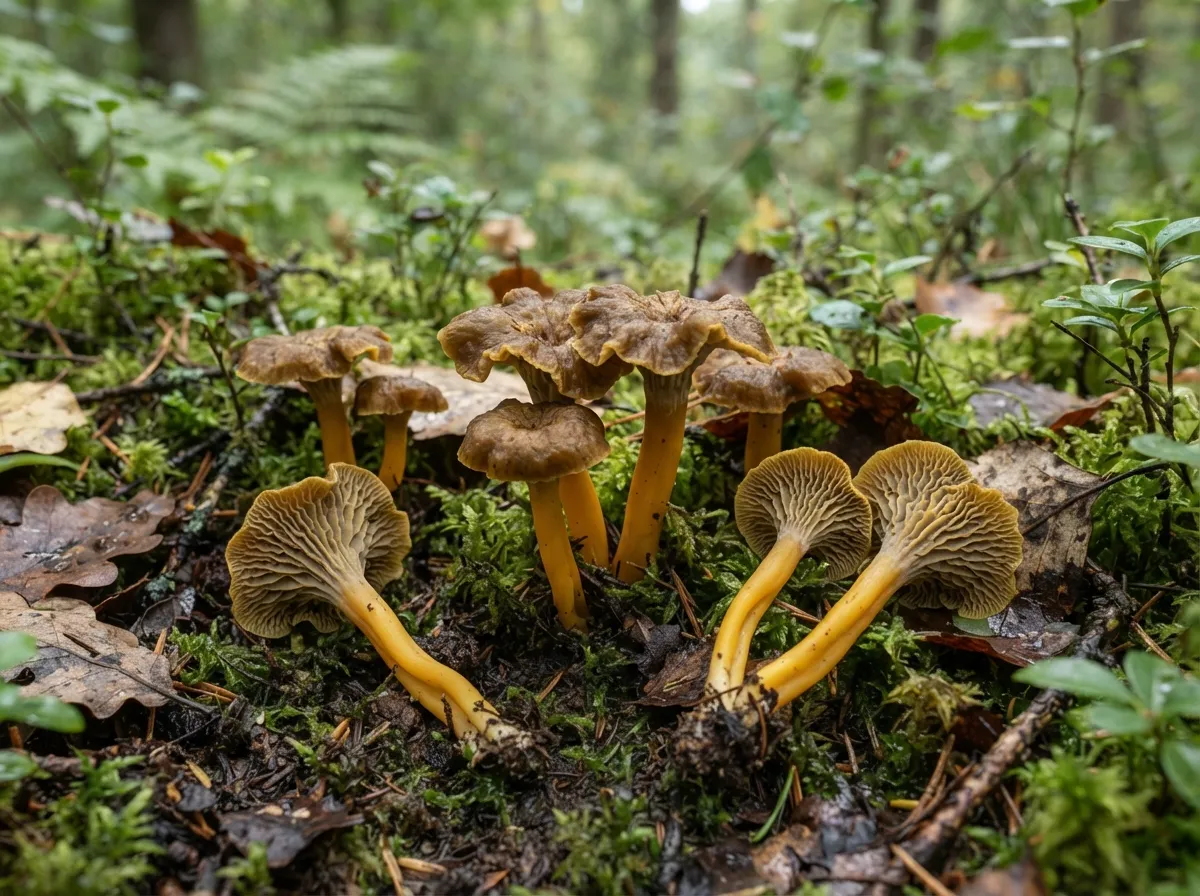
🔍 Identify it without mistakes
Small, discreet chanterelle, very common late in the season, recognizable by its hollow stem and well-defined grey-brown folds. All closely related species in the Craterellus genus are edible, which significantly limits the risk in case of misidentification.
- yellowish-brown to grey-brown, funnel-shaped cap, wavy margin, often perforated in the center
- decurrent folds (not true gills), grey-brown to greyish-yellow, well-formed and forked
- HOLLOW stem (unlike the golden chanterelle), yellow-orange to brown
- thin, yellowish flesh
- creamy white spore print
- grows in dense groups, often late in the season (late autumn)
⚠️ Not to be confused with
To tell them apart: the yellowfoot chanterelle has a hollow stem and more greyish/brownish colors, while the golden chanterelle has a solid stem and a uniform egg-yellow color
To tell them apart: Leotia lubrica has a gelatinous texture and a smooth fertile surface with no folds or gills — the complete absence of folds is enough to rule it out
🍽️ Eating it
Preparation : always cooked; dries very well and keeps for a long time; great cooked with garlic and parsley or as a side dish for game meat
Sources (2)
No entry replaces a certain identification in the field, or medical advice. When in doubt: don't eat it. If ingestion is suspected: poison control or 112/911.