Harmless🪓 Tool
🌳 European Hornbeam
Carpinus betulus · Betulaceae
🧠 To remember it“Hornbeam has teeth, beech is smooth and sweet” — hornbeam leaves have real teeth, while beech has a wavy margin fringed with fine hairs.
🔍 Identify it without mistakes
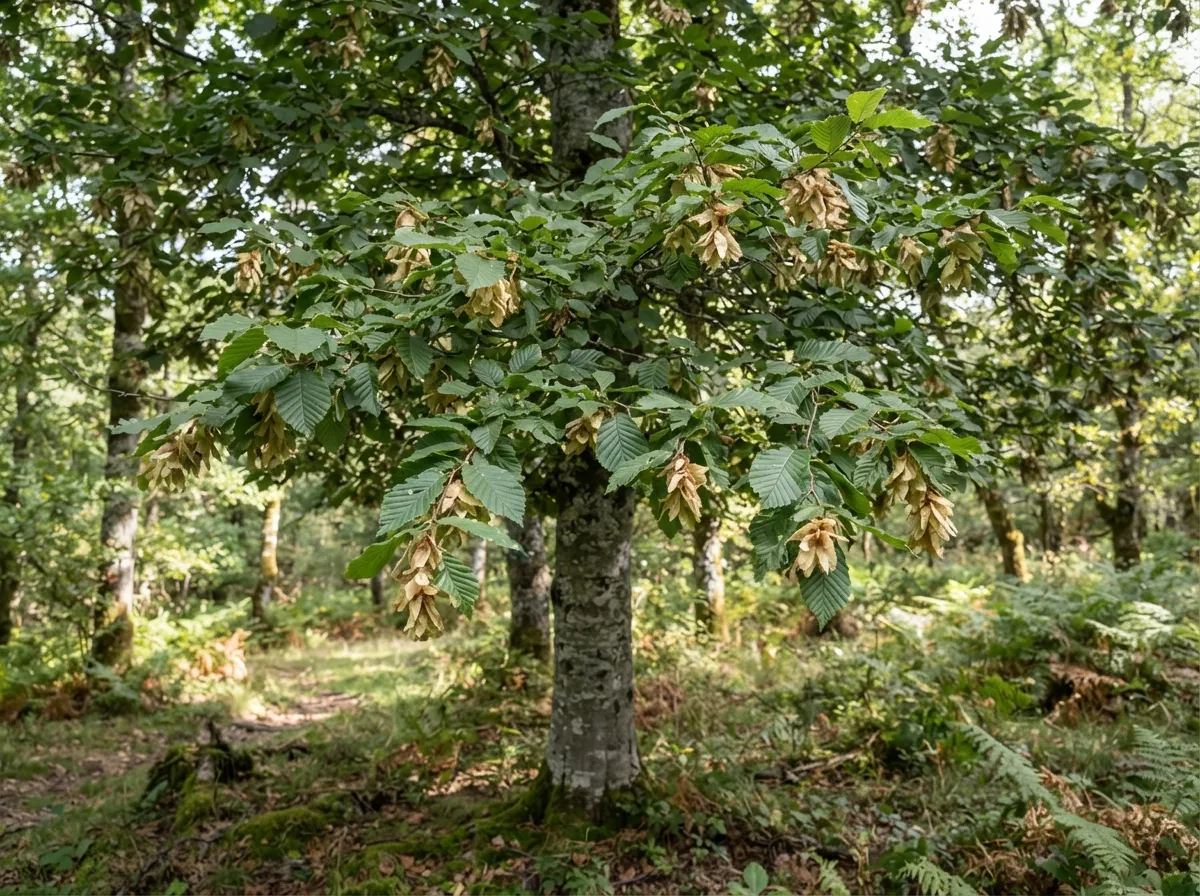
Often confused with beech from a distance (both keep their dead leaves on low shoots through winter), hornbeam is recognized by its fluted, muscle-like trunk, very different from the smooth, cylindrical trunk of beech. Leaves are doubly serrated and ribbed, fruits (achenes) attached to a three-lobed bract in hanging clusters.
- fluted, muscle-like trunk, unlike the smooth and cylindrical trunk of beech
- doubly serrated and ribbed leaves (beech has a simply wavy margin, fringed with silky hairs)
- fruits (achenes) attached to a three-lobed bract, in hanging clusters
- dead leaves remaining on low shoots in winter (marcescence, like beech)
Size15-25 m
Floweringavril-mai
Habitatlowland forests, hedgerows, often under oak canopy, limestone soils
⚠️ Not to be confused with
Beech (Fagus sylvatica)none (edible as well)
To tell them apart: fluted/muscular trunk in hornbeam versus smooth in beech; serrated and rough leaves in hornbeam versus wavy margin fringed with fine hairs in beech
🪓 Other bushcraft uses
- tool handles: one of the hardest woods in Europe (density ~0.75-0.8), impact-resistant — the standard for axe handles, hammer handles, and mallets
- firewood: heat output among the highest of European species, slow burn and intense heat — the ultimate overnight firewood
- blacksmith charcoal: hornbeam charcoal, burning intensely and evenly, was highly sought after in ancient metallurgy
- hedgerows (hornbeam hedges): tolerates hard pruning and quickly forms a dense green wall — a natural windbreak and shelter
- winter camouflage: the marcescent foliage on low shoots blocks the line of sight in underbrush in mid-winter when other hardwoods are bare
- ancient gear teeth: before steel, wooden gear teeth and ox yokes were carved from this wear-resistant wood to withstand friction
- bowling pins and game mallets: hardness and uniform grain are sought after for objects subjected to repeated impacts
No entry replaces a certain identification in the field, or medical advice. When in doubt: don't eat it. If ingestion is suspected: poison control or 112/911.