🌰 American chestnut
Castanea dentata · Fagacées
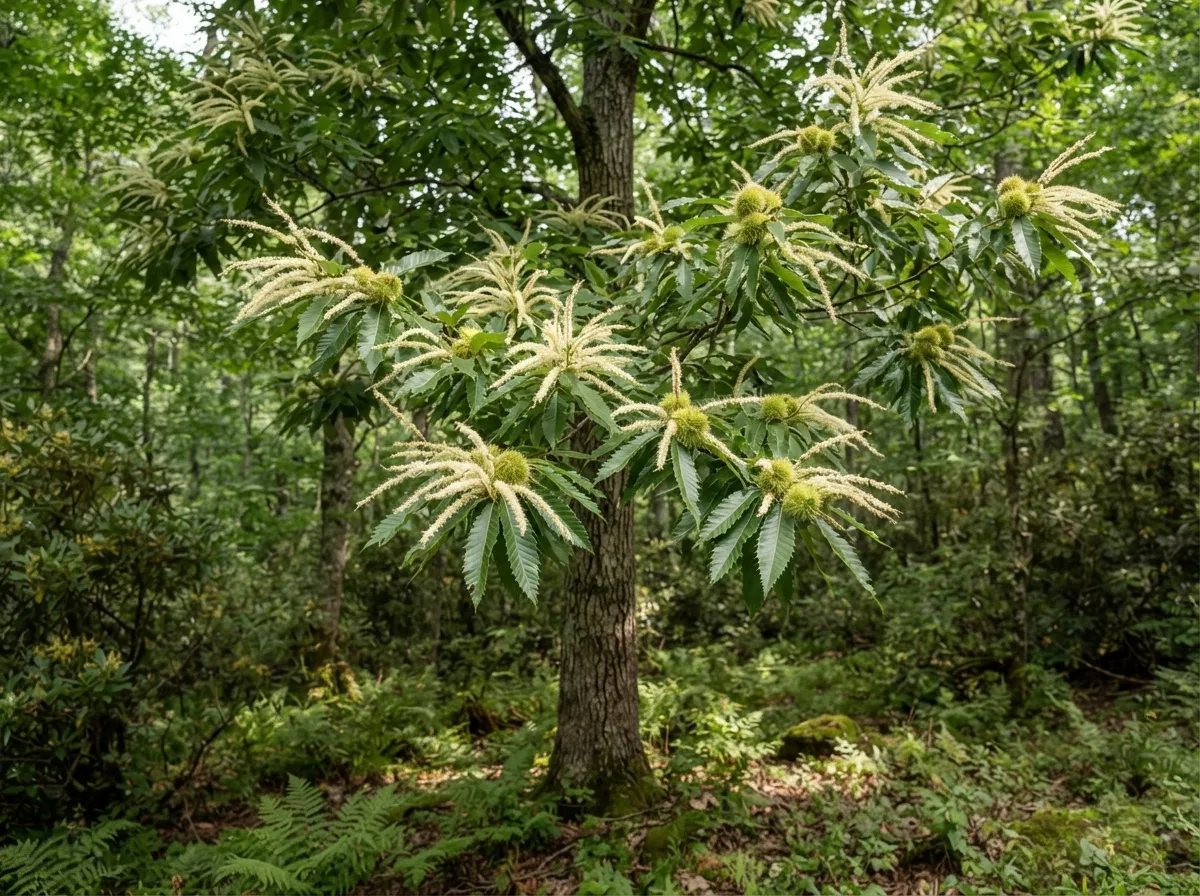
🔍 Identify it without mistakes
Once a dominant tree in eastern North American forests, now almost completely gone as a mature adult: the invasive chestnut blight fungus (Cryphonectria parasitica), introduced by accident around 1904, killed over 3 billion trees in a few decades. Root sprouts still persist widely across the Appalachians but almost always die before reaching reproductive age, killed in turn by the same fungus. Long, narrow leaves with regular saw-toothed margins, spiky bur containing several chestnuts flat on one side.
- long, narrow leaves with regular, sharp saw-toothed margins
- very spiky bur typically containing 2-3 chestnuts flattened on one side
- today found almost exclusively as root sprouts a few meters high, rarely as a mature tree
- smooth grey bark on young sprouts
⚠️ Not to be confused with
To tell them apart: leaves and fruits are very similar; planted European chestnut generally resists the blight better and reaches mature size, unlike wild Castanea dentata sprouts which almost always die before
🍽️ Eating it
Preparation : eaten roasted, boiled, or dried and ground into flour, like any chestnut; unlike acorns, requires no leaching, being naturally low in tannins
💊 Healing with it
bark and leaves traditionally used in decoctions for coughs (astringent properties documented among several Eastern Native nations)
Level of evidence : traditional use — Native American Ethnobotany Database (Moerman, University of Michigan)
⚠️ no notable toxicity; the main issue today is not health-related but ecological (near-extinction of the mature species)
🪓 Other bushcraft uses
- wood was once considered one of the most valuable in North America (lightweight, rot-resistant, straight-grained) for framing, fence posts, and furniture
- subject of a vast backcrossing and genetic engineering program aimed at restoring a blight-resistant variety, still ongoing at several American universities
Sources (3)
No entry replaces a certain identification in the field, or medical advice. When in doubt: don't eat it. If ingestion is suspected: poison control or 112/911.