🌳 Holm Oak
Quercus ilex · Fagaceae
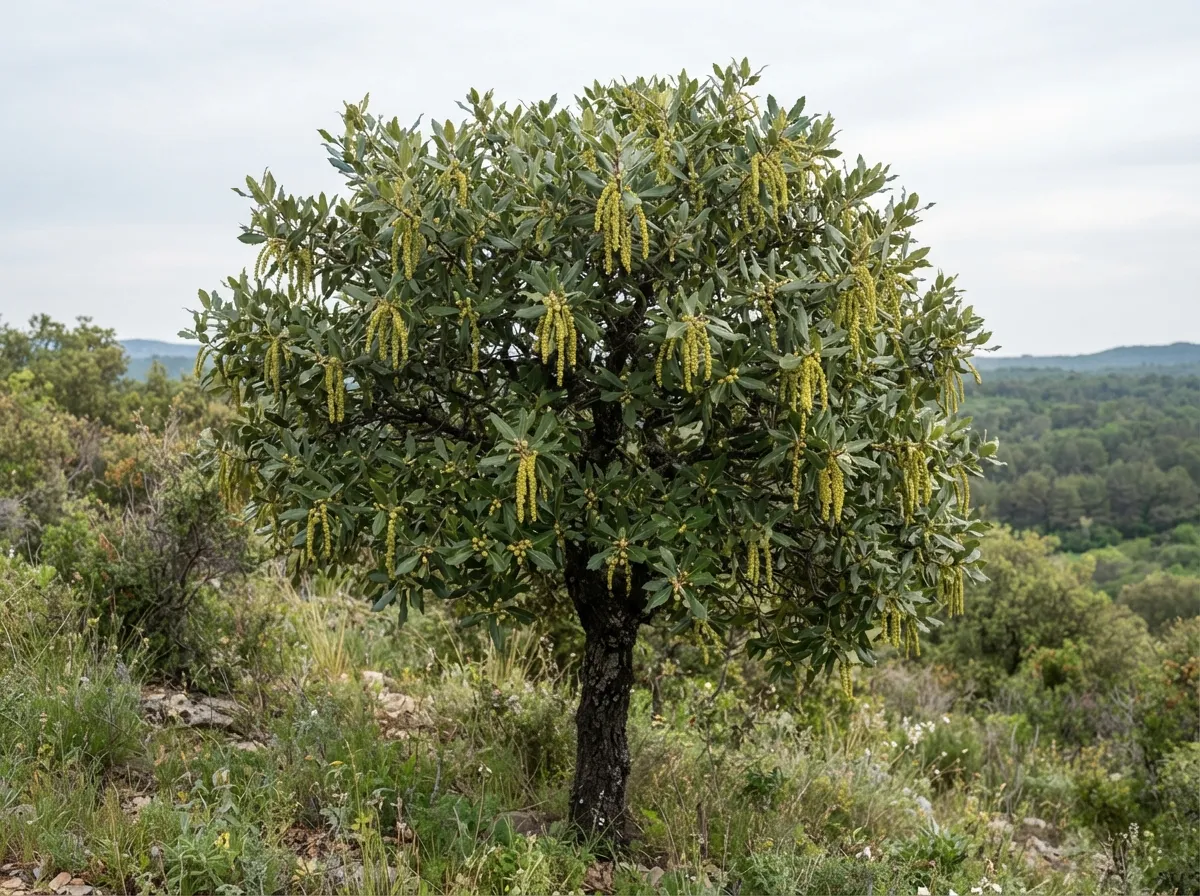
🔍 Identify it without mistakes
Large evergreen tree, 10 to 25 m, with dense dark foliage year-round (rare among oaks), leathery oval leaves, often spiny on lower branches (like holly) and smooth higher up, with a greyish downy underside. Elongated acorns with a cupule covered in overlapping scales, less bitter than other European oaks.
- evergreen foliage year-round (unlike the neighboring deciduous downy oak)
- leathery leaves sometimes spiny at the bottom, smooth at the top of the same tree
- greyish downy underside of the leaves
- elongated acorns, less bitter than other oaks
⚠️ Not to be confused with
To tell them apart: cork oak bark is thick, spongy, and deeply fissured (cork); holm oak bark remains thin, grey, and smooth to cracked
🍽️ Eating it
Preparation : shell then soak the acorns for 24-48 h, changing the water several times (or boil through multiple water changes) to leech out bitter tannins, then roast, grind into flour, or boil into porridge; the holm oak acorn is the least bitter of European oaks and requires less leeching than others
order of magnitude according to general agronomic literature on Quercus acorns, values vary depending on leeching process
🪓 Other bushcraft uses
- very hard wood used in carpentry, high-quality charcoal
- acorn traditionally roasted as a coffee substitute (Spain, Italy)
No entry replaces a certain identification in the field, or medical advice. When in doubt: don't eat it. If ingestion is suspected: poison control or 112/911.