🌱 Chia
Salvia hispanica · Lamiacées
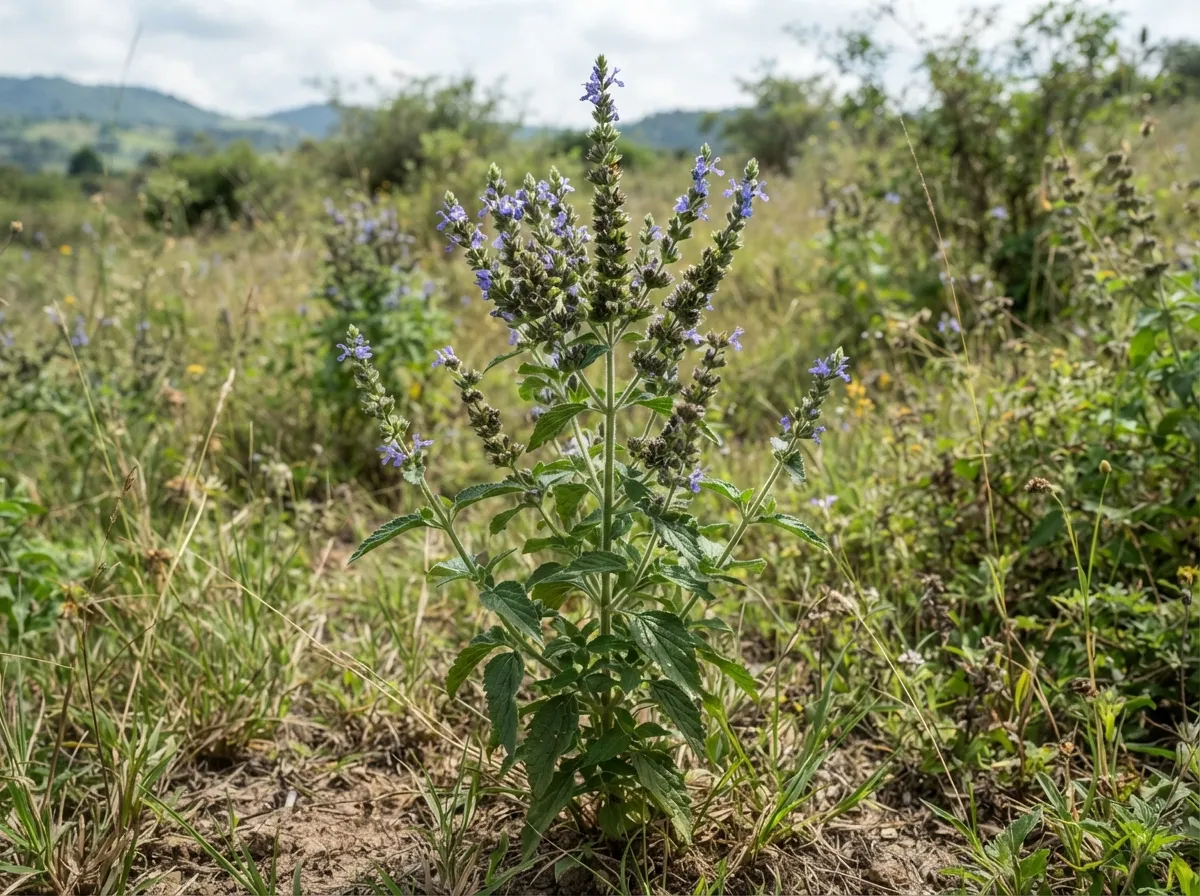
🔍 Identify it without mistakes
Annual herbaceous plant reaching up to 1.75 m, with opposite leaves of 4 to 8 cm and purple or white flowers grouped in dense spikes at the stem tips, typical of the mint family. The seeds, oval and tiny (about 1 mm), are mottled with brown, gray, black, and white. They are hydrophilic and absorb up to twelve times their weight in liquid by swelling, forming a characteristic gel.
- square stem typical of Lamiaceae, opposite leaves 4-8 cm
- purple or white flowers in dense terminal spikes
- tiny oval seeds (~1 mm), mottled brown-gray-black-white
- hydrophilic seeds, forming a gel by absorbing up to 12 times their weight in water
⚠️ Not to be confused with
To tell them apart: several wild Salvia species from the North American desert (including Salvia columbariae) are called "chia" locally and share the same square stem and dense floral spikes; all Salvia with mottled seeds harvested when mature are edible without known risk, which simplifies identification for food use
🍽️ Eating it
Preparation : seeds harvested dry and consumed as is, ground into flour, or soaked in water to form a gel used as a drink (the famous Mexican "chia fresca"); require no cooking
Wikipedia, dried seeds, per 100 g (primary USDA source not directly consulted)
💊 Healing with it
rich in omega-3 fatty acids (about 55% of total lipids), B vitamins, and minerals (magnesium, phosphorus, manganese)
Level of evidence : limited studies — Wikipedia — Salvia hispanica
⚠️ no specific precautions known at normal dietary doses
🪓 Other bushcraft uses
- cultivated since Aztec times as a major food crop in central Mexico
Sources (1)
No entry replaces a certain identification in the field, or medical advice. When in doubt: don't eat it. If ingestion is suspected: poison control or 112/911.