🥬 Sea kale
Crambe maritima · Brassicaceae
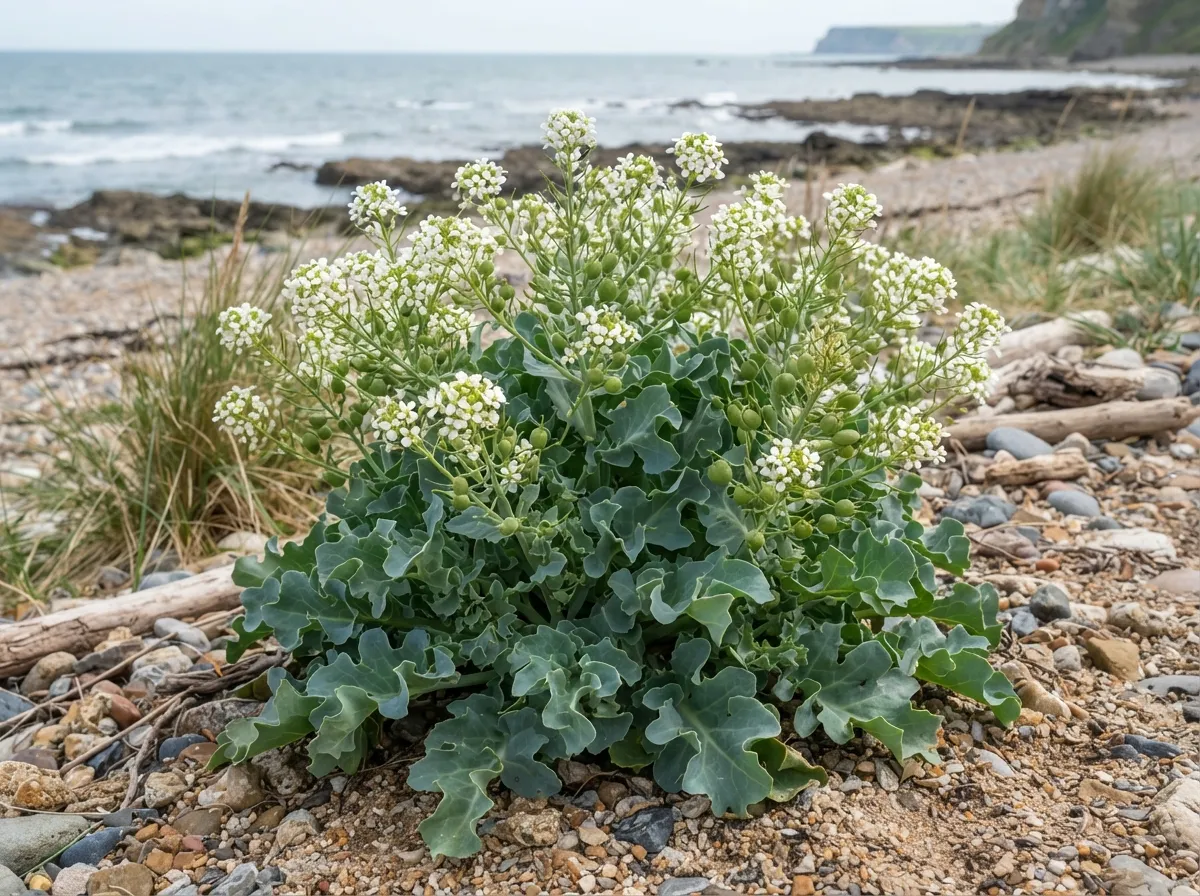
🔍 Identify it without mistakes
Large perennial plant forming a spectacular clump of broad, fleshy, wavy, and lobed waxy blue-green leaves, topped in summer by a highly fragrant, misty white inflorescence in a compact cloud. Resembles a decorative cabbage growing directly on shingle and upper beaches.
- broad fleshy, wavy, lobed, glaucous blue-green leaves with a waxy surface
- white inflorescence forming a dense cloud of small 4-petaled flowers, highly fragrant
- grows in isolated clumps on upper shingle or sandy beaches, dunal ridges of Northern Europe
⚠️ Not to be confused with
To tell them apart: sea kale has large waxy blue-green leaves that are not cut into pointed lobes, growing in a compact clump up to 75 cm; sea rocket is a smaller annual plant with shiny green leaves cut into rounded lobes, with pale mauve flowers
🍽️ Eating it
Preparation : traditionally blanched by covering it with sand or pebbles to etiolate it (like chicory), then steamed or sautéed in butter; protected species across French territory (decree of January 20, 1982) — wild foraging is strictly prohibited there, restrict yourself to cultivated plants or, outside France, to unprotected populations (e.g., Great Britain, where its cultivation and harvest are an old culinary tradition)
💊 Healing with it
no major medicinal use documented beyond its value as a traditional British leafy vegetable
Level of evidence : traditional use — CBN Brest — Fiche espèce Crambe maritima
⚠️ protected species in France: never uproot or harvest a wild plant on national territory, as the decree of January 20, 1982 strictly prohibits it
🪓 Other bushcraft uses
- used in horticulture to stabilize dunes and as a coastal ornamental plant
Sources (2)
No entry replaces a certain identification in the field, or medical advice. When in doubt: don't eat it. If ingestion is suspected: poison control or 112/911.