⚠️ Common Comfrey
Symphytum officinale · Boraginaceae
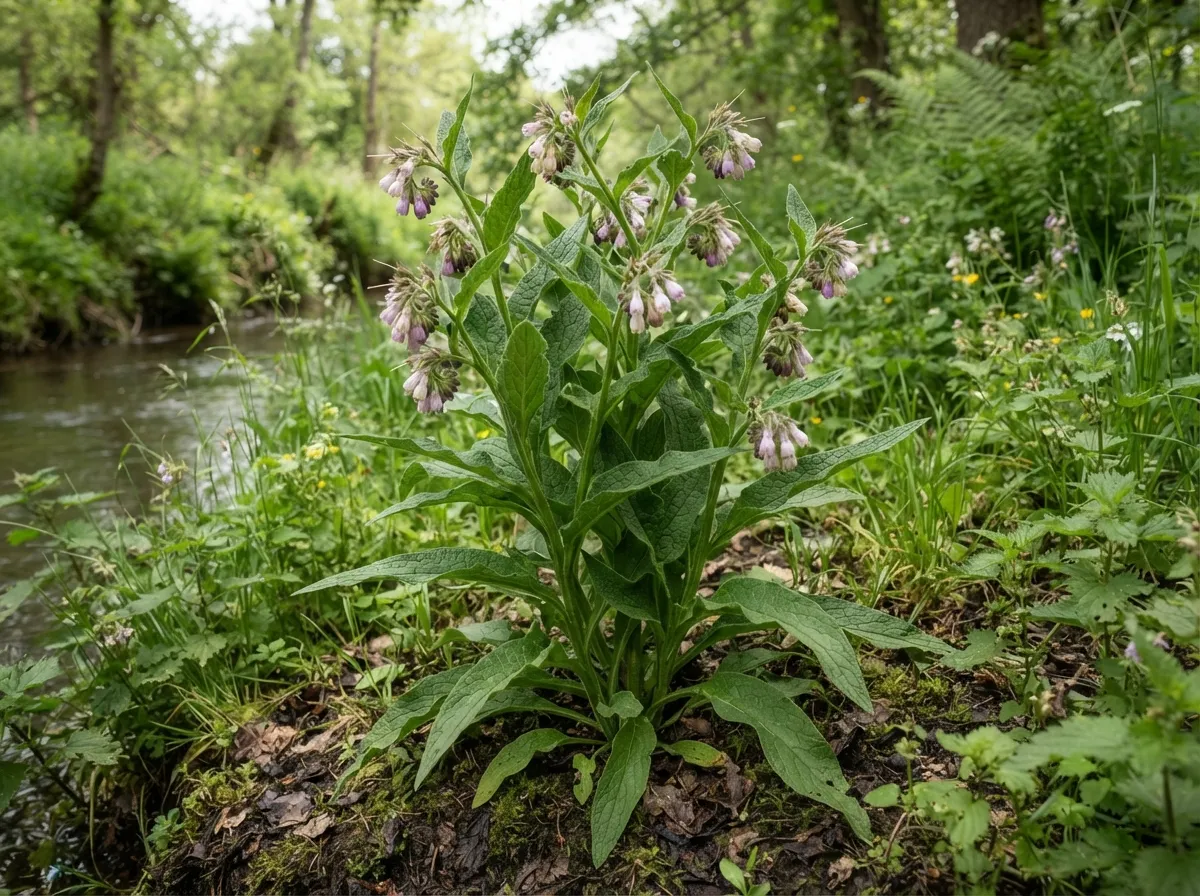
🔍 Identify it without mistakes
Large, robust plant with broad, lanceolate, rough, and hairy leaves that are decurrent along the winged stem (the leaf extends as wings down the stem, a very reliable identifying feature). Drooping tubular bell-shaped flowers, grouped in coiled scorpioid cymes, ranging in color from mauve, pink, to cream-white depending on the variety. Root is black on the outside, white and mucilaginous on the inside.
- decurrent leaves forming wings along the stem
- rough leaves, hairy to the touch (stiff hairs)
- drooping bell-shaped flowers, cymes coiled like a shepherd's crook
- robust, angular, hairy stem
- root black externally, white and mucilaginous inside
⚠️ Not to be confused with
To tell them apart: foxglove leaves are embossed, velvety to the touch (fine, soft down, not rough), without decurrent wings on the stem, and grow in a dense rosette during the first year without a flowering stem; if in doubt about an unflowered rosette, never harvest
🍽️ Eating it
Preparation : INTERNAL USE NOT RECOMMENDED: comfrey was long eaten as a vegetable or fritter in traditional cooking, but this practice is now forbidden by health authorities (see medicinal section) — this guide does not recommend any food preparation
💊 Healing with it
EXTERNAL use ONLY as a poultice or ointment for sprains, contusions, and bruises (well-documented local healing and anti-inflammatory effect, mainly due to allantoin)
Level of evidence : etudes-solides for external use (positive clinical trials for sprains and osteoarthritis, recognized by the EMA/HMPC); internal use is strictly advised against — EMA — Public statement on the use of herbal medicinal products containing toxic pyrrolizidine alkaloids; EMA/HMPC monograph Symphyti radix (external use only)
⚠️ INTERNAL USE PROHIBITED in France, Germany, and by the WHO since the 1990s: the plant contains hepatotoxic, mutagenic, and potentially carcinogenic pyrrolizidine alkaloids that silently accumulate in the liver. Even externally, never apply to broken skin, never use for more than 4 to 6 weeks per year, and avoid during pregnancy, breastfeeding, or in children
🪓 Other bushcraft uses
- used in organic gardening as a compost activator and liquid fertilizer rich in potassium (external garden use, unrelated to consumption)
Sources (3)
No entry replaces a certain identification in the field, or medical advice. When in doubt: don't eat it. If ingestion is suspected: poison control or 112/911.