🍒 Cornelian cherry
Cornus mas · Cornaceae
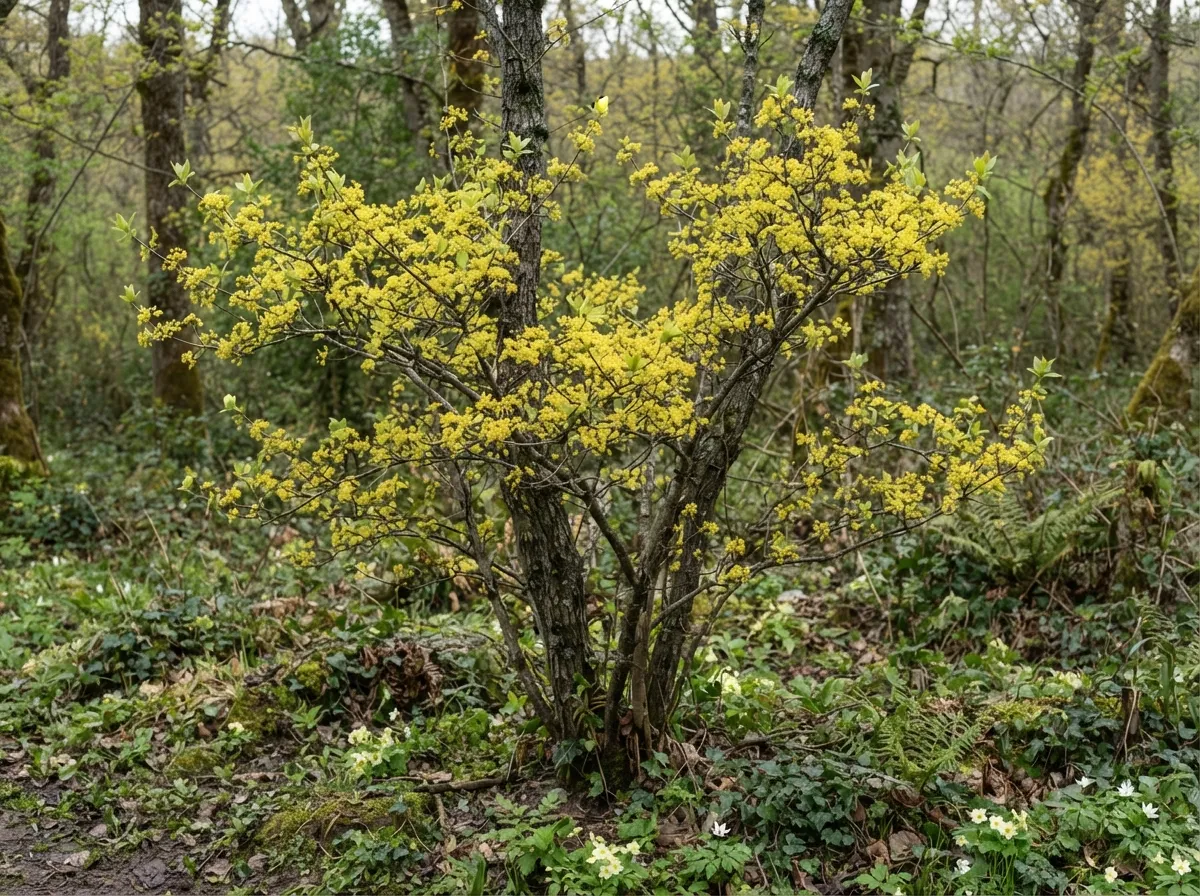
🔍 Identify it without mistakes
Shrub or small tree with very early flowering (from February, before the leaves), small yellow flowers in tight clusters directly on bare branches. Opposite leaves, oval, with arched veins characteristic of Cornus, converging towards the tip without ever crossing it. Bright red ovoid fruit (cornelian cherry) at maturity, resembling a small elongated olive, with a single hard pit.
- very early yellow flowering (February-March), before the leaves
- opposite leaves, arched converging veins typical of Cornus
- bright red ovoid fruit shaped like a small olive
- grey bark peeling off in irregular plates on older specimens
- a single large hard pit per fruit
⚠️ Not to be confused with
To tell them apart: common dogwood has blood-red twigs clearly visible in winter, late flowering (May-June, after the leaves) and black fruits, not red
🍽️ Eating it
Preparation : raw once fully ripe and slightly bletted (tart and astringent before full maturity), or cooked in jam, syrup, liquor — very popular in Eastern Europe and the Middle East
approx, Eastern European compilations where the fruit is commonly eaten and documented
💊 Healing with it
traditionally used in Eastern Europe against diarrhea and to support immune defenses (vitamin C and tannins), poorly documented by Western European agencies
Level of evidence : traditional use — ethnobotanical compilations from Central and Eastern Europe (PFAF)
⚠️ no major contraindications known at dietary doses
🪓 Other bushcraft uses
- extremely hard and dense wood (one of the hardest European woods), used since antiquity for tool handles, spindles, and certain throwing weapons
No entry replaces a certain identification in the field, or medical advice. When in doubt: don't eat it. If ingestion is suspected: poison control or 112/911.