🌿 Ostrich fern fiddleheads (fiddleheads)
Matteuccia struthiopteris · Onocleaceae
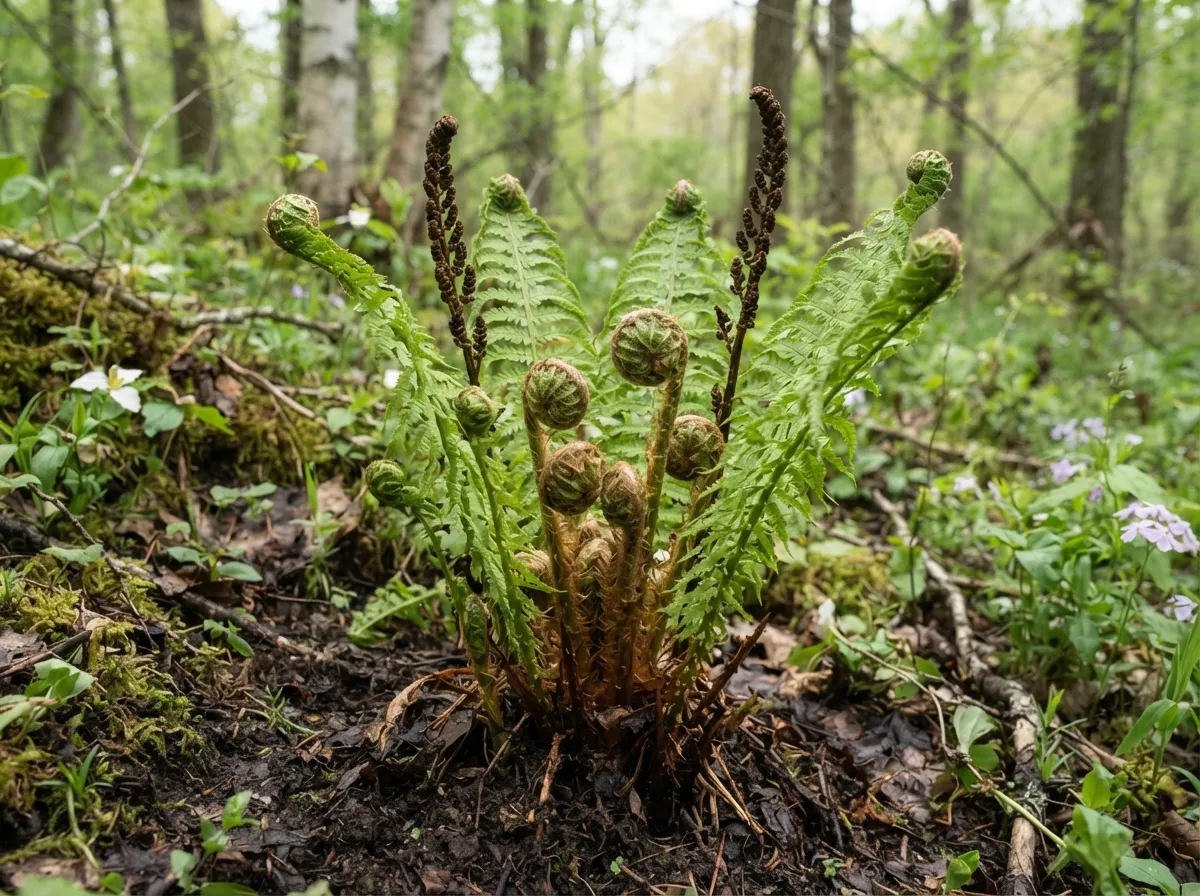
🔍 Identify it without mistakes
Fern forming distinct, funnel-shaped clumps, whose young fronds emerge in spring tightly coiled like a violin scroll ("fiddlehead"). They are covered with characteristic papery brown scales and marked by a deep U-shaped groove on the inner side of the stem, visible in cross-section. Only the ostrich fern is traditionally harvested as a vegetable in Quebec and New England — many other ferns produce inedible or toxic fiddleheads.
- deep U-shaped groove on the inner side of the stem (visible in cross-section)
- thin, papery brown scales, no woolly down
- well-defined, funnel-shaped clump, no isolated creeping stem
- harvest only at the tightly coiled stage, before any unfurling
⚠️ Not to be confused with
To tell them apart: bracken fern grows as isolated stems (not in a funnel-shaped clump), its fiddlehead is covered with silvery woolly hairs (no papery brown scales) and lacks the characteristic U-shaped groove; systematically exclude it from any harvest
🍽️ Eating it
Preparation : wash thoroughly to remove brown scales, then boil for at least 10 to 15 minutes or steam for 10-12 minutes before sautéing or eating — never eat raw or just blanched: food poisonings (nausea, vomiting, diarrhea, a few hours after ingestion) are documented by North American health authorities from undercooked fiddleheads, exact cause still poorly identified
💊 Healing with it
no major traditional medicinal use documented beyond spring food use
Level of evidence : traditional use — Health Canada / Public Health Agency of Canada — advisory on fiddleheads
⚠️ thorough cooking mandatory (see preparation); never harvest fiddleheads that are not identified with certainty, confusion with the carcinogenic bracken fern is the main risk
Sources (2)
No entry replaces a certain identification in the field, or medical advice. When in doubt: don't eat it. If ingestion is suspected: poison control or 112/911.