🍇 Bittersweet Nightshade
Solanum dulcamara · Solanaceae
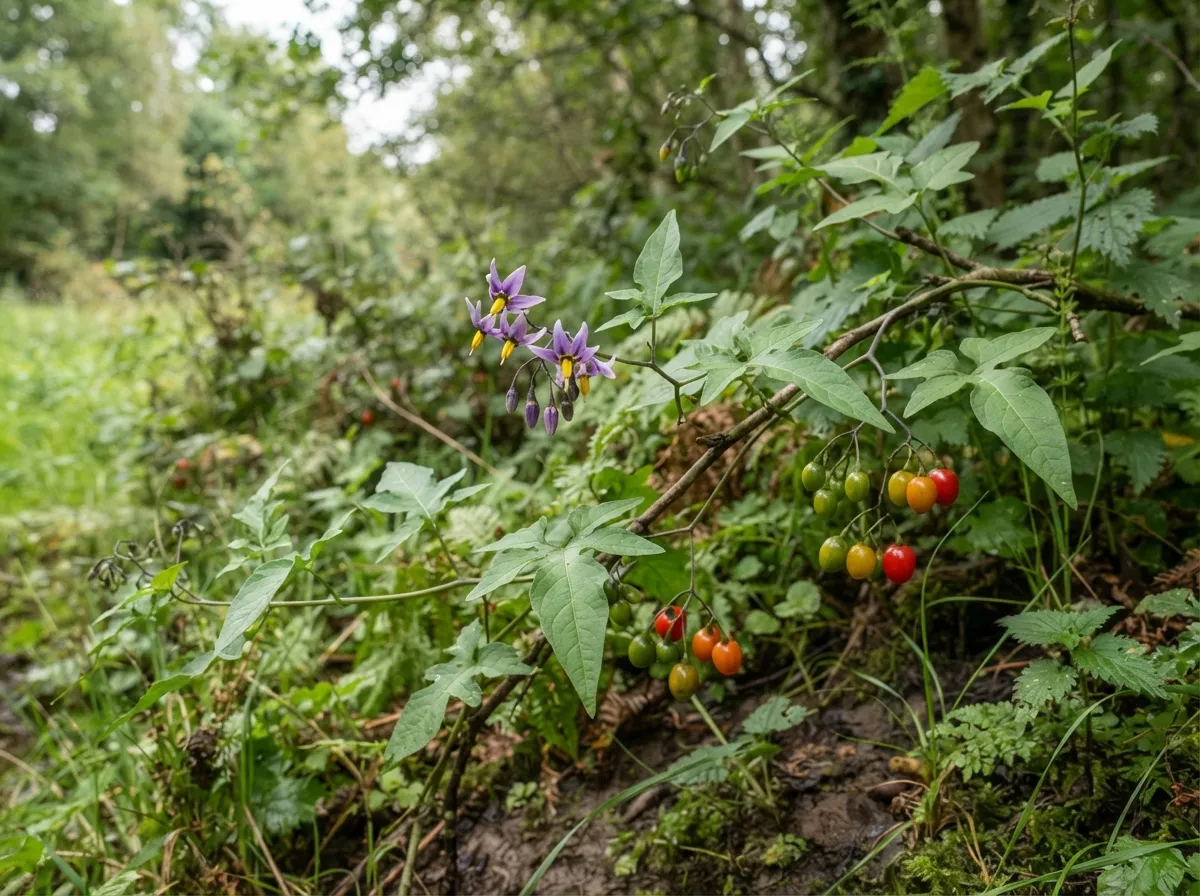
🔍 Identify it without mistakes
Semi-woody vine climbing in damp hedges and riverbanks, with purple flowers typical of Solanaceae (reflexed petals, yellow stamens forming a cone), followed by bright oval shiny red berries in hanging clusters that remain toxic even when ripe, contrary to popular belief.
- purple flowers with 5 backward-pointing petals and a central yellow cone of stamens
- leaves often arrow-shaped or with 2 small lobes at the base
- bright shiny oval red berries in hanging clusters, looking like tiny elongated tomatoes
- climbing stem, woody at the base, scrambling through riparian bushes
⚠️ Not to be confused with
To tell them apart: bittersweet nightshade grows as a wild climbing vine on riverbanks or hedges, never as an upright garden plant; its berries are smaller and more elongated, hanging in loose clusters typical of a vine
To tell them apart: cranberries crawl flush with sphagnum moss, with tiny leathery leaves and floating fruit; bittersweet nightshade climbs, features star-shaped purple flowers with a yellow center, and hanging red berries in clusters on an aerial stem
☠️ What kills
First steps : Call poison control if berries are ingested, especially by a child. Do not induce vomiting. Keep a sample of the berries or stem for identification, even if the berries looked ripe.
No entry replaces a certain identification in the field, or medical advice. When in doubt: don't eat it. If ingestion is suspected: poison control or 112/911.