🌸 Fireweed
Epilobium angustifolium (syn. Chamerion angustifolium) · Onagraceae
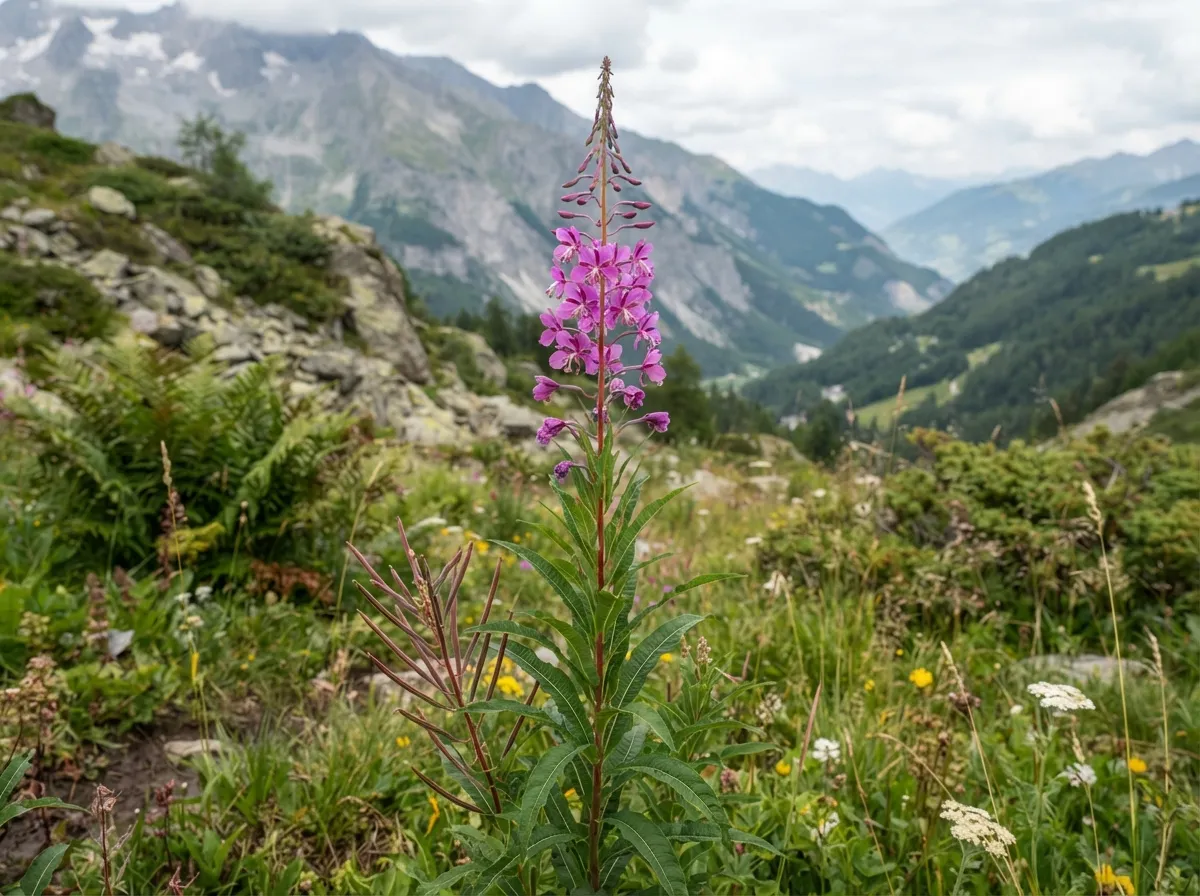
🔍 Identify it without mistakes
A tall, spectacular colonizing plant forming vast pink carpets on freshly cleared, burned, or logged ground ("fireweed"). Leaves are alternate, narrow, and lanceolate, with a characteristic looping secondary venation (the veins never reach the leaf edge). Long, upright spikes of large, 4-petaled, pink-magenta flowers, blooming from bottom to top throughout the summer.
- dense colonizing carpets on disturbed, burned, or logged soil
- narrow lanceolate leaves with secondary veins forming inner loops
- long, upright spike of pink-magenta flowers with 4 petals
- progressive blooming from the bottom to the top of the spike
- elongated capsules releasing seeds with silky white tufts at the end of the season
⚠️ Not to be confused with
To tell them apart: large carpets of pink spiked flowers on disturbed ground are very characteristic and have no toxic equivalent in temperate Europe
🍽️ Eating it
Preparation : young shoots raw or cooked like asparagus; young leaves in salads or infused (the famous Russian "Ivan tea", fermented leaves); flowers as decoration or jelly; sweet, mild inner stem pith extracted by splitting it open
💊 Healing with it
traditionally used in Eastern Europe and North America to support urinary and prostate function (root and leaf), anti-inflammatory properties studied
Level of evidence : etudes-limitees (a few modest preclinical and clinical studies on root extracts for benign prostate disorders) — North European and North American phytotherapeutic compilations (PFAF, Russian ethnobotanical literature on "Ivan tea")
⚠️ no major known contraindications at food doses or as herbal tea
🪓 Other bushcraft uses
- the famous Russian "Ivan tea" (Ivan-tchai), made from dried fermented leaves, was a popular national drink in Russia before the massive adoption of imported tea in the 19th century
- an emblematic pioneer plant of plant recovery after a fire, hence its English name "fireweed"
- seeds with silky tufts usable as tinder material or lightweight padding
Sources (3)
No entry replaces a certain identification in the field, or medical advice. When in doubt: don't eat it. If ingestion is suspected: poison control or 112/911.