🍁 Field Maple
Acer campestre · Sapindaceae
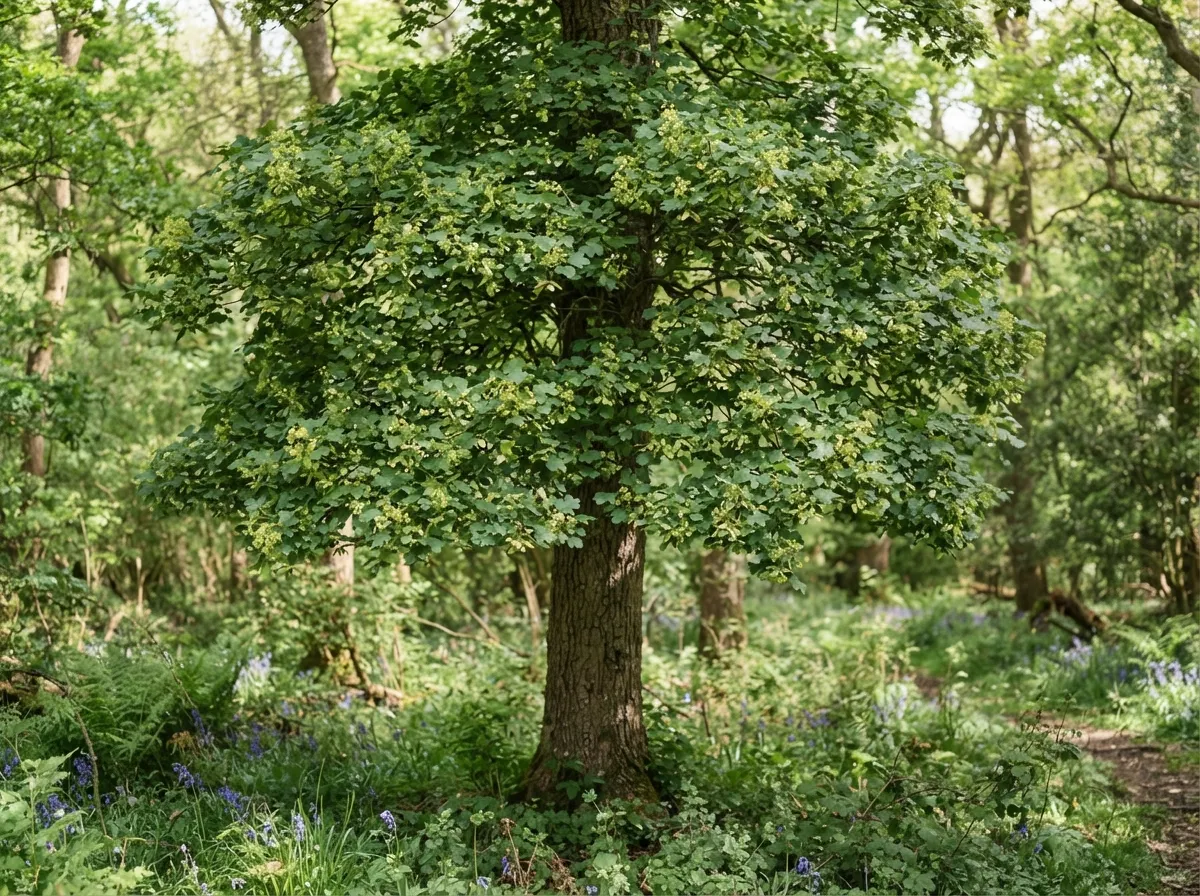
🔍 Identify it without mistakes
The smallest of the common European maples, featuring pale gray cracked bark, sometimes corky on young twigs. Small deciduous leaves with 3-5 rounded lobes (never pointed like the sycamore), greenish flowers appearing with the leaves, and double samara fruits with horizontal wings set at 180°.
- small leaves with 3-5 rounded lobes (not pointed like sycamore)
- pale gray, cracked bark, sometimes corky on young twigs
- samaras (winged fruits) with horizontal wings opposite at 180°
- often found in trimmed hedges or understory, rarely a large isolated tree
⚠️ Not to be confused with
To tell them apart: leaf lobes are small and rounded on the field maple versus large, pointed, and toothed lobes on the sycamore; field maple often has corky ridges on young twigs
To tell them apart: the maple has OPPOSITE leaves (two per node, facing each other) while the wild service tree has ALTERNATE leaves (one per node, staggered) — the most reliable feature to tell them apart in the field
🍽️ Eating it
Preparation : controlled tapping just like sugar maple, drink the sap fresh or boil it down to syrup — much less concentrated in sugar than the North American sugar maple, requiring two to three times more sap for the same volume of syrup
🪓 Other bushcraft uses
- sweet sap tapped in late winter, exactly like the North American sugar maple but with a lower yield — a little-known European resource
- spoons and small crafts: hard and dense wood (among the hardest of European maples), used for spoons, toys, and tool handles
- luthiery and marquetry: fine, uniform grain appreciated for small turned items
- hedgerows: takes extremely well to pruning into dense hedges, providing windbreaks and wildlife shelter (like hornbeam)
- firewood: burns well and long, comparable to hornbeam in heating value
- winter identification: young twigs with corky ridges, a good identification feature by feel once the leaves have fallen
- wildlife indicator: leaves favored by livestock and deer — a great indicator of animal travel corridors
No entry replaces a certain identification in the field, or medical advice. When in doubt: don't eat it. If ingestion is suspected: poison control or 112/911.