🍁 Sycamore maple
Acer pseudoplatanus · Sapindaceae
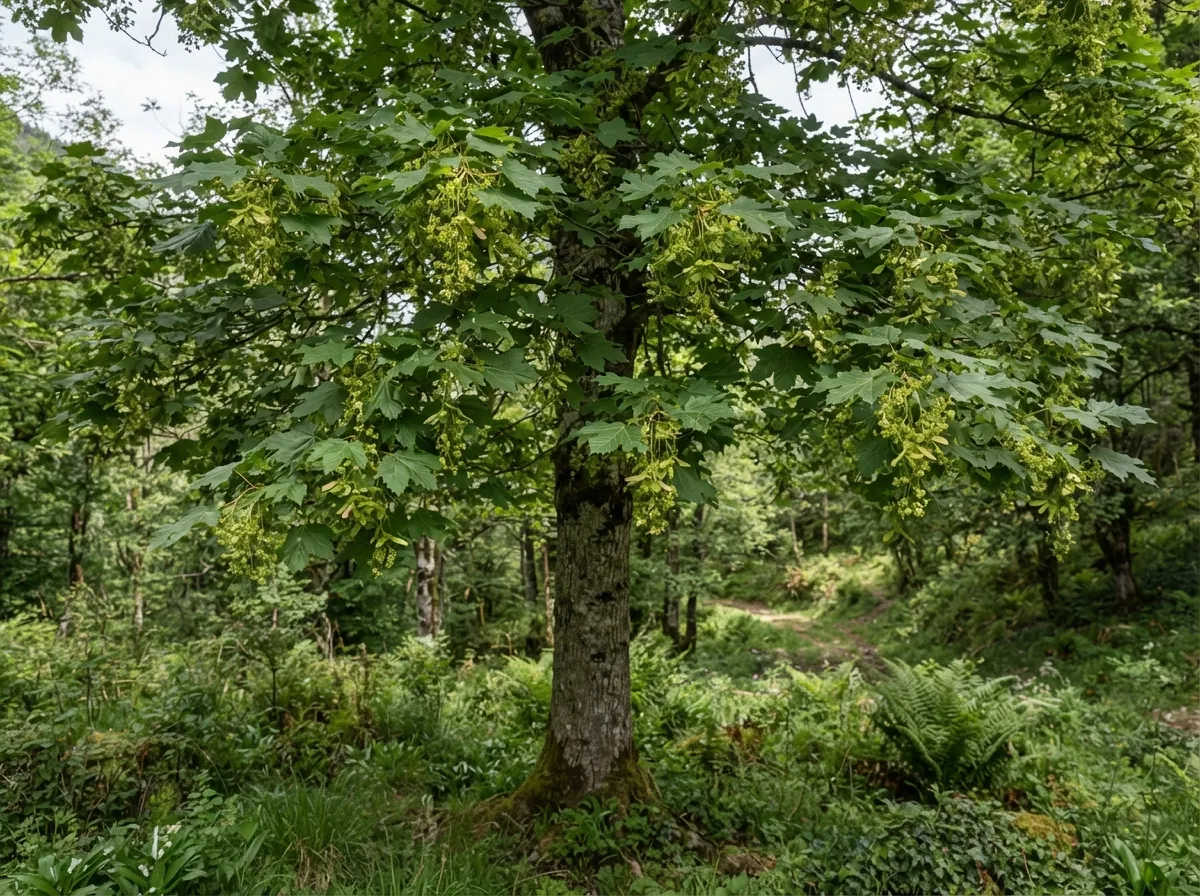
🔍 Identify it without mistakes
Large tree with big palmate leaves with 5 pointed and toothed lobes, shiny dark green on top. Grey-brown bark that flakes off in characteristic plates with age, a bit like plane trees. Paired samaras forming an acute angle. One of the largest deciduous trees in Europe, growing up to 35-40 m.
- large palmate leaves with 5 pointed and toothed lobes (versus rounded lobes on field maple)
- bark that flakes off in plates with age, a bit like a plane tree
- paired samaras at an acute angle
- can reach 30-40 m, one of Europe's largest deciduous trees
⚠️ Not to be confused with
To tell them apart: the Norway maple exudes a milky white latex when you snap the petiole, which sycamore maple never does since its sap is clear
To tell them apart: leaf lobes are small and rounded on field maple versus large, pointed, and toothed on sycamore; field maple often has corky wings on young twigs
To tell them apart: the plane tree's bark peels off in large, very characteristic multicolored plates, whereas the sycamore's bark remains more uniformly grey; plane tree leaves are alternate, while sycamore leaves are opposite
🍽️ Eating it
Preparation : tap the trunk as you would for sugar maple, reduce sap into syrup; lower sugar content than North American sugar maple, so lower yield
🪓 Other bushcraft uses
- sweet sap harvestable by tapping in late winter like all maples — a lesser-known European spring resource
- lutherie: light white wood, hard and easy to work, reference benchmark for string instrument soundboards (violins) thanks to its acoustic qualities
- spoons and utensils: odorless and resin-free wood that leaves no taste in food — traditionally used for cutting boards and kitchen tools
- decent firewood, burns cleanly
- improvised wrapping: large leaves usable as a makeshift plate or insulation under a sleeping bag
- long-distance identification landmark: bark peeling in plates with age makes it recognizable even without leaves
- coastal windbreak: fast growth and wind/salt tolerance, often planted in exposed coastal and mountain areas — a good landmark for windy terrain
No entry replaces a certain identification in the field, or medical advice. When in doubt: don't eat it. If ingestion is suspected: poison control or 112/911.