🌵 Candelabra tree
Euphorbia candelabrum · Euphorbiaceae
🔍 Identify it without mistakes
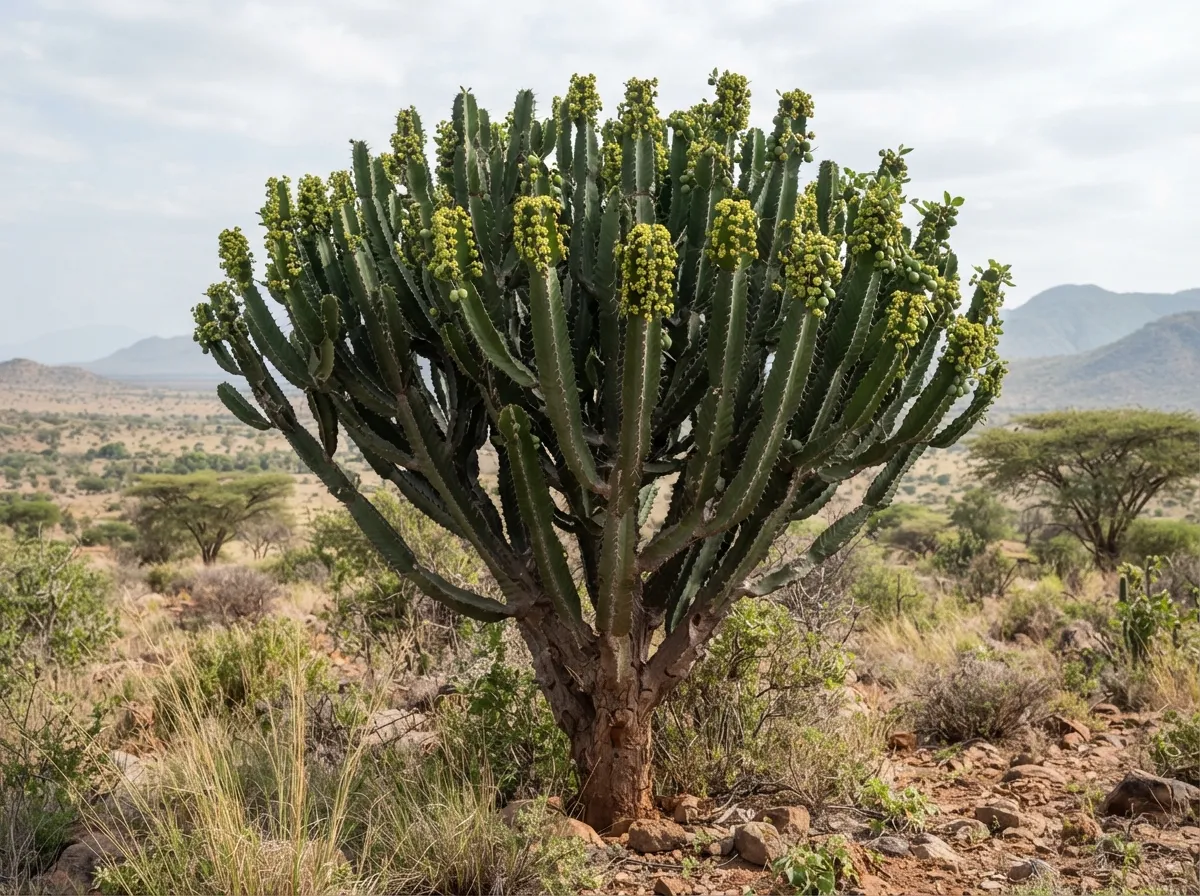
Succulent tree with thick, angled branches rising like the arms of a candelabra, sometimes forming true "cactus forests" in the rocky savannas of East Africa — even though botanically it has nothing to do with real cacti (absent from wild Africa), a textbook case of convergent evolution. Its milky white sap, released at the slightest cut, is extremely caustic.
- thick, angled branches (4-5 sides), succulent, rising in the shape of a candelabra
- abundant milky white sap that beads as soon as the bark or a branch is cut
- short spines arranged in pairs along the angles of the branches, resembling cactus spines
- overall giant cactus silhouette, even though the genus Euphorbia has no relation to real cacti (Cactaceae), which are not native to Africa
⚠️ Not to be confused with
To tell them apart: make a small nick in a branch: the candelabra tree immediately releases abundant milky white sap, whereas a cactus never produces this latex; this simple test ensures you never confuse the two despite their almost identical silhouette
💊 Healing with it
in traditional Ethiopian medicine, highly diluted sap mixed with clarified honey was used as a purgative, and in ointments for certain leprosy symptoms; the Ovaherero and Damara peoples of Namibia use it as arrow poison or to poison waterholes during traditional hunting
Level of evidence : traditional use — PMC — Pharmacological Significance, Medicinal Use, and Toxicity of Extracted and Isolated Compounds from Euphorbia Species Found in Southern Africa
⚠️ the sap is a severe skin and mucous membrane irritant, classified as a potential carcinogen (phorbol esters), and can cause temporary or permanent blindness upon eye contact; never use for self-medication
🪓 Other bushcraft uses
- sap traditionally used to poison pond water to make catching fish easier (traditional fishing)
- impenetrable living fences planted around homes and livestock enclosures thanks to its dense, spiky shape
Sources (2)
No entry replaces a certain identification in the field, or medical advice. When in doubt: don't eat it. If ingestion is suspected: poison control or 112/911.