⚠️ Sea Spurge
Euphorbia paralias · Euphorbiaceae
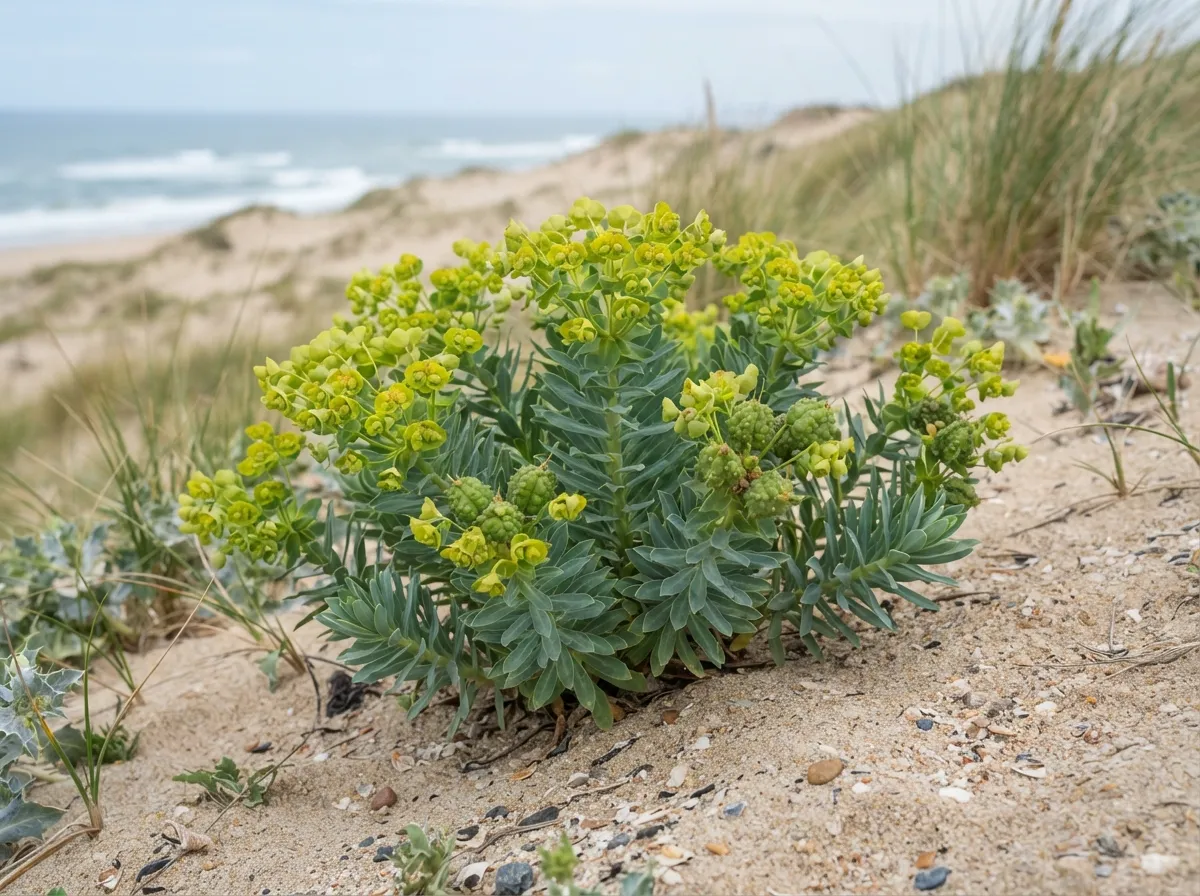
🔍 Identify it without mistakes
Perennial dune plant growing 30 to 60 cm tall, with upright, unbranched stems that are reddish at the base and turn yellow-green toward the top, densely covered with small, fleshy, blue-green overlapping leaves. Like all spurges, it instantly exudes a caustic, milky white latex when broken — the signature sign of the entire genus, particularly treacherous here because the plant grows in the same sands as several edible species.
- milky white latex flowing immediately when a stem or leaf is broken — signature of the whole Euphorbia genus
- fleshy, sessile, blue-green leaves, densely overlapping along erect, unbranched stems that are reddish at the base
- yellow-green cyathia inflorescence characteristic of the genus, arranged in terminal umbels
- grows in erect tufts in coastal dune sand, never forming a creeping carpet
⚠️ Not to be confused with
To tell them apart: the decisive test is the latex: break a leaf or stem — sea spurge instantly releases a sticky white latex, sea sandwort never does; sea sandwort leaves are also arranged in 4 very regular overlapping rows, absent in sea spurge
To tell them apart: glasswort has no visible leaves at all (fleshy jointed stems without leaves) and releases only a clear, salty sap when broken; sea spurge bears small, clearly visible blue-green leaves and releases a milky white latex as soon as you break it — this latex is the decisive test
☠️ What kills
First steps : If splashed in the eye: flush thoroughly with clean water for at least 15 minutes and seek emergency ophthalmic care. If ingested: call poison control immediately, do not induce vomiting. Wash your hands after any contact with the latex.
Sources (3)
No entry replaces a certain identification in the field, or medical advice. When in doubt: don't eat it. If ingestion is suspected: poison control or 112/911.