🟤 Bladderwrack
Fucus vesiculosus · Fucacées
🔍 Identify it without mistakes
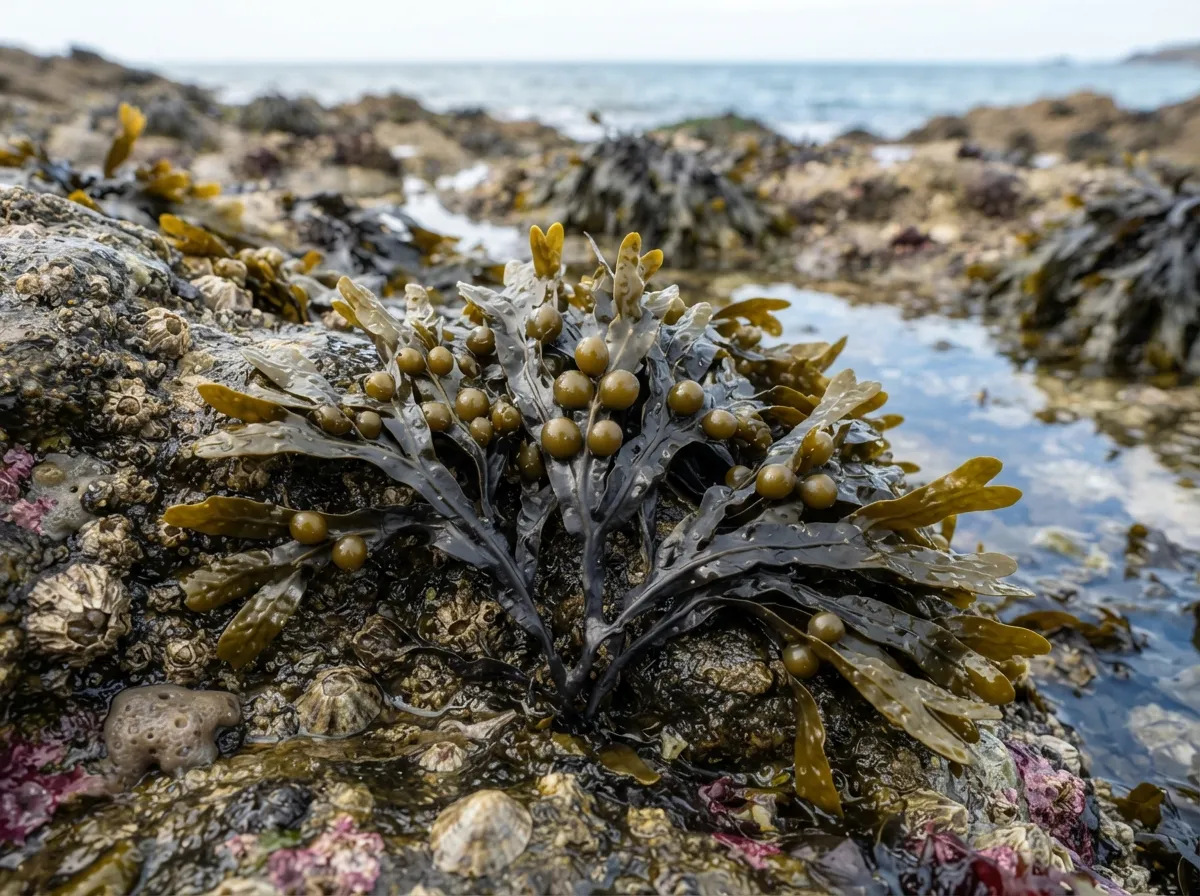
Very common brown seaweed, immediately recognizable by its pairs of air vesicles arranged on either side of a midrib on a flat, fork-branching frond. These floats, which give it its name, form large carpets on the rocks of the mid-intertidal zone, making it arguably the most familiar seaweed of rocky beaches.
- flat frond branching in forks (dichotomous), olive-brown to yellow-brown
- pairs of round or oval air vesicles on either side of the midrib, characteristic of the species
- well-marked midrib along the entire length of the frond
⚠️ Not to be confused with
To tell them apart: spiral wrack grows higher up on the shore, its spirally twisted frond lacks air vesicles; bladderwrack, lower down, bears its clearly visible pairs of floats along the midrib
To tell them apart: bladderwrack bears its air vesicles in pairs on either side of a visible midrib; knotted wrack has single swellings, one by one along a strap-like frond without a distinct midrib
🍽️ Eating it
Preparation : consume in small quantities, dried and ground into powder as a salty-iodized condiment, or as an infusion; the very strong, salty iodine taste discourages eating it in large amounts, which is actually recommended given its high iodine content
💊 Healing with it
traditionally used in herbal medicine to support thyroid function (thanks to iodine) and, externally, against cellulite and for weight loss
Level of evidence : etudes-limitees pour les effets métaboliques, tradition pour le reste ; la Commission E allemande reconnaît un usage traditionnel contre l'obésité modérée — Commission E (Allemagne) — monographie Fucus vesiculosus
⚠️ avoid in case of thyroid disorders (hyper- or hypothyroidism), pregnancy, or breastfeeding without medical advice, due to its very high iodine content; possible interactions with thyroid treatments; avoid harvesting in port zones (heavy metals)
🪓 Other bushcraft uses
- historical source of iodine and potash (soda ash) before the industrial era, burned to ash for these uses
Sources (3)
No entry replaces a certain identification in the field, or medical advice. When in doubt: don't eat it. If ingestion is suspected: poison control or 112/911.