🌳 European Spindle
Euonymus europaeus · Celastraceae
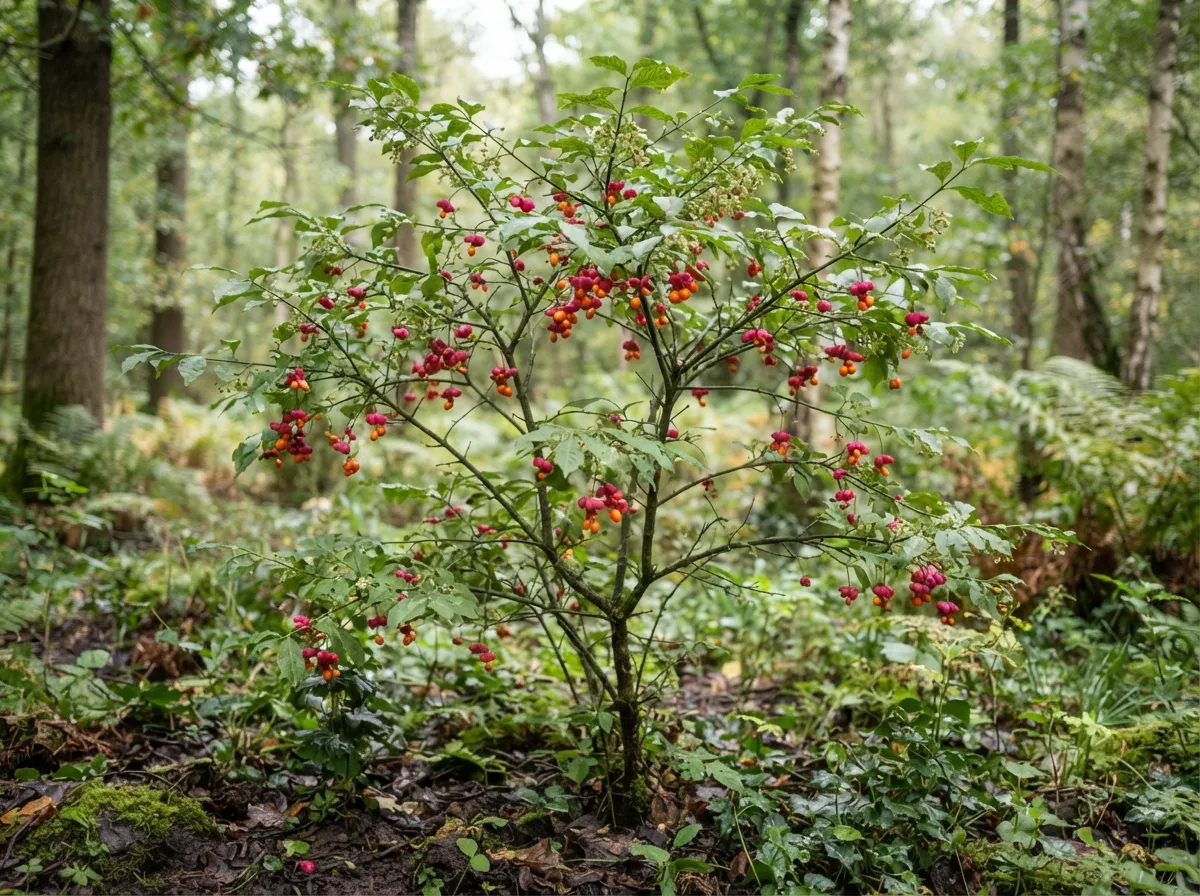
🔍 Identify it without mistakes
Shrub with green young twigs having an almost square cross-section and four corky ridges. Opposite, finely toothed leaves. The fruit is its most distinctive feature: a bright pink 4-lobed capsule ("bischofskappe" or "priest's cap") that opens in autumn to reveal orange seeds — stunning, but highly toxic.
- young green twigs with an almost square cross-section and four corky ridges
- finely toothed opposite leaves, bright green
- bright pink 4-lobed capsule fruit ("bischofskappe") opening to reveal orange seeds — HIGHLY TOXIC
- smooth grey bark dotted with lenticels
💊 Healing with it
crushed seeds were formerly used as an antiparasitic powder (against lice and fleas) before the advent of modern insecticides
Level of evidence : tradition, abandoned practice — LPO — European Spindle; toxiplante.fr
⚠️ the entire plant is toxic; ingesting just 3-4 fruits in an adult (only 1 in a child) can cause, after a deceptive delay of 8-15 hours, severe digestive irritation, dizziness, fever, and in serious cases convulsions or coma
🪓 Other bushcraft uses
- drawing charcoal: the resin-free, fine-grained young wood is charred in an airtight container (without oxygen) to produce artist charcoal sticks — the only European species traditionally used for this purpose
- make-shift fine charcoal: the same airtight charring process can produce lightweight charcoal useful for crude water filtration powder
- small turned items: hard, dense wood used in marquetry and to make wool-spinning spindles (hence the French name "fusain", from "fuseau")
- toothpicks and small pegs: the fine, hard wood is easy to carve into precise small pieces
- navigation landmark: the bright pink fruit with orange seeds, highly recognizable even from a distance in autumn, serves as a visual landmark at the forest edge
- tactile identification: twigs with an almost square cross-section — a great exercise to identify a species by touch, even in the dark
No entry replaces a certain identification in the field, or medical advice. When in doubt: don't eat it. If ingestion is suspected: poison control or 112/911.