🌲 Eastern Redcedar
Juniperus virginiana · Cupressacées
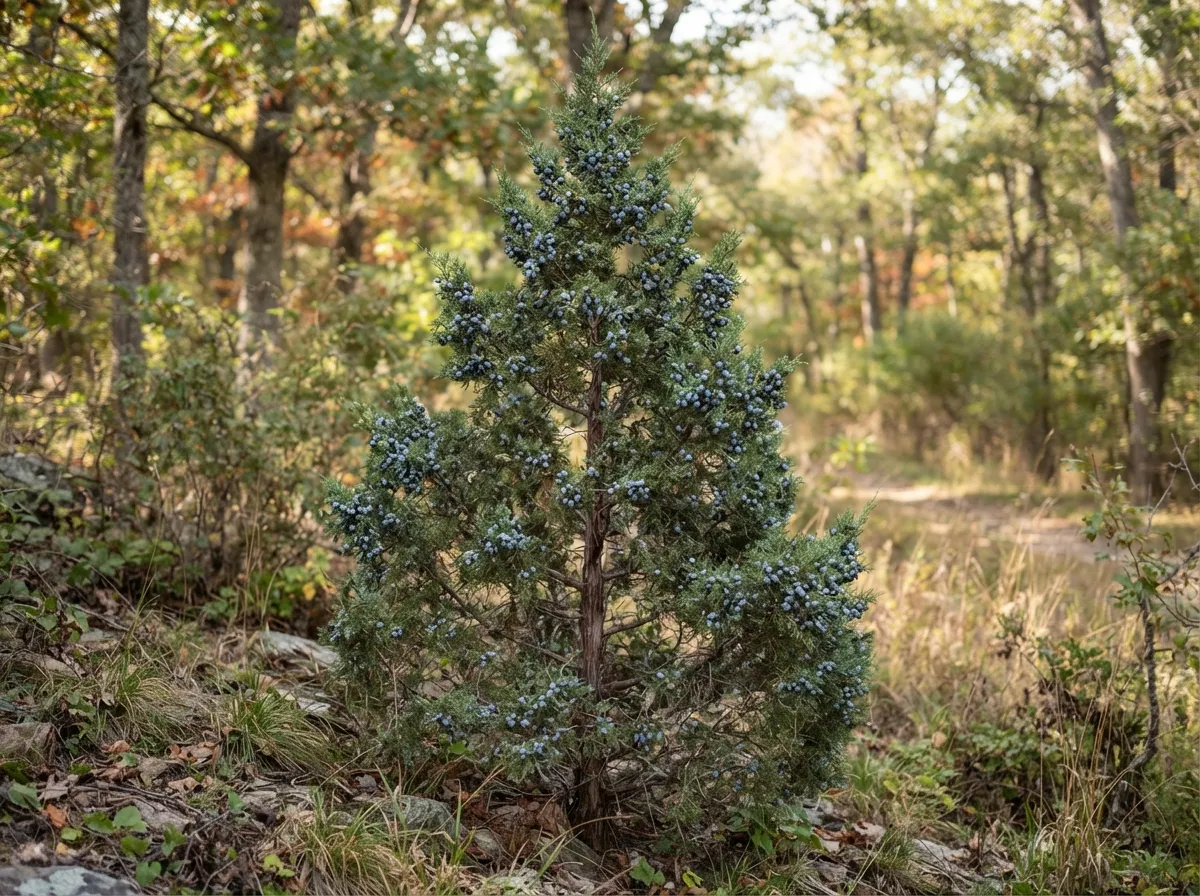
🔍 Identify it without mistakes
North American species distinct from the European common juniper, featuring tight cypress-like scale foliage (prickly needles only on young shoots), a dense conical silhouette, and reddish-brown bark peeling in long fibrous strips. Small fleshy blue-violet berry-like cones covered with a waxy bloom, borne only on female trees (dioecious species).
- tight cypress-like scale foliage (prickly needles on juvenile shoots only)
- reddish-brown bark peeling in long fibrous strips
- fleshy blue-violet berry-like cones covered with a whitish bloom
- characteristic aromatic smell when crushed
⚠️ Not to be confused with
To tell them apart: juniper has scaly foliage and blue-violet berry-cones covered with bloom; yew has flat needles arranged in two rows and a bright red fruit open at the top (aril) — color and foliage arrangement are enough to tell them apart
To tell them apart: white-cedar has flat fan-like foliage, while juniper has prickly needle-like leaves or finer scale leaves on rounded twigs
🍽️ Eating it
Preparation : the berry-cones are crushed and used in small quantities as a seasoning (game marinades, sauerkraut), never consumed raw in large amounts; a mild infusion of the berry-cones has a traditional use as a digestive aid
💊 Healing with it
infusion of berry-cones and foliage traditionally used as a diuretic and digestive aid; burned foliage used in ritual purifying smudging by many First Nations
Level of evidence : traditional use — Native American Ethnobotany Database (Moerman, University of Michigan)
⚠️ use in moderation: berry-cones in large quantities irritate the kidneys and are not recommended in cases of kidney failure, pregnancy, or breastfeeding; the foliage is not edible
🪓 Other bushcraft uses
- aromatic, rot-resistant red wood, widely used for pencils, chests, and moth-proof closets
- burned foliage used in ritual smudging and as an insect repellent
- fibrous bark used as tinder and rough cordage
Sources (3)
No entry replaces a certain identification in the field, or medical advice. When in doubt: don't eat it. If ingestion is suspected: poison control or 112/911.