🌼 Great Yellow Gentian
Gentiana lutea · Gentianaceae
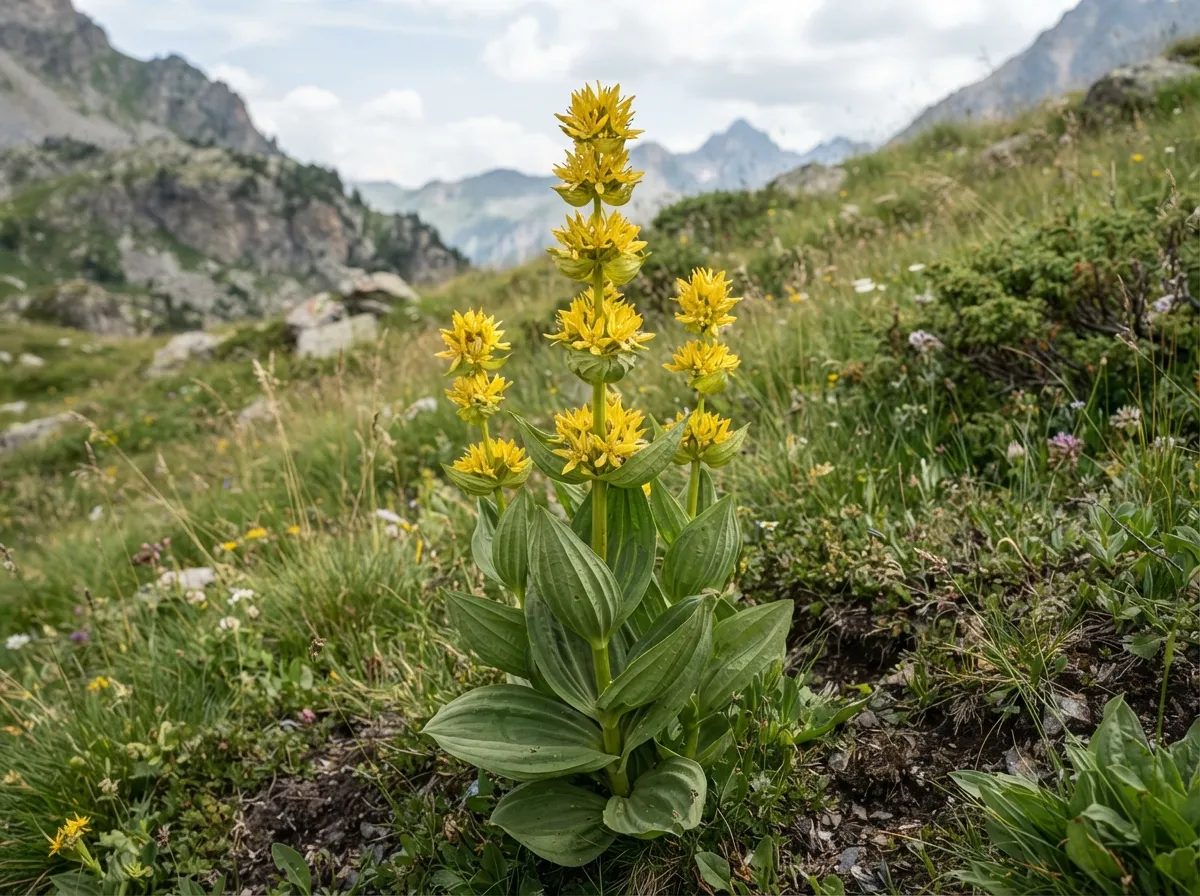
🔍 Identify it without mistakes
Large, robust perennial plant, up to 1.5 m, with a single erect, unbranched stem, bearing large opposite, oval leaves with very prominent parallel veins, hairless and glaucous. Bright yellow flowers in tiered whorls along the stem, in the axils of the upper leaves — never white. Thick, yellowish-brown taproot, very bitter, which is the source of its traditional use.
- OPPOSITE leaves (arranged face-to-face in pairs) with prominent parallel veins
- YELLOW flowers in tiered whorls along the stem
- single unbranched stem, hairless
- taproot bitter when broken
⚠️ Not to be confused with
To tell them apart: ALTERNATE leaves on white helleborine (never opposite) with strongly pleated, fan-like veins, greenish-white flowers (never yellow) in a large terminal panicle, rooted not via a taproot but a stocky rhizome; when young and non-flowering, only the leaf arrangement (alternate vs. opposite) allows for a 100% reliable distinction
🍽️ Eating it
Preparation : dried root macerated in alcohol or infused as a traditional bitter aperitif (the base of many Alpine liqueurs: Suze, Salers, Avèze)
💊 Healing with it
appetite stimulant and bitter digestive aid (well-established traditional use)
Level of evidence : limited studies — EMA/HMPC Monograph Gentianae radix (well-established traditional use)
⚠️ not recommended if you suffer from peptic ulcers or acid reflux; no risk at normal food doses, but confusing it with white helleborine during foraging is the real danger, not the plant itself
🪓 Other bushcraft uses
- base for many traditional Alpine aperitifs and digestifs (Suze, Salers)
Sources (3)
No entry replaces a certain identification in the field, or medical advice. When in doubt: don't eat it. If ingestion is suspected: poison control or 112/911.