🍄 False Morel
Gyromitra esculenta · Discinaceae
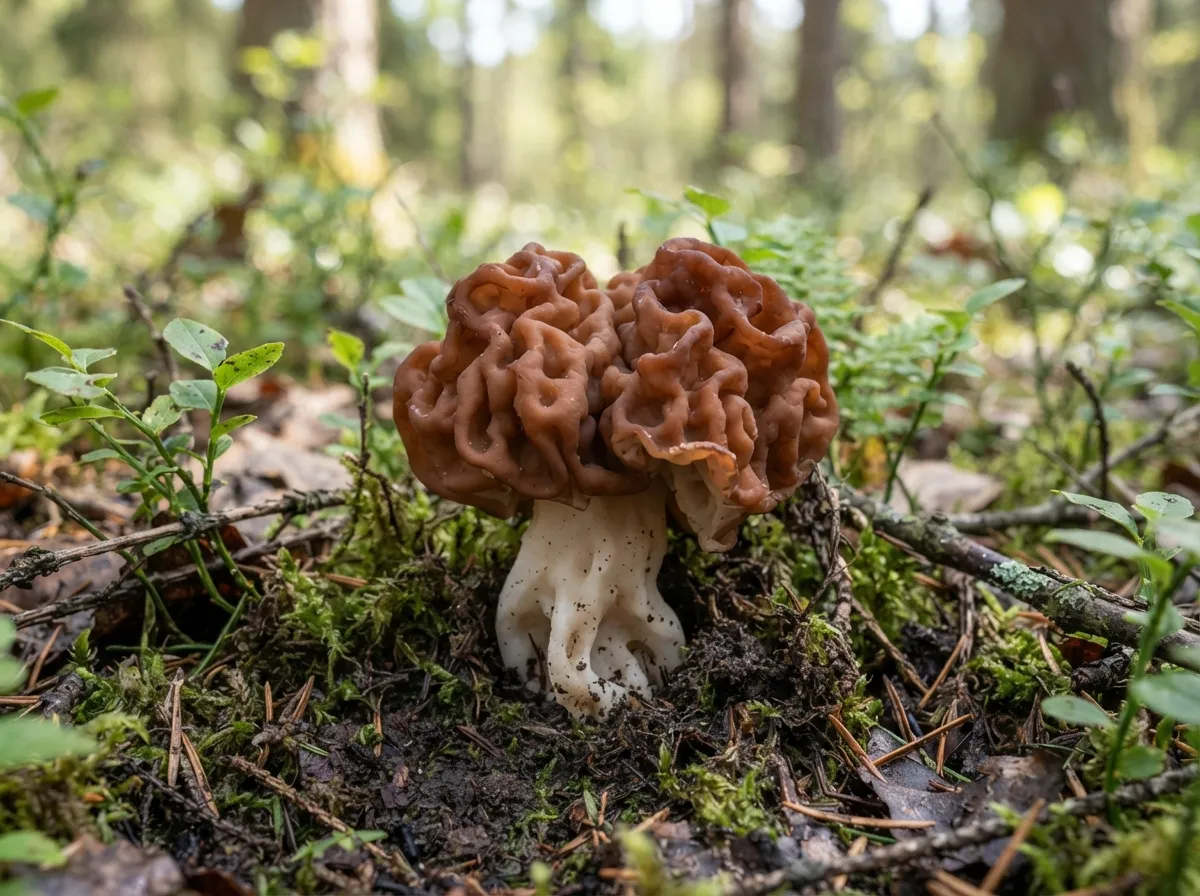
🔍 Identify it without mistakes
A spring mushroom with a deeply folded, brain-like reddish-brown cap, often mistaken for a true morel by hasty spring foragers. Its species name "esculenta" (edible) is misleading and outdated: the gyromitrin it contains hydrolyzes in the body into monomethylhydrazine, a compound closely related to certain rocket fuels. It is still consumed traditionally in a few Scandinavian countries only after strict preparation, which does not entirely eliminate the risk.
- reddish-brown to chocolate-brown cap, irregularly folded and convoluted like a brain, NEVER with regular honeycomb pits like a true morel
- hollow cap but NOT clearly separated from the stem (unlike true morels whose cap detaches cleanly)
- whitish stem, often irregular and hollow
- grows in spring, often under conifers in sandy soil
⚠️ Not to be confused with
To tell them apart: CUT THE MUSHROOM IN HALF lengthwise: the true morel has a completely hollow cap clearly attached to the stem with regular honeycomb pits; the false morel has an irregularly folded, brain-like cap, never with distinct pits, and is often partially filled with internal tissue
☠️ What kills
First steps : Call poison control immediately if ingested, even after cooking: the risk is never fully eliminated by traditional preparation. Do not induce vomiting. Never cook false morels inside an enclosed living space, as the cooking vapors are themselves toxic if inhaled.
Sources (3)
No entry replaces a certain identification in the field, or medical advice. When in doubt: don't eat it. If ingestion is suspected: poison control or 112/911.