🟤 Himanthalia (sea spaghetti, thongweed)
Himanthalia elongata · Himanthaliacées
🔍 Identify it without mistakes
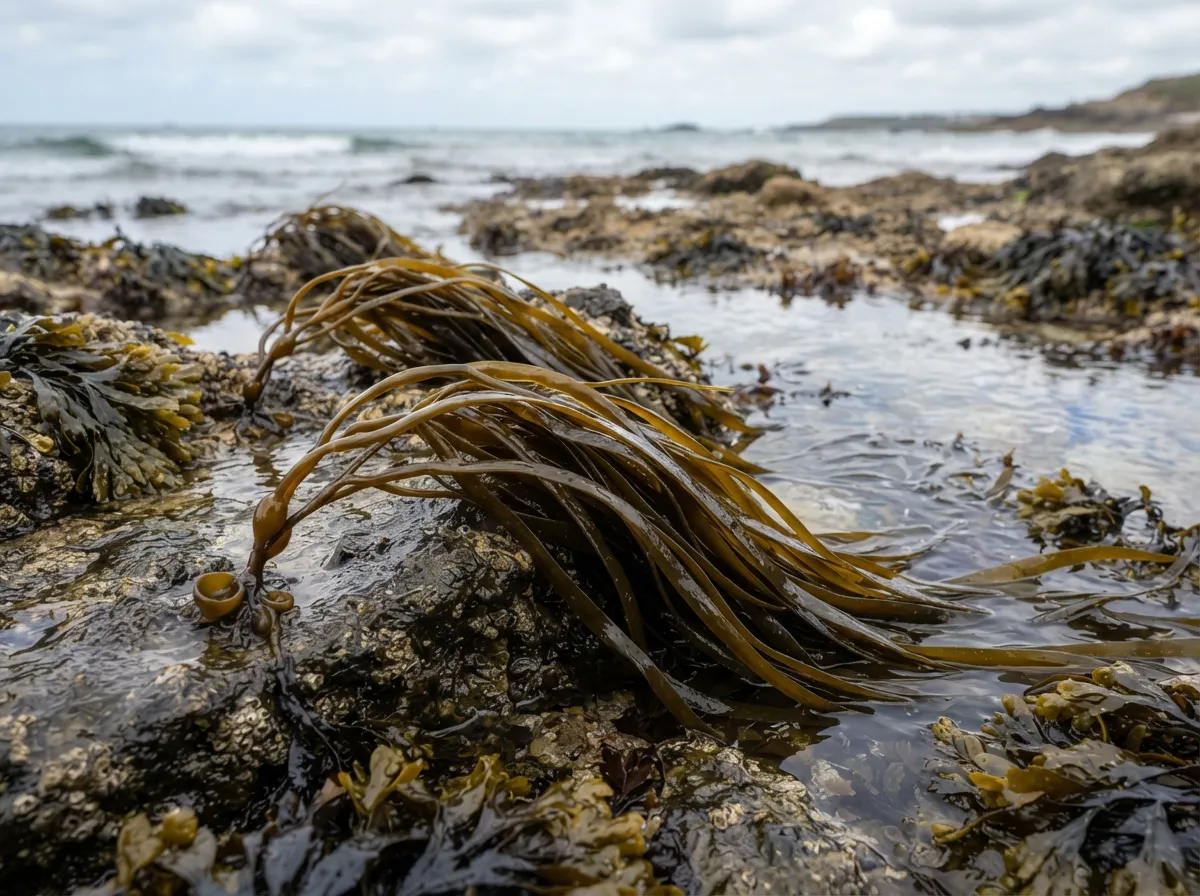
A brown seaweed with a baffling life cycle: it starts as a small button or mushroom-shaped disc attached to the rock (the juvenile stage), which then develops two long, thin, fork-branching thongs in spring that can reach several meters (the sea spaghetti, reproductive organ).
- young stage: concave cartilaginous disc shaped like a button or small mushroom, 2 to 4 cm, attached to rocks
- mature stage: long, thin, yellow-green to brown thongs branching into repeated forks, up to 2-3 m long
- grows in the mid to low intertidal zone on exposed rocks, often in dense stands
⚠️ Not to be confused with
To tell them apart: the two very distinct life stages (button then fork-branching thongs) are not found in any other European seaweed, making the species easy to identify with certainty
🍽️ Eating it
Preparation : cut into 5-6 cm pieces, blanched and then sautéed or simmered for about ten minutes like green beans; the juvenile disc can be pickled and served as a condiment
💊 Healing with it
no major traditional medicinal use documented beyond its nutritional value as a sea vegetable
Level of evidence : traditional use — Guide de la cueillette des algues — bonnes pratiques littorales
⚠️ like all seaweed, avoid harvesting in the immediate vicinity of ports and industrial areas (heavy metals); iodine content is more moderate than in kelp, but still consume in moderation; in France, the legal minimum harvest size is 80 cm for sea spaghetti
Sources (3)
No entry replaces a certain identification in the field, or medical advice. When in doubt: don't eat it. If ingestion is suspected: poison control or 112/911.