🌿 Hops (wild hops)
Humulus lupulus · Cannabaceae
🔍 Identify it without mistakes
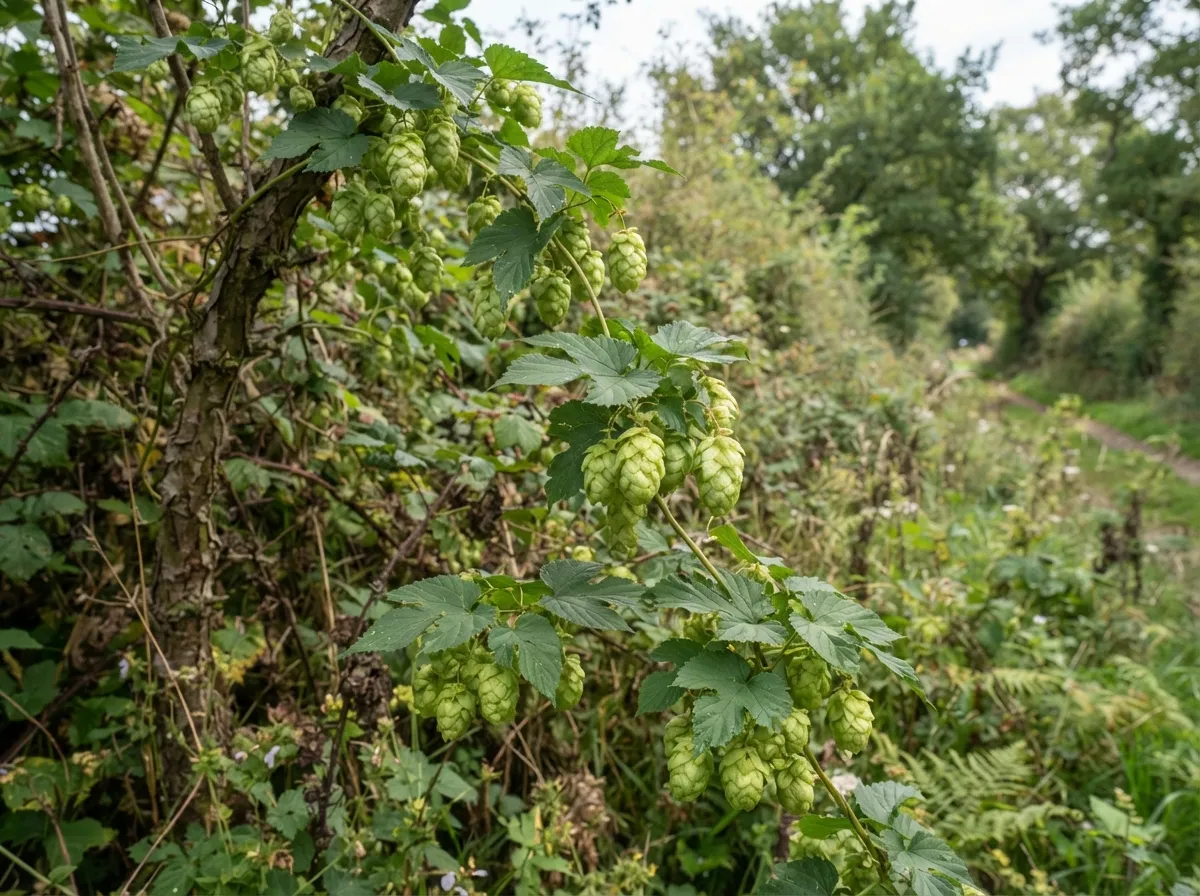
Large perennial vine that climbs several meters each year by twining clockwise around any support, with stems rough to the touch (covered in small hooked prickles). Palmate leaves with 3-5 toothed lobes, resembling those of Virginia creeper. The female cones (strobiles), small pale green scaly spikes, are used to flavor beer.
- climbing vine twining clockwise around its support (hedges, shrubs)
- rough stem and petioles, bristling with tiny hooked prickles
- opposite leaves, palmate with 3-5 toothed lobes, heart-shaped base
- female cones (strobiles) in pale green scaly spikes, characteristic resinous scent
- tender spring shoots resembling asparagus tips, before foliage develops
⚠️ Not to be confused with
To tell them apart: young hop shoots are rough to the touch (prickles) whereas young clematis stems are smooth; mature hops have vine-like palmate leaves, while clematis has pinnately compound leaves
🍽️ Eating it
Preparation : harvest young shoots very early in spring, cook them like asparagus (blanch then sauté or steam); in Belgium, these shoots are nicknamed 'truffles of the North', a sought-after and expensive gourmet delicacy; female cones are used to flavor beer and herbal teas
💊 Healing with it
female cones (Humuli lupuli flos) are recognized by the EMA for traditional use as a mild sedative to relieve stress and aid sleep, often combined with valerian
Level of evidence : traditional use — EMA — monographie Humuli lupuli flos
⚠️ not recommended in cases of depression or during pregnancy as a precaution; sedative effect potentialized by alcohol and other sedatives
🪓 Other bushcraft uses
- before the widespread use of hops in brewing (starting in the Middle Ages), beer was flavored with an herbal mixture called 'gruit', which notably contained heather and wild rosemary
No entry replaces a certain identification in the field, or medical advice. When in doubt: don't eat it. If ingestion is suspected: poison control or 112/911.