🍠 Wild Yam (Air Potato, Aerial Yam)
Dioscorea bulbifera · Dioscoreaceae
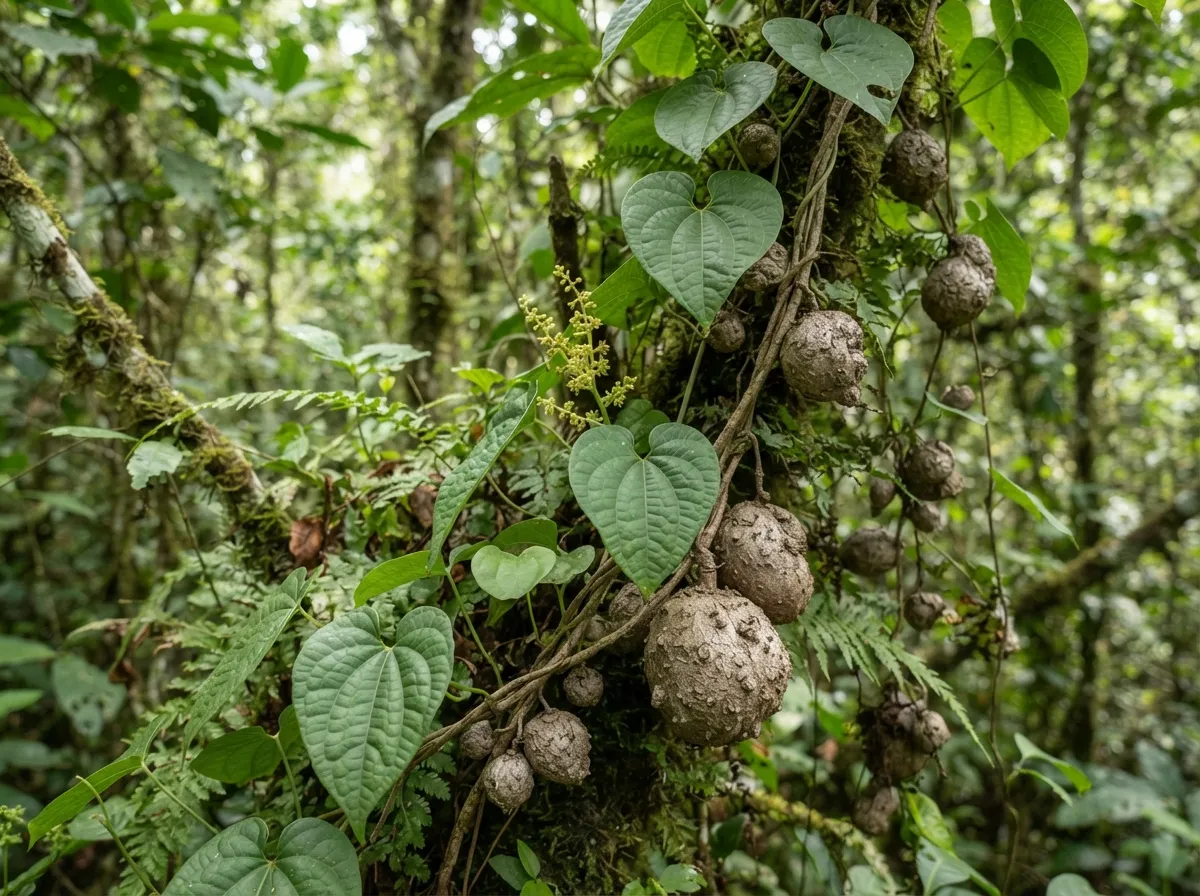
🔍 Identify it without mistakes
Pantropical twining vine (Southeast Asia, Africa, naturalized in the Americas) that wraps around its supports and bears brownish aerial bulbils—small "potatoes" hanging in the foliage—at the leaf axils of wide, heart-shaped leaves, in addition to an occasional underground tuber.
- twining vine wrapping around its supports
- broad, heart-shaped leaves with well-marked palmate veins
- rounded to knobby, light to dark brown aerial bulbils borne in the leaf axils
- underground tuber sometimes present, but aerial bulbils are the most visible and most harvested
⚠️ Not to be confused with
To tell them apart: touch a tiny raw fragment to the tip of your tongue: a sharp bitterness and a tingling sensation indicate the toxic form requiring full detoxification; sweet cultivated yam lacks this pronounced bitterness, but when in doubt, always detoxify
🍽️ Eating it
Preparation : mandatory detoxification before any consumption: peel, slice thinly, soak for several hours to overnight in running or salted water while changing the water regularly (some groups add wood ash to the soak), then boil for at least 20 to 30 minutes, discarding the cooking water; never eat raw and spit out immediately any bulbil that still tastes bitter after cooking
💊 Healing with it
the tuber is studied in traditional Asian medicine for antidiabetic and anti-inflammatory properties
Level of evidence : limited studies — Springer — Phytochemistry Reviews, Bioactivity, toxicity and detoxification assessment of Dioscorea bulbifera
⚠️ diosbulbins (norditerpenes) remain hepatotoxic even after partial cooking; traditional use only after full detoxification, avoid during pregnancy as a precaution due to lack of data
Sources (2)
No entry replaces a certain identification in the field, or medical advice. When in doubt: don't eat it. If ingestion is suspected: poison control or 112/911.