🧡 Jewelweed / Touch-me-not (Impatiente du Cap)
Impatiens capensis · Balsaminacées
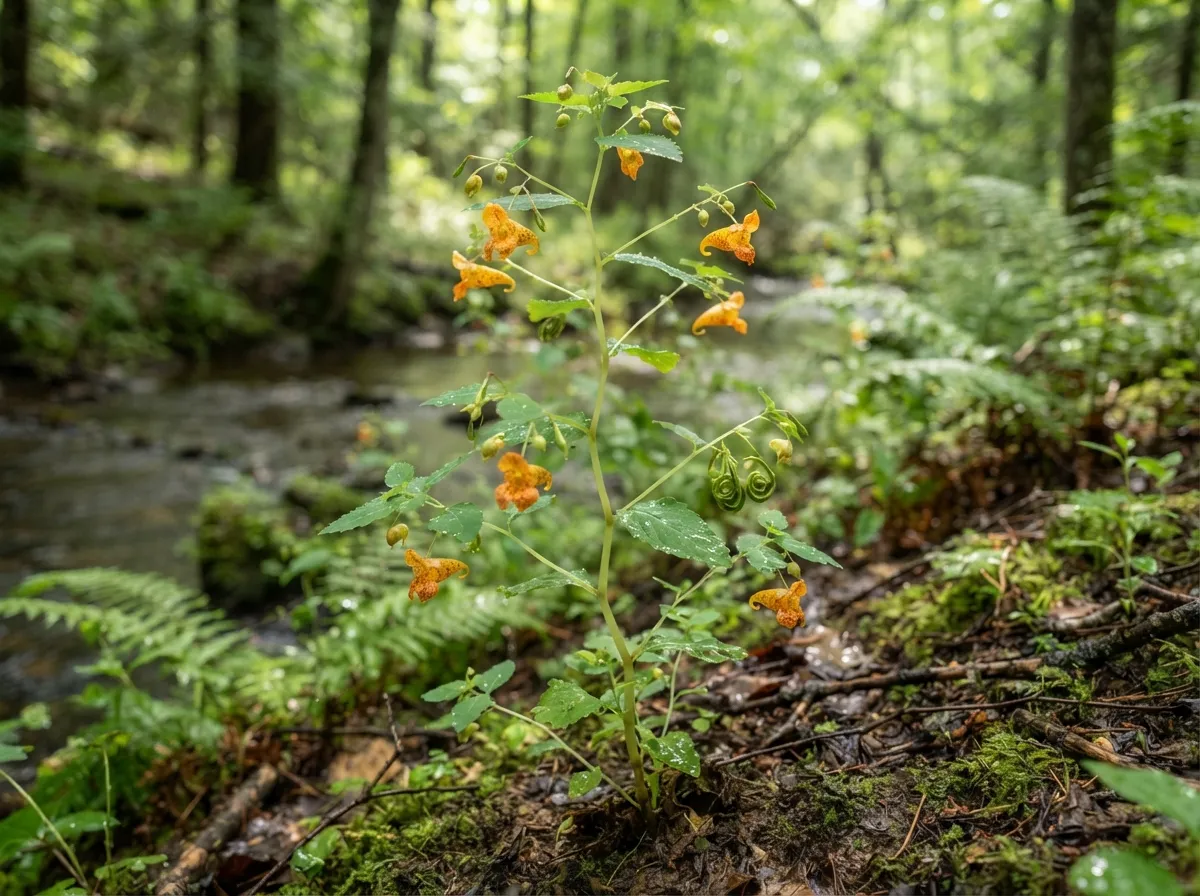
🔍 Identify it without mistakes
An annual plant with translucent, succulent stems swollen at the nodes, bearing small orange trumpet-shaped flowers spotted with red and ending in a curved spur. It almost always grows in the immediate vicinity of poison ivy along the same damp forest edges—a coincidence long exploited as a field remedy.
- translucent, juicy, brittle stem with swollen nodes
- drooping orange flowers spotted with red, featuring a curved spur
- oval leaves with coarsely rounded teeth, underside showing a silvery sheen underwater
- seed capsules that burst violently when touched once ripe (hence "touch-me-not")
⚠️ Not to be confused with
To tell them apart: the translucent, succulent stems swollen at the nodes and the seed capsules that explode when touched are unique to jewelweed among plants of damp forest edges
🍽️ Eating it
Preparation : young spring shoots can be cooked as a green vegetable after brief boiling, but the plant is harvested mainly for topical skin use, not as food
💊 Healing with it
the sap and crushed plant are traditionally applied to the skin after contact with poison ivy or poison sumac, as well as on sting nettle rashes, minor burns, and skin irritations
Level of evidence : limited studies — Long, Ballentine & Marks, "The effectiveness of jewelweed… in preventing post poison ivy exposure contact dermatitis", PubMed 22766473
⚠️ a 2012 controlled study showed that fresh crushed plant tissue ("mash") effectively reduced dermatitis after poison ivy exposure, but jewelweed extracts and soaps were no more effective than regular soap, and lawsone (the compound long credited for the effect) did not correlate with the observed protection—current hypothesis points toward the plant's saponins; washing with soap remains the most reliable measure after contact
🪓 Other bushcraft uses
- orange dye extracted from the plant
Sources (3)
No entry replaces a certain identification in the field, or medical advice. When in doubt: don't eat it. If ingestion is suspected: poison control or 112/911.