🌵 Common Houseleek
Sempervivum tectorum · Crassulaceae
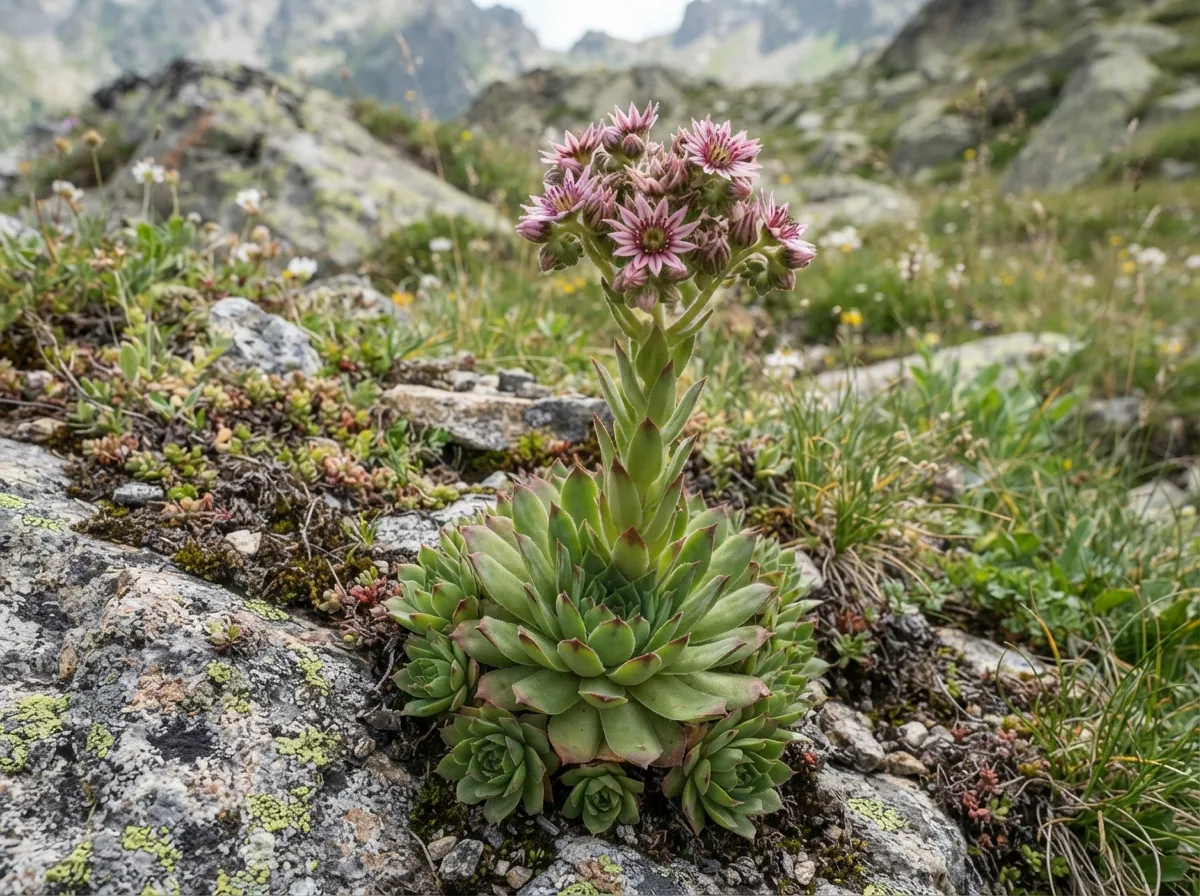
🔍 Identify it without mistakes
A succulent perennial forming compact, fleshy rosettes with thick, pointed leaves often tipped with red-brown, propagating via offset rosettes around the parent plant. A single flower stem, 20-50 cm high, appears only once every few years, bearing pink flowers in a cyme; the rosette dies after flowering.
- compact, fleshy rosette of pointed leaves
- multiplies through offset rosettes forming a ring around the mother plant
- grows on rocks, low walls, and historically on thatched or tiled roofs
- rarely produces a pink flower stem, only once every few years
💊 Healing with it
traditionally used externally to soothe mild burns, insect bites, and minor wounds (fresh pulp applied directly, much like aloe vera)
Level of evidence : traditional use — Traditional Alpine ethnobotanical literature
⚠️ traditional external use with no known toxicity; lacks robust modern clinical evaluation
🪓 Other bushcraft uses
- traditionally planted on thatched roofs to symbolically protect against fire and lightning (Charlemagne reportedly ordered it to be grown on every roof in his empire)
No entry replaces a certain identification in the field, or medical advice. When in doubt: don't eat it. If ingestion is suspected: poison control or 112/911.